



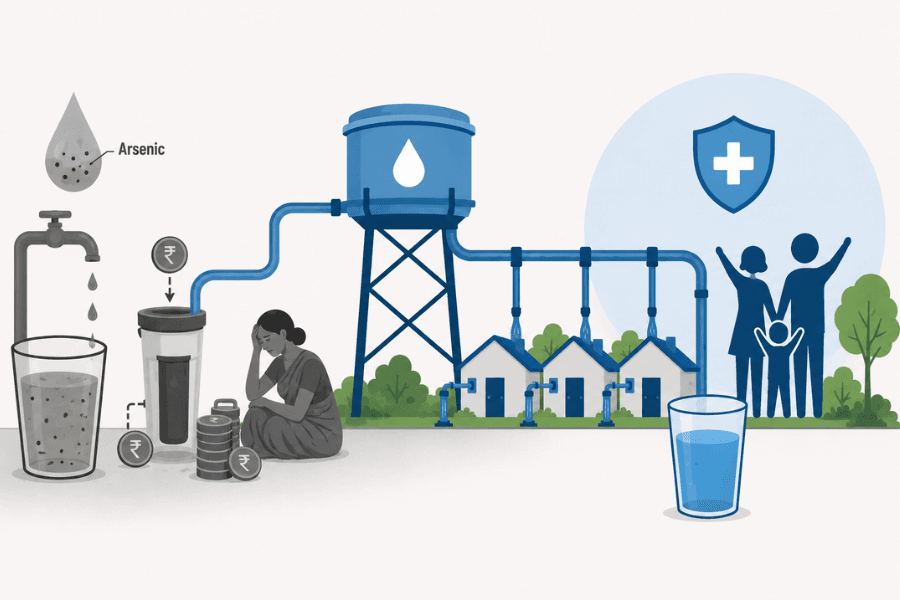
Households in arsenic-affected blocks of Bihar incur significant costs to reduce exposure, yet health outcomes remain sharply unequal across contamination levels. In high-arsenic areas, households spend around INR 343 per month to secure safer water, roughly 13 percent of average per capita income, while reporting 3.52 sick days per month compared to 0.81 in low-exposure settings.
The stakes are high. Reducing arsenic from current levels to the WHO benchmark of 10 μg/L is estimated to generate annual welfare gains of INR 700.8 million through lower illness and improved productivity. Awareness is widespread, with 71 percent of households recognising arsenic risks, but continued reliance on unsafe sources keeps exposure elevated.
How Water Choices Are Shaped
Evidence from a survey of 388 households across Maner (Patna) and Shahpur (Bhojpur) blocks in Bihar shows that water choices are shaped by the conditions under which safer access is secured. Safe sources are unevenly available and often require daily effort through travel, queuing, or recurring payments. Households therefore combine sources, relying on contaminated wells when safer options are uncertain or costly.
The cost of safer water is not limited to what households pay. It includes the time spent fetching it, which increases the overall burden of access and constrains how consistently safer sources can be relied upon.
This produces a split consumption pattern, where safer water is used intermittently rather than as a stable primary source Under these conditions, exposure does not decline in proportion to awareness or spending, since risk reduction depends on continuous access rather than occasional substitution.
When Lower Exposure Does Not Reduce Risk
Health outcomes do not change proportionately with exposure. In the surveyed areas, 59 percent of households in Patna and 29 percent in Bhojpur consume water with arsenic levels above 50 μg/L, far exceeding safe limits. At these concentrations, reductions that fall short of the WHO benchmark of 10 μg/L do not sufficiently lower health risk.
Intermittent use of safer water therefore leaves overall exposure above harmful thresholds. As a result, partial mitigation lowers risk at the margin but does not shift health outcomes in a sustained way.
Why Effort Does Not Convert into Outcomes
The persistence of exposure reflects differences in households’ ability to translate effort into sustained access. Higher arsenic concentration makes water harder to treat and increases the cost of avoiding exposure, but these pressures are not felt equally across households.
Higher-income households are able to sustain expenditure and limit illness. Lower-income households, by contrast, spend a larger share of their income on safer water, but are less able to sustain consistent access, and therefore continue to report higher sick days.
This burden is also uneven within households. Women report higher incidence of illness, which suggests that exposure is not only shaped by access but also by how water use is distributed within the household.
These pressures are reinforced by unreliable service delivery, which prevents safe water from becoming a dependable primary source. Exposure, in effect, reflects what households can sustain over time rather than what they know or prefer.
Where Intervention Needs to Shift
Reducing exposure requires shifting the point of intervention from households to the water system itself. As long as safe water depends on repeated household effort, outcomes will continue to vary with income and access conditions.
When safe water is available at the point of use and delivered with consistency, the need for averting expenditure declines and health outcomes improve more uniformly.This shifts focus to reliable local delivery systems, whether through piped supply or community-level treatment that households can depend on without daily effort.
The scale of unrealised welfare gains, estimated at INR 700.8 million annually in the surveyed areas, provides a benchmark for prioritising such investments. Aligning infrastructure, pricing, and service reliability can shift risk reduction from a private coping strategy to a shared public outcome.
The path ahead depends on whether systems maintain low exposure consistently, allowing health gains to accumulate rather than reset with each break in access.