



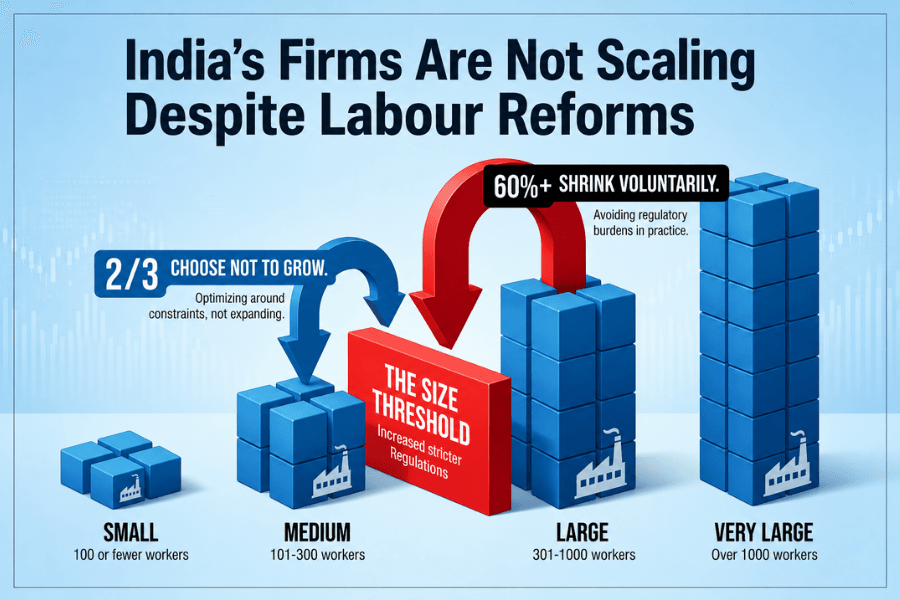
India’s manufacturing firms are not failing to grow, they are choosing not to cross size thresholds. Nearly three-fourths of large firms remain in the same category over time, while over 60 percent of very large firms move down to become merely large. Even among medium firms, close to two-thirds do not scale up. This pattern reflects a system where firms optimise around constraints rather than expand through them. However, these constraints are often misidentified.
The constraint is not simply the law on paper. Formal reforms, such as raising the threshold for stricter labour regulation from 100 to 300 workers, have altered the legal landscape. Firms also report fewer regulatory obstacles over time, especially in reforming states where perceived constraints fell from roughly 75–80 percent to about 45–50 percent. The system is changing, but the behaviour of firms is not shifting in proportion. The gap lies in how regulation is experienced in practice.
The Real Drivers Beyond Legal Reform
Firm growth in India is visible but limited in depth. Employment expands within firms, but rarely enough to shift them into higher size categories, where productivity gains are strongest. Only about 16 percent of large firms become very large, and just 4–5 percent of medium firms make that jump.
Three sets of forces shape this outcome, and they operate through distinct channels.
First, regulatory design influences firm incentives at specific thresholds. When compliance requirements change sharply at certain employment levels, firms adjust to remain just below those cut-offs. Even when such limits are relaxed, the memory of regulatory risk persists, and firms respond cautiously.
Second, the lived experience of regulation matters more than statutory change. Firms that report labour laws as a constraint show slower employment growth. This reflects day-to-day frictions, such as inspections, approvals, uncertainty, that affect hiring decisions. These frictions persist regardless of legislative change
Third, firm capabilities and market linkages determine who can absorb costs of expansion. . Exporting firms, those in metropolitan areas, and firms with multiple establishments are more likely to grow. These firms have better access to markets, infrastructure, and managerial capacity. In contrast, smaller or domestically oriented firms face tighter margins and greater exposure to compliance burdens.
Across these forces, policy intent and firm behaviour diverge most sharply. Reforms aim to enable expansion, but firms respond by stabilising within safer zones.
A Layered Constraint Structure
This divergence is sustained by a broader structure of constraints that shape the conditions under which firms operate. The persistence of this pattern reflects multiple, overlapping constraints.
Institutional constraints relate to enforcement. Inspection intensity has declined across many states, but not uniformly. In some regions, enforcement remains high; in others, it is weaker but more variable in practice. This unevenness creates compliance unpredictability, which firms price into their hiring and expansion decisions.
Economic constraints arise from the cost of scaling. Hiring additional workers increases not just wage bills but also compliance and administrative costs. For firms operating on thin margins, these costs can outweigh the benefits of expansion.
Structural constraints stem from the composition of Indian manufacturing. A large share of firms operate in informal or semi-formal settings, where scaling up requires a transition into more regulated environments. This transition raises both compliance and operating costs.
Social and organisational constraints also matter. Managerial capacity, risk tolerance, and familiarity with formal systems influence whether firms choose to grow. Crossing a size threshold often requires changes in management practices, not just an increase in workforce.
These constraints do not operate independently. They reinforce each other, making the decision to scale a complex calculation rather than a straightforward response to opportunity.
Where the System Breaks
The critical fault line lies between large and very large firms. Movement from medium to large remains possible, with about one-third of firms making that transition. But the next step is far narrower. Only a small fraction of large firms cross into the highest size category, even after regulatory thresholds have been raised.
At the top end, the pattern reverses. A majority of very large firms reduce their size. This is not decline in the conventional sense; it is adjustment. Firms appear to recalibrate to an optimal size that balances operational efficiency with regulatory exposure. The result is a circulation within size bands rather than progression across them.
Rethinking the Policy Focus
The challenge is not to increase the number of firms, but to change the conditions under which firms choose to grow. This requires shifting attention from formal rules to operational realities.
One priority is to smooth regulatory thresholds. When compliance requirements change abruptly at specific employment levels, they create artificial ceilings. Gradual, predictable transitions reduce the incentive to remain below these cut-offs.
Another focus area is enforcement quality. Consistency matters more than intensity. When firms can anticipate how rules will be applied, they are more likely to plan for expansion. This involves standardising procedures, reducing discretion, and improving transparency in inspections.
Firm capabilities also need to be part of the policy conversation. Access to export markets, infrastructure, and managerial support increases the returns to scaling. Policies that integrate firms into larger value chains can make growth more viable.
Finally, labour flexibility within firms deserves attention. The ability to adjust workforce composition without excessive cost or uncertainty allows firms to respond to market conditions. This does not require weakening worker protections; it requires designing systems that balance flexibility with security.
Toward Deeper Industrial Growth
India’s manufacturing trajectory reflects a pattern of constrained progression. Firms are growing, but not in ways that shift the structure of the economy. The distinction between growth within categories and movement across them is central to understanding this gap.
Future progress will depend on whether firms can move beyond the plateau that currently defines their expansion. This is less about entering the system and more about continuing through it.