



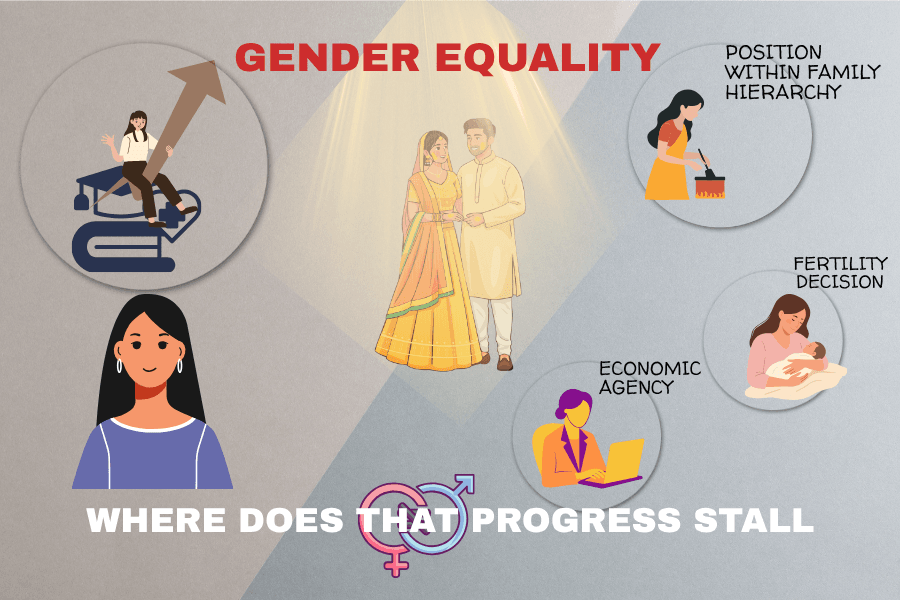
India’s gender equality outcomes are constrained less by lack of progress and more by where that progress stops. A composite measure of household power relations, capturing who holds authority, how families are organised, and how work and childbearing decisions are made, shows that patriarchy scores vary widely: from 16 in Meghalaya to 36 in Haryana, with a national average of 31. But this measure has barely shifted over two decades. It declined from 34 in the early 1990s to 31 by the mid-2000s and has since plateaued.
This persistence in household power contrasts with gains in schooling, health access, and maternal mortality decline. Women are entering education systems in greater numbers and seeing improvements in maternal and birth outcomes. But these gains are not translating into greater influence over work, resources, or decisions within families. The gap lies in conversion. Improvements at the level of individuals are not carrying through into the structures where everyday choices are made.
Where Gains Fail to Convert
Individual gains weaken at specific transitions in the life cycle, limiting their effect on women’s position within households.
Before marriage, improvements in education and health are visible and expanding. The first disruption occurs at marriage, when women move into their husband’s household. This shift is institutional. Entry into a new family resets position within established hierarchies, placing young women at the bottom. Gains accumulated earlier do not carry forward in the same form.
Fertility decisions are rarely individual. They reflect family expectations, where son preference continues to shape outcomes. Even as overall fertility declines and contraceptive use improves, the composition of births reflects this bias, with around 61 percent of last-born children being boys. This pattern embeds gender preference within demographic behaviour, reproducing inequality even as aggregate indicators improve.
The sharpest drop occurs at the transition to economic participation. Despite improvements in education, entry into professional work remains limited. Without sustained access to paid work, the ability to influence household decisions remains constrained. Education does not translate into bargaining power.
These effects do not remain isolated. They accumulate and are consolidated over time. Authority within households remains concentrated among older men. Even where younger cohorts are more educated, their ability to reshape norms is mediated by age and position. Only around 15 percent of households are headed by women, and even this often reflects male absence rather than redistribution of power.
Across these transitions, progress does not accumulate. It is weakened and absorbed before it can shift underlying power relations. Taken together, these transitions form a chain through which early gains lose force as individuals move from one stage to the next.
A System That Absorbs Change
These transition-level losses persist because the underlying system aligns incentives, norms, and authority in the same direction. Improvements at one stage are filtered through arrangements that prioritise continuity over redistribution. They do not accumulate into durable shifts in power.
This alignment creates a reinforcing loop. Limited access to paid work weakens women’s influence over household decisions. Restricted decision-making, in turn, reduces their ability to enter or remain in the workforce. Preferences over child composition, particularly desire for sons, are embedded within this structure, tying demographic choices to lineage and economic security. Change in one domain is offset elsewhere, allowing the system to adjust without altering the underlying balance of power.
What anchors this system is a set of overlapping constraints. Family structures that prioritise co-residence and male lineage shape living arrangements and authority. Social norms around gender roles and marriage stabilise expectations. Economic opportunities remain uneven, limiting access to paid work. Formal rights are mediated by informal institutions that often carry greater weight in practice.
Policy Success and Blind Spots
Public policy has been effective in expanding access. Investments in schooling, maternal health, and basic services have improved women’s educational attainment, maternal and birth outcomes, and strengthened survival outcomes. These gains reflect a model that works well when the constraint is entry, bringing individuals into systems that deliver services at scale.
The limits emerge once outcomes depend on decisions that lie outside the reach of program design. Marriage, fertility choices, and work participation are shaped by household authority and social expectations. Formal access does not automatically translate into influence or control. This is where the pathway from capability to agency weakens.
Resource gaps explain part of the story, but not the persistence of unequal outcomes. Even where access improves, the conditions under which decisions are made continue to shape how far these gains extend.
The blind spot is visible but difficult to act on. Expanding services does not alter how families allocate roles or negotiate authority. Policy can influence incentives and enable alternatives, but it cannot substitute for slower shifts in norms and intra-household bargaining that determine outcomes.
If the constraint has shifted from access to intra-household decision-making, policy must engage with the transitions where these decisions are shaped.
Where Policy Can Shift Outcomes
If the constraint lies in how decisions are made within households, intervention must focus on the points where these decisions are most contested. Policy shapes the environment in which household decisions are made. It does not replace those decisions. These same transitions in the life cycle therefore become the key points of intervention.
The transition into marriage remains one such point. Policies that expand options around residence, mobility, and continued education or work after marriage can reduce the abrupt loss of autonomy that resets earlier gains. The objective is to widen the set of feasible choices available at this stage, without altering family structures directly.
The transition into paid work offers another lever. Expanding access to stable and remunerative employment, especially in sectors that can absorb women at scale, can strengthen their position within households. This requires more than job creation. It depends on safe mobility, predictable working conditions, and continuity of employment. Where women’s economic contribution becomes visible and sustained, it begins to influence how decisions are negotiated within families.
A similar approach applies to fertility-related choices and norms valuing women and daughters. Shifting preferences around sons by aligning incentives with changing economic realities can be a viable pathway. When daughters are seen as contributors to household security through education, employment, or inheritance, the basis of preference begins to change.
Future gains will depend on how effectively policy engages with these transitions. Early achievements must not weaken as individuals move through different stages of life. Without this shift, improvements in education, health, and fertility will plateau at the level of individual capability, without producing durable changes in household power.