



India’s child sex ratio has been a source of unease for decades. In a large rural district in Tamil Nadu, not usually seen as a hotspot, the ratio stands at 109 boys per 100 girls. The natural benchmark, based on historical census data before sex selection became widespread in South India, is closer to 102. What is more striking, however, is the pattern within caste groups. Among the poorest households within a caste, the ratio is close to parity, about 101. Among the wealthiest, it rises to as high as 118. The imbalance is systematic rather than random.
The conventional explanation emphasises son preference: boys inherit land, support parents in old age, and carry the family line. A second explanation focuses on daughter aversion: dowry makes daughters financially burdensome. Both contain truth. But taken on their own, they leave an important pattern unexplained. Sex selection is not simply a reflection of prejudice or poverty. It is also an equilibrium outcome of how India’s marriage markets are organised with wealth as a pivotal lever, particularly within caste.
Understanding that mechanism matters because if sex selection is partly driven by how marriage markets operate – how families compete for and secure matches, with limited outside options for girls’ parents and patrilocality – then policies that change incentives in one segment of the marriage market can have unintended consequences in others.
How Caste-Bound Marriage Markets Shape Incentives
Marriage in much of India remains overwhelmingly endogamous. In rural Tamil Nadu, over 95 percent of marriages take place within caste. Each caste therefore operates, in effect as its own marriage market. Wealth differences are large within these groups, and marriages are typically arranged by families with wealth as a central consideration. In a context where remaining unmarried carries severe social stigma for women, families cannot opt out of this market; they must compete within it.
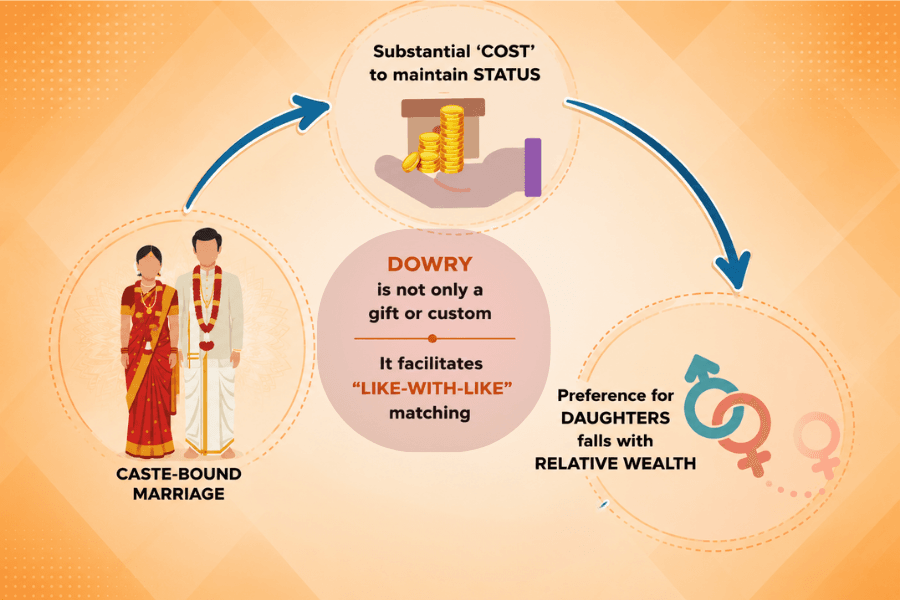
Dowry, in this context, does two things at once. It is often described as a transfer from the bride’s family to the groom’s family: a burden. But it also performs a second, less discussed function: as a market-clearing price that allows families to secure matches of similar or higher wealth. The dowry, therefore, is not only a gift or custom; it is also a mechanism through which assortative matching – like-with-like in wealth – is sustained.
This distinction matters for understanding incentives. A daughter’s future consumption depends not only on her parents’ wealth but also on the wealth of the household she marries into. In a patrilocal system, where the woman moves into the husband’s household, dowry passes to the in-laws and is then redistributed within that household. When bargaining power inside the marital home is unequal – as is often the case – daughters do not necessarily receive resources commensurate with the transfer made on their behalf. As a result, altruistic parents, who intrinsically value sons and daughters equally, are worse off with a girl than with a boy.
Why Relative Wealth Drives Gender Imbalance
While it may seem counterintuitive, sex selection increases with relative wealth within caste, even for the same level of absolute wealth. What matters is a household’s position vis-à-vis others in its caste marriage market.
Data from a census of nearly 298,000 rural households across 57 caste groups, covering over 1.1 million individuals and close to 80,000 children aged 0–6, make this pattern visible. Among the poorest households within a caste, the child sex ratio is close to parity. Among the richest, it can reach 118 boys per 100 girls – levels comparable to the most skewed regions of the country. A simple statistical breakdown suggests that marriage market channel explain about 52 percent of the variation in sex ratios within caste groups. Even where son preference persists, roughly half the imbalance reflects how these markets are structured and function rather than attitudes alone.
Why does this pattern emerge? Within caste, wealthier households compete most intensely to secure equally wealthy matches. The dowry required to maintain status can be substantial – on average, three to four times annual household income.
The logic changes for poorer households. Daughters from poorer families often “marry up” – into households somewhat wealthier than their own. In addition, when sex selection is more prevalent in wealthier households, girls become relatively more “sought” further down – improving bargaining conditions for their families. The incentive to avoid having daughters then weakens.
This dynamic helps explain why growth alone does not solve the problem. What matters is not rising incomes in the aggregate, but how wealth inequality within caste interacts with the institutional structure of marriage.
When Good Intentions Shift Market Equilibria
Over the past two decades, governments have introduced numerous cash transfer schemes to encourage families to have daughters. These programmes often target low-income households and provide payments conditional on the birth, education, or delayed marriage of a girl.
At first glance, these interventions appear straightforward. But if sex selection is partly driven by marriage market equilibrium, then altering resources in one segment of the market can shift prices – that is, dowries – within caste.
Marriage markets are competitive. When the ability of some families to pay increases, dowries adjust. Transfers to poorer households can therefore change the competitive landscape within caste, increasing pressure on relatively wealthier households to maintain status through higher payments and, in turn, potentially worsening sex ratios at the top.
This does not mean such programmes are misguided. But their effects ripple across the marriage market, and incentives do not operate in isolation.
A more promising approach may lie in changing who controls the transfer and when it is delivered. Payments routed directly to married women, rather than to parents at the time of birth, can bypass the marriage market channel. By strengthening women’s bargaining position within the marital household, such transfers address the structural driver of disadvantage rather than only the perceived cost of raising a daughter. Even a shift in timing – from pre-marriage parental transfers to post-marriage transfers in the woman’s name and not via dowry – could alter the underlying incentives more effectively.
Institutional Reform, Not Moral Messaging
Sex selection is often framed as a cultural bias or moral failing. Yet the evidence points to a deeper institutional logic. In caste-bound marriage markets where daughters must marry, dowry clears the market and bargaining power inside the marital home is unequal, skewed sex ratios can emerge as an equilibrium response to economic incentives, rather than a social aberration.
Recognising sex selection as a function of relative wealth and marriage market dynamics is the first step toward designing policies that do not merely offset imbalance, but prevent it from arising in the first place. Policies that focus solely on changing attitudes or compensating families for having daughters therefore risk addressing symptoms while leaving the structure intact.