



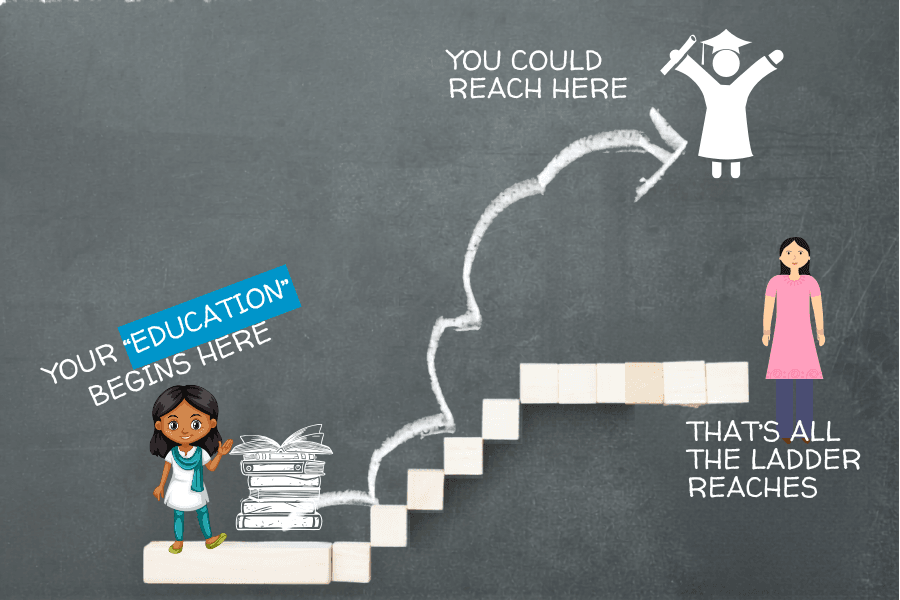
India is witnessing substantial upward movement in girls’ education across generations. Yet this movement does not extend uniformly into higher levels of schooling, raising a central policy question: how far does this mobility translate into sustained educational and economic outcomes?
Recent evidence from 18 villages in Varanasi district, Uttar Pradesh, shows that nearly three-fourths of women have attained higher levels of education than their mothers, and about 70 percent have surpassed their fathers. Most of this movement is upward, marking a clear shift in educational attainment across generations.
However, even though movement from very low levels of education into basic schooling is widespread, continuation into secondary, higher secondary, and beyond is less consistent. This creates a pattern where mobility is visible, but its depth is at risk.
Scale of Change Is Significant
The scale of this shift becomes clearer when set against the starting point. About 67 percent of mothers had no formal schooling, and nearly 80 percent had less than primary education. In contrast, one-third of daughters have completed at least 12 years of schooling.
This shift is not confined to better-off households. Among daughters of mothers with no schooling, more than a quarter complete 12 or more years of education.
These patterns suggest that India’s education system has enabled substantial upward movement even where the baseline was weak.
Household Aspirations Are Driving Educational Gains
What explains this mobility across generations? The evidence points to internal drivers within households, particularly aspirations and parental influence.
Around 30 percent of daughters who studied beyond their mothers attribute this to their mothers’ desire for them to do so, while another 23 percent cite their own aspirations. Fathers’ encouragement and joint parental support also contribute to these outcomes.
Educational mobility, in this sense, is not only a function of access but also of expectations. The experience of one generation shapes the ambitions of the next, creating a reinforcing, intergenerational cycle. As more women attain schooling, they are more likely to support similar or higher attainment for their daughters, sustaining upward movement even in low-income or low-education settings.
Progress Breaks Down at Key Transition Points
While these internal drivers enable mobility, sustained progression depends on external conditions that shape whether students can move through key transition points in the education system.
Economic constraints are central. Many women who do not move beyond their parents’ level of education cite limited household resources, the cost of schooling, and income constraints as decisive barriers.
Structural constraints further shape these outcomes. Distance to schools, lack of transport, and gaps in facilities for girls affect continuation, particularly at secondary and higher levels where access becomes more uneven.
Time and social constraints also remain binding. Domestic responsibilities, support to family occupations, expectations around girls’ roles, and prevailing gender norms reduce the likelihood of continued schooling or longer educational trajectories.
Taken together, these constraints do not prevent entry into schooling but concentrate drop-offs at specific stages, especially beyond basic education.
Early Gains Are Not Converting into Sustained Attainment
This uneven progression is visible in outcomes. While most daughters move ahead of their parents, a small share remain at similar or lower levels of education: about 1.6 percent fall below their mothers’ attainment, and nearly 7 percent fall below their fathers’.
These patterns point to a structural limit: early gains in educational mobility are not consistently converted into sustained attainment at higher levels of schooling. This creates the risk of a plateau, where early improvements do not extend into higher levels of attainment.
Policy Must Shift from Expanding Access to Sustaining Progression
The policy challenge is no longer expanding entry into schooling but sustaining progression beyond initial gains. With enrolment and basic schooling already expanded, the next phase depends on whether girls successfully move through secondary and higher levels.
Because drop-offs are concentrated at transition points, particularly beyond primary education, policy must address the constraints that operate at these stages. Reducing the cost of continued education can ease economic pressures on households. Improving access to secondary schooling through better infrastructure and reliable, affordable transport can mitigate structural barriers. Addressing social constraints requires sustained engagement with families and communities to support girls’ continued education.
The role of households also underscores the importance of adult women’s education and awareness. As mothers’ educational experiences shape daughters’ trajectories, strengthening this intergenerational link can reinforce gains over time.
Taken together, this marks a shift in policy focus: from expanding access to ensuring continuity.
Future of Mobility Depends on Continuity, Not Entry
The scale of upward movement across generations in settings such as rural Varanasi indicates that change is underway in women’s educational attainment. The question is whether these gains extend into sustained progression through higher levels of education.
If they do not, the effects on economic participation, productivity, equity, and long-term mobility will remain limited. The durability of recent gains will depend not on entry into schooling, but on the ability to carry that progress forward.