


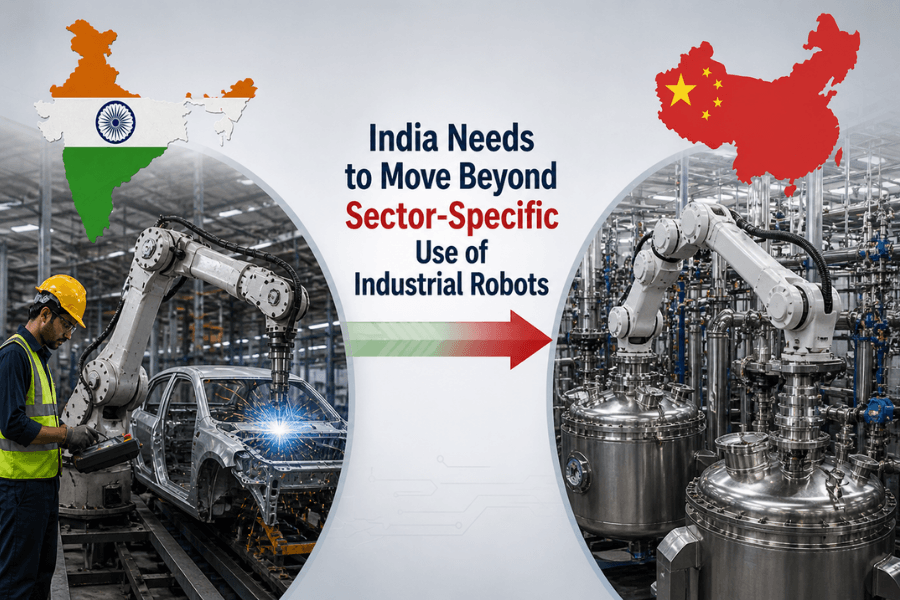
Manufacturing outcomes increasingly depend on how widely industrial robots are used. Adoption is rising, and several sectors are already integrating automation into core processes. Yet in India, the use of these technologies across industries remains limited.
The contrast with China is instructive. By 2023, China accounted for about 51 percent of global industrial robot installations, while India’s share remained around 1.57 percent. This gap reflects not just differences in pace, but how automation is embedded within production systems.
Scale Gap in Industrial Robot Adoption
The contrast between India and China is most visible in the scale at which automation is deployed.
China’s annual installations increased from around 15,000 units in 2010 to over 290,000 in 2023, while India’s rose from about 1,300 to 5,500 units over the same period. By 2023, China’s operational stock of industrial robots was nearly 54 times that of India, resulting in a much larger base of automated production.
Robot density, measured as the number of robots per 10,000 manufacturing workers, shows the same pattern. China’s density reached nearly 470 by 2023, suggesting that automation is widely embedded across manufacturing activities. India’s density, by contrast, remains in the low double digits at around 10 to 15 per 10,000 workers, indicating a far more limited presence within production systems.
Concentrated and Uneven Adoption
Industrial robot adoption in India is concentrated in a few sectors, with the automotive industry accounting for about 42 percent of total installations. Other sectors, including metals, plastics, and chemicals, account for much smaller shares, while penetration in electronics remains limited.
This concentration limits the spread of automation across industries. Industrial robots are being deployed intensively within a narrow set of sectors rather than spreading across the manufacturing base. As a result, productivity gains remain confined rather than system-wide.
The breadth of adoption across sectors is reflected in the Robot Diversity Index, which reflects how evenly robots are distributed across industries on a scale of zero to one. By 2023, India’s value stood at 0.66, compared to 0.73 for China and 0.74 globally.
A similar concentration is visible in the tasks performed by robots. In India, welding accounts for nearly half of installations, closely aligned with automotive manufacturing, while applications such as assembly, packaging, and handling remain limited Industrial robots are mainly used to improve efficiency in existing processes.
This concentration reflects how adoption decisions are structured sectors.
Why Adoption Remains Limited
At the firm level, the decision to deploy robots is shaped by how incentives operate within production and investment choices. Firms invest in automation when it lowers costs, improves reliability, or opens access to new markets.
Labour costs and availability are a central part of this dynamic. A large and relatively low-cost workforce reduces the immediate pressure to substitute labour with capital-intensive technologies. Firms are therefore more likely to prioritise incremental improvements within existing processes rather than invest in automation at scale.
This is reinforced by the structure of manufacturing. A significant share of India’s manufacturing base consists of small and medium enterprises, which often operate with tighter margins and limited access to capital and technical capabilities. For these firms, the upfront cost and integration challenges associated with industrial robots can outweigh potential gains, especially when production volumes are limited.
Policy signals further shape these incentives. While manufacturing has received policy support, there has been less emphasis on enabling broad-based adoption of industrial robots across sectors. In the absence of targeted support, such as cost-sharing mechanisms, technology diffusion programmes, or ecosystem development, adoption tends to remain concentrated among larger firms that can absorb risks.
These conditions reinforce each other, leading to adoption that remains gradual and confined to specific segments.
The Cost of Remaining Unscaled
Slower automation delays immediate disruption, but it reshapes how firms compete over time.
Lower levels of automation are associated with less consistent quality, longer production cycles, and limited scalability. As production systems elsewhere become more standardised and digitally integrated, these differences are already reshaping how global production is organised.
Supply chains increasingly favour locations where output can be scaled quickly, quality can be standardised, and processes can be digitally coordinated. Where industrial robots are more widely used, these conditions are easier to achieve.
In this context, India faces the risk of delayed adjustment to changing production systems. A later acceleration in automation is likely to be more compressed, requiring sharper adjustments for both firms and the workforce.
Uneven adoption also limits how widely productivity gains are distributed, with improvements concentrated in a few sectors while the broader manufacturing base struggles to keep pace.
How Scale Changes the Role of Industrial Robots
China’s experience shows how the role of industrial robots evolves as adoption expands across the manufacturing system.
Rising wages of about 7 to 10 percent annually in recent years pushed firms to adopt automation not just to reduce costs, but to stabilise production. Over time, this shifted the role of industrial robots from supporting individual processes to shaping how production itself is organised.
This shift is reinforced by the development of a domestic robotics ecosystem. The share of domestically supplied robots in China increased from about 19.4 percent in 2018 to 43.2 percent in 2023. Greater local availability has reduced costs and made automation accessible to a wider range of firms, allowing adoption to extend beyond large manufacturers.
With this scale, firms are able to standardise processes, integrate operations across stages, and respond more quickly to changes in demand. These changes support competitiveness not only in high-technology sectors, but also in segments that were traditionally labour-intensive.
This transition also creates new pressures within the labour market, increasing demand for technical and supervisory roles while reducing routine tasks.
Balancing Scale and Adjustment
As automation expands, its implications extend beyond firms to the labour market. Wider adoption of industrial robots can improve productivity and competitiveness, but it also raises concerns about the displacement of workers engaged in routine manufacturing tasks. Where labour markets are characterised by large numbers of low- and semi-skilled workers, the pace and sequencing of automation become critical.
A rapid and unsequenced expansion of automation could place pressure on segments of the workforce that are less able to transition quickly. The way this transition unfolds therefore determines how labour-market adjustments are managed, particularly for workers in routine-intensive manufacturing roles.
Whether these adjustments remain gradual depends on how widely adoption extends beyond a narrow set of firms and sectors. Whether this transition remains gradual depends not only on how widely adoption extends, but also on whether it diffuses beyond the current set of firms and sectors. For many firms, industrial robots remain capital-intensive and difficult to integrate, limiting the spread of automation and shaping how labour-market adjustments unfold.
India’s automation challenge lies in aligning the scale of adoption with the pace at which labour-market adjustments can be absorbed. Slower adoption has limited immediate disruption, but it has also delayed integration into more competitive production systems. As this gap narrows, how adoption is sequenced across firms, sectors, and skill levels will determine whether the adjustment unfolds in a distributed manner or becomes compressed and more difficult to absorb.