


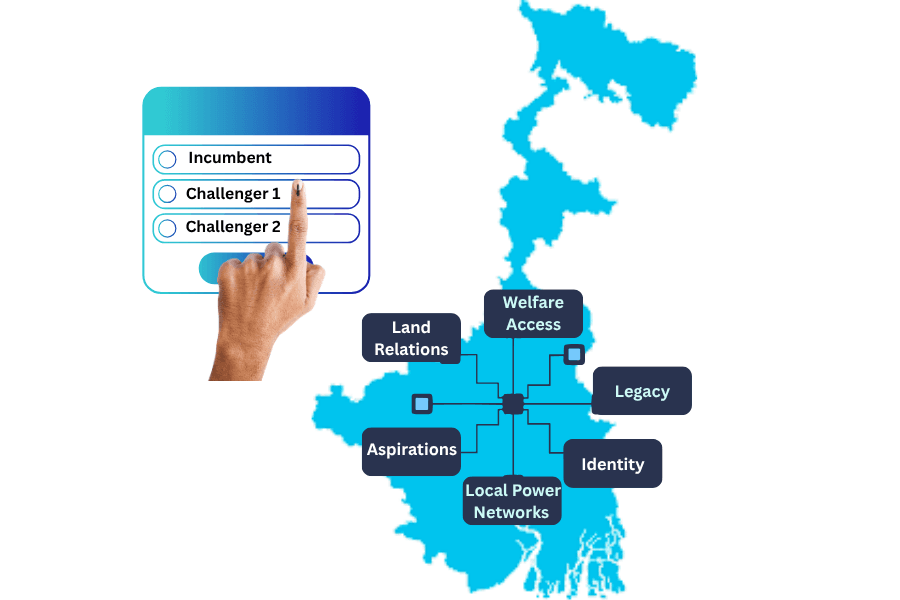
West Bengal’s electoral shifts reflect a recurring pattern in democratic politics: extended periods of stability followed by decisive voter realignment. Political change does not emerge abruptly; it builds across social groups before converging into a broader shift. This process reflects how power and accountability are periodically recalibrated through citizen action.
In Bengal, long incumbencies have repeatedly given way to moments of recalibration, shaped by how different groups experience and respond to the state.
Voter Diversity and Political Incentives
Electoral outcomes in Bengal are anchored in its political history, marked by long phases of ideological dominance and deeply mediated access to the state. Voting behaviour reflects this layered legacy.
In districts such as Bankura and Purulia, political choices are closely tied to welfare access, land relations, and local power networks that shape everyday security. In parts of Kolkata, such as Ballygunge, particularly among the middle class, voting behaviour is shaped by aspirations, identity, and comparisons with governance trajectories elsewhere.
These differences are reinforced by Bengal’s history of cadre-based politics and programmatic mobilisation, which continue to shape how citizens interpret the state's presence and political alternatives. As a result, expectations from the state and thresholds for political change vary sharply across regions and social groups.
This variation helps explain both the persistence of incumbency despite visible dissatisfaction and the conditions under which it eventually breaks.
How Incumbency Persists and Breaks
Party networks in Bengal have long mediated access to welfare, dispute resolution, and everyday interaction with the state. This creates forms of embedded loyalty that can endure even when governance outcomes are uneven, as voters weigh loyalty continuity against the uncertainty of change. Political persistence, therefore, reflects not only performance but also the depth of organisational reach and the credibility of alternative networks.
Over time, however, these arrangements come under strain. As welfare delivery expands beyond tightly controlled local channels and aspirations shift, especially among younger and urban voters, the alignment between political networks and voter expectations begins to weaken. Perceptions of access and fairness become more salient across groups, including those previously accommodated within existing systems.
The urban middle class tends to shift more gradually, influenced by risk calculations and comparative benchmarks, but its eventual alignment with broader dissatisfaction can signal a wider turning point. When these pressures converge across organisational, material, and perceptual dimensions, electoral outcomes change with surprising speed.
Across Bengal’s political history, these shifts have unfolded over varying time horizons, from multi-decade incumbencies to more rapid political turnover. The length of each cycle is shaped by how long local political structures can sustain legitimacy before shifts in aspirations and access begin to erode their hold.
Role of Fear and Identity
Material conditions alone do not explain political behaviour in Bengal. Historically embedded narratives of fear and identity remain central.
Fear often takes concrete form: concerns over losing access, protection, or position within local political structures. In regions where party structures have long shaped everyday interactions with the state, voters weigh the risks of exiting familiar systems against uncertain alternatives.
Identity also operates through Bengal’s distinct political history, where class, community, and ideological affiliation intersect. Legacies of left mobilisation, minority consolidation, and regional political assertion continue to influence how voters interpret political choices. These narratives influence not only voter perception but also the durability of political alignments, particularly in closely contested settings. As welfare delivery becomes less tightly mediated, and as new political narratives gain traction, the hold of established alignments begins to loosen.
Why Political Cycles Vary
The duration of political cycles reflects how long existing political arrangements continue to match voter expectations across regions. Variation emerges as this alignment begins to fragment, partly due to shifts in aspirations and uneven experiences of governance across districts.
The timing of change also depends on whether credible political alternatives emerge with sufficient reach. In Bengal, challengers have needed to move beyond urban pockets and establish organisational presence across districts. Electoral turnover accelerates when this spatial reach is matched by organisational depth and credible alternatives for political choices.
Implications for Democratic Design
Bengal’s experience offers a broader insight into democratic functioning. Electoral correction is built into the system, but it operates with a lag: governance outcomes accumulate before translating into political consequences.
This places sustained emphasis on the quality and inclusiveness of state delivery, as well as on the conditions under which citizens exercise political choice. When institutional pathways remain open, individuals can convert lived experience into political participation, strengthening democratic responsiveness.
The central challenge lies in narrowing the gap between governance performance and political accountability. Transparent and consistent public service delivery strengthens legitimacy. Reduced reliance on intermediated access improves citizens’ ability to respond to governance failures. Strengthening local institutions, improving transparency, and ensuring equitable access to welfare can make democratic correction more responsive and less episodic.
Bengal’s electoral patterns show how citizens recalibrate political power when incentives align or differ across groups. A more responsive democratic system would allow these adjustments to emerge earlier and more steadily, strengthening accountability and trust in public institutions. The policy task, therefore, is to reduce reliance on mediation and enable more direct state-citizen interaction.