



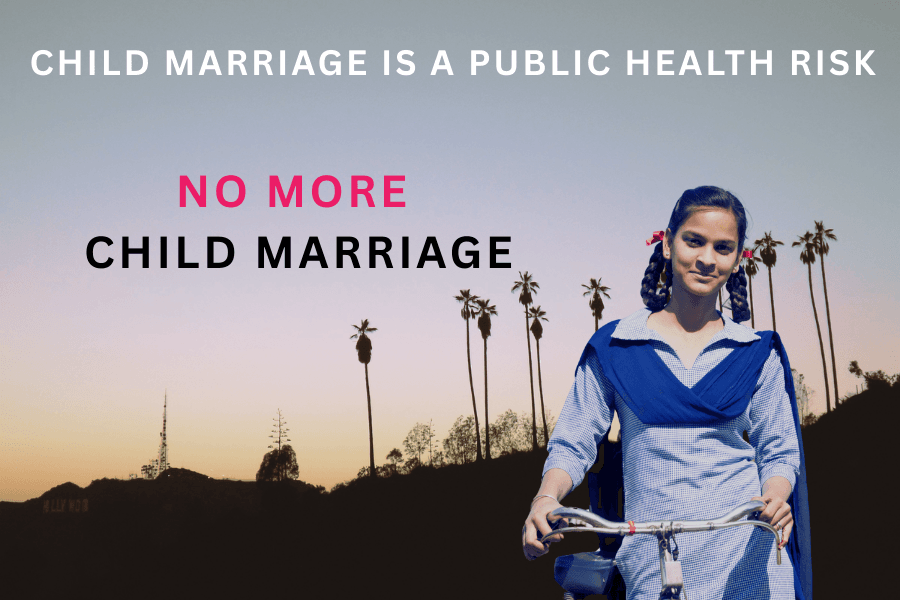
As India observes National Girl Child Day – a moment intended to affirm girls’ survival, health, and life chances – child marriage is widely recognised as unacceptable. Yet many underage married girls are brought to hospitals with obstructed labour – anaemic, undernourished, and unprepared for pregnancy. For the health system, this is a condition to manage. The more pressing issue is whether India is prepared to treat child marriage as a predictable and preventable public health risk – a shift that changes how the state classifies the problem. Governments can then act earlier, spend more efficiently, and achieve gains across multiple objectives – maternal health, nutrition, and girls’ education – through the same preventive investments.
Treating child marriage as a public health issue does not replace legal or social approaches. Rather, it reframes early marriage as a measurable risk factor that can be identified and mitigated well before irreversible harm occurs.
Child Marriage as a Drag on the Health System
Seen through a public health lens, child marriage reflects not a lack of institutional capacity, but an under-utilisation of preventive potential. Early pregnancy places physiological stress on bodies that are still growing. Pelvic immaturity, limited nutritional reserves, and untreated anaemia increase the likelihood of prolonged labour, haemorrhage, pregnancy-related complications, and maternal mortality. Children born to these mothers are more likely to be born underweight, experience early malnutrition, and face poorer developmental outcomes. These risks compound over time, placing sustained pressure on healthcare systems. Framing child marriage as a public health priority clarifies the gains from prevention. Reducing these compounded risks eases pressure on frontline health facilities, lowers referral and emergency care costs, and improves the effectiveness of existing maternal and child health investments. Early action, in this sense, is not an additional obligation but a high-return governance investment.
Why Legality Alone is Insufficient
India’s legal prohibition of child marriage provides a strong enabling foundation for action. However, law enforcement remains uneven and institutional coordination constrained – legal bans struggle to influence household decisions shaped by economic stress and entrenched social norms. Integrating prevention into health and nutrition services allows the state to act earlier, more consistently, and with greater legitimacy – intervening before marriage and pregnancy translate into medical emergencies.
Data from the National Family Health Survey (NFHS-5) show that child marriage remains unevenly distributed across states, closely overlapping with regions where a high share of adolescent girls are anaemic and early pregnancies remain common – the same districts that report weaker access to quality maternal healthcare. This pattern points not to a failure of law, but to the need to operationalise legal intent through routine health and welfare service delivery – embedding prevention within health, education, and welfare systems.
What Policy Interventions have achieved – and what they have not
Policy efforts to delay marriage demonstrate that progress is possible. West Bengal provides a useful case in point. The state’s Kanyashree Prakalpa – a conditional cash transfer scheme – shows that financial incentives linked to schooling can reduce early marriage for beneficiaries when outreach, monitoring, and implementation are strong. Yet West Bengal continues to record high child marriage prevalence because implementation of Kanyashree Prakalpa has been uneven and geographically concentrated.
This does not suggest limits of incentives themselves, but underscores the importance of reinforcing them with regular health monitoring, community-level engagement, and coordination across departments. State capacity is strongest when incentives align closely with service delivery.
Building a Governance Checkpoint
Creating an efficient child marriage prevention system would involve jointly reviewing a small, feasible set of indicators at the district level: prevalence of under-18 marriages, anaemia among adolescent girls, pregnancy outcomes among young mothers, institutional delivery rates, and school continuation beyond secondary education. These data already exist across administrative systems; aligning them would allow earlier identification of risk and clearer attribution of responsibility. Importantly, this approach relies more on coordination than on institutional expansion.
Frontline workers are well placed to support this shift. Through nutrition and reproductive health programmes, they already engage regularly with adolescent girls. School-linked platforms provide an additional point of contact, with routine adolescent health screenings conducted through the Rashtriya Bal Swasthya Karyakram allowing nutrition and health risks to be identified before marriage or pregnancy occurs.
With clear coordination protocols and targeted training, these interactions can trigger timely responses across departments. Where districts demonstrate improvement, additional resources and flexibility can reinforce success. Elsewhere, slower progress should prompt focused institutional support to strengthen capacity.
From Prevention to State Capacity
India has demonstrated its ability to monitor immunisation, nutrition, and maternal health outcomes at scale. Applying similar rigour to prevent the health consequences of child marriage is both feasible and fiscally prudent. The institutional architecture is already in place; what remains is to fully recognise early marriage as a governance and health system challenge, not merely a social concern.
National Girl Child Day can then mark a shift from intent to outcomes – strengthening health systems, improving girls’ lives, and delivering durable social returns.