



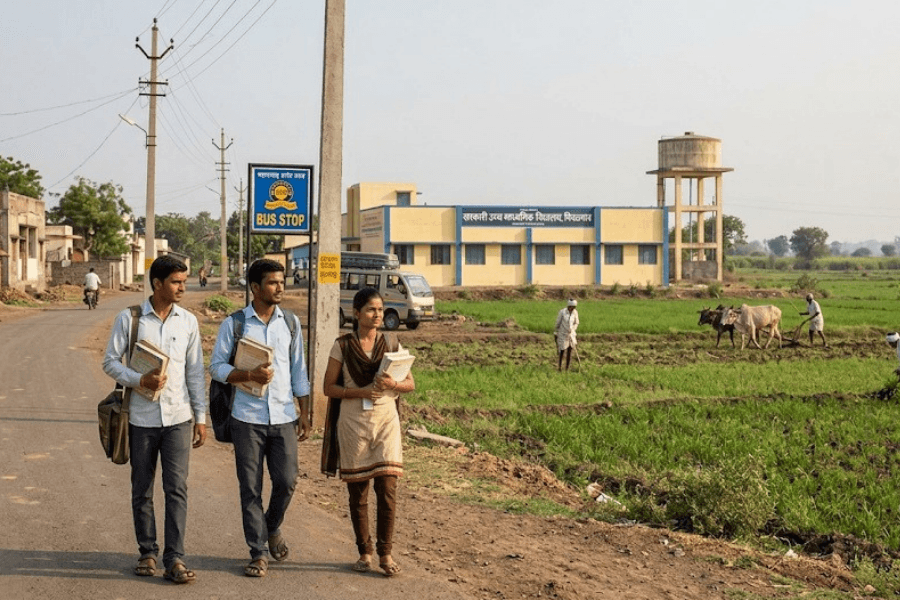
In rural India, education has expanded across generations, but labour market opportunities have not kept pace. Sons today study longer than their fathers and grandfathers, yet many still end up in insecure or low-status work. This disconnect is not accidental. It reflects the continued power of village institutions – especially landownership and local dominance – in shaping who can turn education into occupational progress, and who cannot. Far from fading in a modernising economy, traditional village structures still affect how opportunity is distributed.
Two Divergent Ladders of Mobility
Intergenerational mobility has two distinct dimensions. Educational mobility captures whether each generation completes more years of schooling than the previous one. Occupational mobility reflects intergenerational movement into more secure and higher-status work, such as shifting from agricultural labour to skilled non-farm or clerical employment.
Using nearly 18,000 grandfather–father–son triads across 1,326 rural villages between 1913 and 2012, a clear pattern emerges. Educational mobility has risen sharply over time, but occupational mobility has lagged behind – including widespread occupational descent, driven largely by movement from cultivation into agricultural labour – a pattern that reflects structural vulnerability rather than short-term fluctuations.
This divergence matters because jobs, not schooling alone, determine long-term security and social standing. For many households, especially those dependent on agriculture, fragmentation and other changes in land access, labour demand and local power relations can push offspring into more precarious work even if their schooling improves.
Social Groups and Uneven Gains
These patterns vary sharply across caste and religious groups. Scheduled Castes (SCs) and Scheduled Tribes (STs) have substantially narrowed gaps with upper castes in years of schooling over generations. Muslims, on the other hand, have not seen any reduction in gaps with upper castes over the past several decades.
Occupational outcomes tell a different story. There is little evidence that SCs and STs are catching up with upper castes in the kinds of jobs they access. For Muslims, occupational mobility used to be comparable to that of upper castes but for the youngest generation this is no longer the case.
SCs, STs, OBCs and Muslims face higher risk of intergenerational occupational descents as compared to upper caste men.
Village Dominance Matters
A key factor affecting these outcomes is village dominance defined by landownership. The group that owns the largest share of agricultural land in a village may control credit, local offices and access to public investment. Better infrastructure raises the chances that education continues beyond the basics. Stronger links to markets and the state make it more likely that schooling translates into stable, higher-status work.
Villages can be characterised as SC-, ST-, OBC-, Muslim- or upper-caste–dominated, depending on landownership patterns. For individuals, this creates two distinct contexts: living in a village dominated by one’s own group, or living under the dominance of another group. Each shapes mobility in different ways.
Scheduled Castes: Hierarchy with Proximity
SC-dominated villages tend to have better access to basic infrastructure than ST and Muslim-dominated villages – a case where control over land partially offsets historical exclusion. They are also marked by greater social cohesion: residential segregation into separate hamlets is less pronounced and local conflict is lower. These conditions may make it easier for education to translate into upward occupational mobility. Such villages are relatively rare – only about one in ten SC households lives in an SC land-dominated village.
Living under upper-caste dominance presents a structurally ambivalent setting – access to roads, electricity and public services is better, and links to markets and administration are deeper. SC men in these villages can benefit educationally from access to higher-quality schools and exposure to aspirational role models, even as discrimination endures. Despite schooling gains, SC households remain highly vulnerable to occupational descent, as informal group networks appear to offer less protection than suggested by existing research.
Scheduled Tribes: Isolation Overrides Solidarity
Unlike SC-dominated villages, ST-dominated villages are often remote, far from towns and district headquarters, with poor road connectivity and weak state presence. They are also more likely to be located in less favourable agro-ecological zones and to lack secondary schools and other critical infrastructure. While living among one’s own may reduce direct social discrimination, remoteness overwhelms that advantage. As a consequence, upward educational mobility is limited in these villages. Furthermore, few ST households live in upper-caste–dominated villages, preventing ST households from taking advantage of the better infrastructural provision in these villages.
Muslims: Proximity Without Inclusion
The challenge in Muslim-dominated villages is not distance, but exclusion. Unlike ST villages, they are often well located – close to towns, district headquarters and situated in favourable agroecological areas. At the same time, they remain systematically under-served. Access to secondary schools, electricity, piped water and roads is markedly lower than in upper-caste–dominated villages, with primary schooling the main exception. Living among one’s own does not compensate for weak public provision.
Educational mobility suffers not because of distance, but because proximity to centres of growth has not translated into sustained public investment. Living under the dominance of another group offers limited improvement. Muslims do not experience strong educational gains from residing in upper-caste–dominated villages, and their occupational mobility has worsened in the youngest generation. The core problem is not physical access, but exclusion from the pathways that advance educational attainment and convert schooling into good and stable jobs.
Beyond Individual Schemes
These patterns highlight the limits of purely person-based policy. Scholarships, hostels, reservations and targeted benefits remain essential, but they cannot undo the disadvantages of growing up in an under-served village. A complementary place-based strategy is needed – one that prioritises secondary schools, transport connectivity, electricity and water in ST- and Muslim-dominated villages and in areas marked by high occupational descent. Monitoring must extend beyond enrolment and completion to whether education is translating into better work.
India’s next mobility challenge is therefore not only one of aspiration, but also of translation. Education has expanded but labour market opportunities have not kept pace. Unless policy confronts how village power shapes access to infrastructure, markets and secure work, mobility gains will remain fragile and uneven. The risk is not just stalled progress, but a generation that studies more – and falls just as hard.