



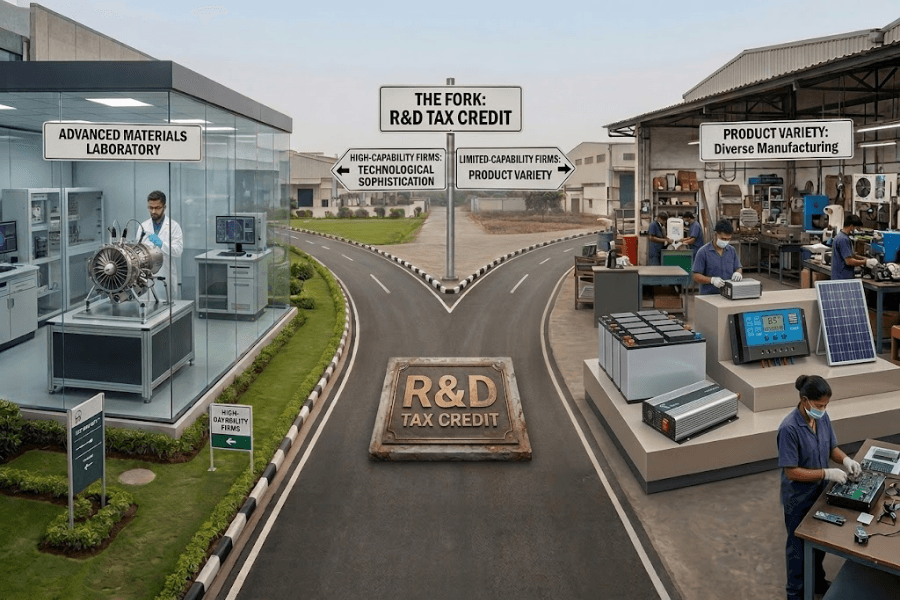
For decades, governments have relied on tax incentives to nudge firms towards greater investment in research and development (R&D). The underlying logic is straightforward: lower the cost of innovation, the higher is the probability for the firms to innovate. India’s experience with R&D tax credits since the late 1990s broadly supports this intuition. Yet focusing on aggregate R&D spending alone obscures a more consequential question – what kind of innovation these incentives end up producing, and which firms are positioned to benefit from them.
India’s R&D tax credit did not simply increase innovation expenditure; it systematically amplified existing capabilities and steered firms towards different innovation paths. Firms with established R&D capacity used the incentive to deepen product quality and technological sophistication, while firms with more limited capabilities tended to expand product variety. This distinction matters because quality upgrading and product proliferation have very different implications for productivity growth, export competitiveness, and consumer welfare.
R&D tax policy is not only about how much firms innovate, but about the mode of innovation, who is innovating, and to what economic effect.
How India’s R&D Tax Credit Was Designed
To understand why firms responded so differently, it is essential to examine how India’s R&D tax credit was designed. Introduced in 1998, the policy initially applied to selected manufacturing industries – pharmaceuticals, chemicals, electronic equipment, computers, and telecommunications equipment – where domestic technological capability was considered strategically important. Firms in these sectors were allowed a weighted tax deduction of 125 percent of approved R&D expenditure, meaning that for every ₹100 spent on eligible R&D, ₹125 could be deducted from taxable income. This deduction was raised to 150 percent in 2001, further reducing the effective cost of R&D.
Crucially, eligibility was not automatic. Firms had to be certified by the Department of Scientific and Industrial Research (DSIR) under the Ministry of Science and Technology. Certification required evidence of a dedicated in-house R&D facility, specialised personnel, appropriate equipment, and documented research activity aligned with the firm’s business, alongside periodic reporting for continued approval. Firms without DSIR recognition, even within the same industries, continued to receive only the standard 100 percent deduction available to all firms.
This design feature effectively created two classes of firms within the same sectors: those with recognised R&D infrastructure that could access enhanced incentives, and those without. The tax credit therefore did not merely subsidise R&D spending; it rewarded prior readiness and institutional capacity.
Which Firms Responded Most to the Incentive
This design mattered because it shaped which firms were able to respond most strongly to the incentive. Evidence from CMIE PROWESS data covering more than 9,200 manufacturing firms during 1992–2007 shows that while eligible firms increased R&D spending significantly after the introduction of the tax credit, the magnitude of response varied sharply by pre-existing R&D capacity.
Firms that already spent more than ₹50 million annually on in-house R&D expanded their R&D expenditure by over 650 percent following the policy change. Firms with mid-range R&D spending of ₹10–50 million increased expenditure by around 150 percent, while firms with small R&D budgets showed only modest growth. The tax credit thus amplified existing innovation capacity rather than equalising it, allowing firms that were already R&D-intensive to pull further ahead.
Equally important is what the policy did not achieve. While it deepened innovation activity among established players, it did little to induce the creation of new R&D capabilities among firms starting from a low base. Incentives tied primarily to expenditure therefore strengthened incumbents more than they broadened participation in formal R&D.
Two Innovation Paths: Quality Upgrading or Product Expansion
Higher R&D spending alone, however, reveals little unless we examine how firms deployed these additional resources. The tax credit channelled firms into two distinct innovation paths, depending on their existing capabilities.
Firms with large and mature R&D operations used the incentive predominantly to upgrade product quality – improving performance, reliability, and technological sophistication within existing product lines. For these firms, expanding product variety offered limited returns, as additional variants risked internal competition and sales cannibalisation. Quality upgrading, by contrast, allowed them to command higher prices, adopt more advanced inputs, employ skilled labour, and strengthen their position in technologically demanding markets.
Firms with smaller R&D bases followed a different path. Facing less internal competition and lower risks of cannibalisation, they introduced new products more often than substantially enhancing the quality of existing ones. The same policy instrument thus generated fundamentally different innovation outcomes, not because firms faced different incentives, but because they entered the policy with different capacities.
Where the Economic Gains Accrued: Firms and Consumers
These divergent innovation strategies translated into distinct but interconnected economic outcomes. Quality upgrading yielded the strongest returns among exporting firms and firms producing differentiated goods – products that compete on features and performance rather than standardised prices. Exporting firms with large R&D capacity increased revenues primarily through higher prices rather than higher volumes, indicating that gains were driven by quality improvements rather than scale expansion. At the same time, domestic sales declined, reflecting a strategic reorientation towards global markets where quality premia are easier to sustain.
At first glance, rising prices and export shifts might appear to disadvantage domestic consumers. Yet once improvements in quality and product variety are taken into account, the picture changes markedly. Adjusting for these factors, the effective manufacturing price index fell by nearly 50 percent between the pre-policy period and the mid-2000s. In practical terms, consumers would have required more than twice the expenditure in the earlier period to achieve the same level of satisfaction.
Seen together, these outcomes suggest that R&D tax credits functioned not only as a producer-side incentive but also as a consumer welfare mechanism. By encouraging quality upgrading and variety expansion – albeit unevenly – the policy improved long-term value and choice even where headline prices increased.
From Tax Incentives to Innovation Strategy
For industrial policy, the case for supporting R&D investment is largely settled. What remains unresolved is how such support aligns with broader policy objectives. India’s experience shows that R&D tax incentives, on their own, tend to reinforce existing capabilities and steer innovation towards quality upgrading among already strong firms.
If the objective is to push Indian manufacturing closer to global technological frontiers, tax incentives may be effective when complemented by policies that support large-scale, quality-focused innovation. If, instead, the goal is to broaden participation and encourage more firms to enter formal R&D activity, additional instruments – such as shared research infrastructure, risk-sharing grants, or targeted support for first-time R&D units – are likely to be necessary.
Recognising firm heterogeneity is therefore not a technical detail but a central design choice. It marks the difference between an industrial policy that passively subsidises activity and one that actively steers the direction of economic transformation.