



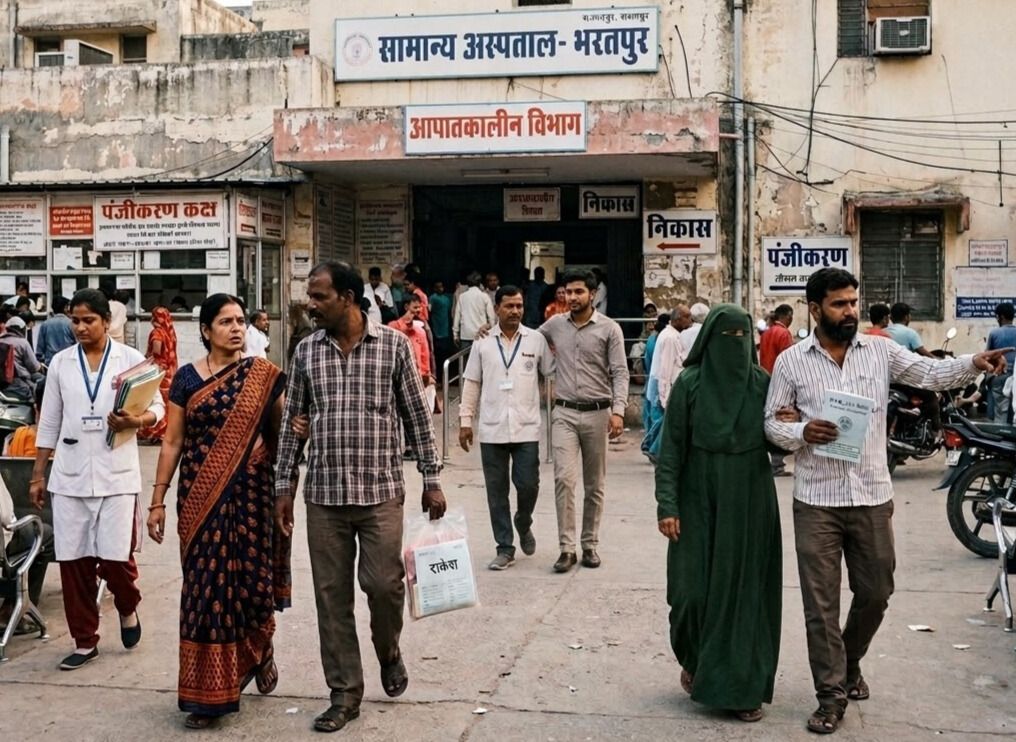
Consider a woman in her mid-thirties, married and living in a tier-3 Indian city. Her children attend a decent school. Her husband earns more than her father did. The local health clinic has been upgraded to a health and wellness centre. By most metrics that feature in government press releases, her life reflects progress.
India’s development gains for women over the past two decades are real. Female literacy has risen steadily, maternal mortality has declined sharply, and millions more girls now complete secondary school than a generation ago. Public programmes have expanded schooling, health services and welfare support across the country.
Yet a simpler question follows: can she visit her parents without asking permission, or walk alone to that upgraded clinic? For many Indian women, the answer is still no. Data from the National Family Health Survey (NFHS-5, 2019–21) helps quantify how widespread that reality remains.
Measuring what women actually decide, rather than what services they can access, is not straightforward. Survey indicators such as those used in the NFHS have limitations: women may influence household decisions without being recorded as the formal decision-maker. Even so, the patterns in the data remain striking.
The key question is whether expanded access to services has translated into greater decision-making power.
Decision-Making Power Has Barely Changed
One of the most basic questions in the NFHS asks who decides about a woman’s own healthcare.
Respondents can report that the decision is made by the woman alone, jointly with her husband, or by another household member. Across India, only about one in ten married women reports making that decision independently, while most say it is taken jointly with their spouse.
More striking than the level is how little the number changes across social groups.
Among the poorest households, about 9.2 percent of women report deciding their own healthcare independently. Among the richest, the figure is 9.9 percent.
Among women with no formal education, roughly 10 percent report independent decision-making; among women with higher education, about 10.1 percent do.
The difference between a woman who has never entered a classroom and one who has spent two decades in formal education is barely a decimal point. Similar patterns appear across other household decisions, where the share of women reporting independent decision-making typically falls between five and eleven percent across caste, religion, education and income.
Rather than improving steadily across social groups, the pattern suggests a persistent floor – one that gains in schooling, income and service delivery have yet to shift.
Social Norms Still Shape Women’s Mobility
Beyond household decisions, the picture becomes more complex.
The NFHS also asks women whether they can visit places such as health facilities, markets or locations outside their village without accompaniment. Here mobility varies more widely.
Across India, about 51.6 percent of Hindu women report being able to go to a health facility alone. Among Muslim women, the comparable figure is around 41.9 percent. Similar gaps appear for visits to markets and travel outside the village.
The gap – roughly ten to fifteen percentage points – appears consistently across indicators. Economic explanations alone struggle to account for these differences, which persist even when wealth and education gaps are considered.
These patterns point instead to social norms – the unwritten rules governing women’s behaviour within households and communities. Infrastructure, schooling and welfare transfers expand access; norms determine whether that access can be used freely.
These norms can also vary in unexpected ways across social hierarchies.
Caste Mobility Produces Unexpected Gender Norms
The data also reveal a pattern that complicates conventional assumptions about hierarchy and freedom.
Scheduled Caste and Scheduled Tribe women – communities historically located at the sharpest end of India’s caste hierarchy – report higher mobility in several indicators than women from Other Backward Classes.
Only about 46.4 percent of OBC women report being able to travel outside their village alone. Among Scheduled Caste women, the figure rises to roughly 51.4 percent; among Scheduled Tribe women, it reaches about 52.9 percent.
These comparisons cannot fully account for differences across regions, occupations or household structures that may shape mobility.
One explanation may lie in how communities pursue upward social mobility. As communities attempt to move upward within social hierarchies, they sometimes adopt the norms of groups above them. Practices such as purdah or ghoonghat, historically associated with upper-caste respectability, can spread as markers of social alignment.
If that dynamic plays any role here, the implication is uncomfortable: upward mobility may sometimes involve adopting gender norms that restrict women’s freedom of movement.
Education Does Not Automatically Expand Freedom
Education policy presents another paradox. Schooling is widely treated as one of the most reliable pathways to women’s empowerment. Yet the relationship between education and freedom of movement is less straightforward.
Among women with no formal education, about 53.9 percent report being able to visit a health facility alone. Among women with secondary education – often treated as a major milestone in gender policy – the figure falls to about 47.6 percent. Similar patterns appear in women’s ability to visit markets independently.
These figures do not imply that education restricts women’s freedom. They may reflect households that support schooling while maintaining stricter expectations around movement and reputation. The data suggest that education alone cannot be treated as a reliable proxy for empowerment.
What Policy Should Measure
India’s progress in health, education and poverty reduction is undeniable. Yet the indicators used to track these gains mostly measure services delivered, not freedom to use them. The National Family Health Survey already records whether women can make decisions about healthcare or move independently, but these indicators rarely feature in development dashboards or programme evaluations.
That omission matters. When agency is not measured, it is rarely prioritised in policy design. A more serious approach to women’s empowerment would treat autonomy itself as a development outcome — tracking whether women can decide about healthcare, move independently and influence household resources.
Which brings us back to the woman in that tier-3 town. The clinic may be upgraded and her children may attend better schools. But if she still cannot decide to see a doctor or walk there alone, the most important measure of development has not changed.
A certificate is not the same as freedom.