



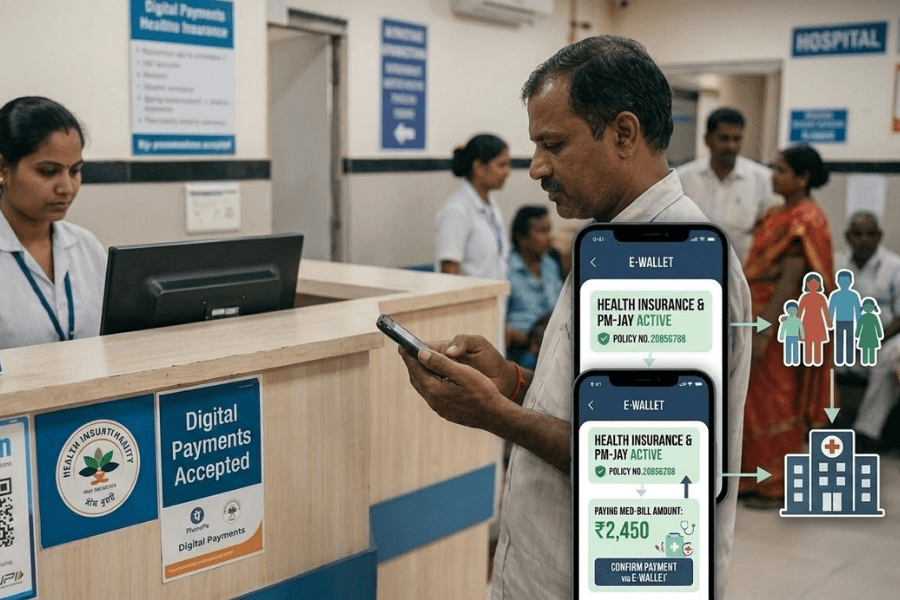
India’s digital payments revolution has transformed how households transact. What began as a matter of convenience is now embedded in routine economic life, with digital payment apps forming the backbone of everyday transactions for a large and growing share of households. Yet policy discussions continue to treat these platforms largely as payment infrastructure. A larger opportunity remains underexplored.
Digital payment apps may offer a practical pathway to expand household protection against health shocks, at a time when medical expenses remain one of the most destabilising risks facing Indian families. The question, then, is one of policy design: how everyday digital payment behaviour can be aligned with household protection against health risks.
Why Voluntary Health Insurance Remains Rare
India’s health insurance landscape reflects a structural segmentation. Public schemes rightly prioritise the poorest, but large sections of informal and near-poor households fall between eligibility thresholds and affordability constraints. These families are neither fully protected by subsidised programmes nor financially secure enough to absorb medical shocks on their own.
This means that despite the expansion of public schemes such as Pradhan Mantri Jan Arogya Yojana (PM-JAY), health financing in India continues to rely heavily on households themselves. The result – derived from the 77th Round of the National Sample Survey (NSS) data – is that around 82 percent of households lack any form of health insurance, while voluntary health insurance covers barely 1.2 percent.
These vulnerabilities are unevenly distributed. Rural households – nearly 60 percent of the population – face higher exposure due to volatile incomes and limited access to healthcare. Social divides intersect with digital divides: adoption of e-wallets is significantly lower among Scheduled Tribe households than among other social groups, and households headed by women are less likely to use them.
When Digital Payments Change Risk Choices
When insurance coverage is limited and socially divided, the challenge is not only one of incremental allocations, but of policy design – so that digital finance mitigates the existing inequalities; rather than replicating them. The opportunity lies in understanding how households interact with money, and whether these interactions can generate meaningful gains in financial protection.
The central question then is: what changes household risk behaviour? The patterns from the NSS data are revealing. Insurance uptake is higher among working-age households and rises steadily with age of the members. Larger households, facing tighter budget constraints, are less likely to adopt. These gradients underscore that insurance uptake does not operate in isolation; it interacts with income, lifecycle stage, and consumption capacity – which also shape households’ preference for convenience and low-friction financial tools.
E-wallets therefore fit naturally as a policy instrument. Repeated engagement with digital money reduces frictions around planning, liquidity management, and follow-through. Insurance, then, becomes easier to evaluate, easier to pay for, and harder to postpone.
Accordingly, e-wallet adoption is associated with a 1.8 percentage-point increase in insurance coverage – a sizable effect given the extremely low baseline. In proportional terms, this represents an increase of well over 100 percent relative to current voluntary coverage levels. Active use of e-wallets appears to lower the behavioural and informational barriers that keep voluntary health insurance out of reach.
Three Shifts That Turn Payments into Protection
Three mechanisms help explain why regular engagement with digital payments translates into higher insurance uptake.
First, e-wallet use appears to build insurance-relevant financial capability. Users are more likely to enrol in low-cost accident insurance schemes such as Pradhan Mantri Suraksha Bima Yojana. This reflects not abstract financial literacy, but familiarity with premiums, exclusions, and risk pooling – the specific competencies required to navigate insurance products.
Second, digital payment users display greater resilience to health shocks. When households can track spending, manage liquidity, and transact predictably, insurance shifts from being a last-minute response to a feasible preventive investment.
Third, digital platforms strengthen social interactions and information flows. Peer-to-peer transfers, bill-splitting, and digital gifting increase financial exchanges within trusted networks. These routine interactions can double as informal channels through which information about financial products circulates, reinforcing uptake through peer effects rather than formal outreach alone.
Designing the Link Between Fintech and Public Policy
The implication is clear: digital payments should no longer be treated as a separate policy domain for increasing health insurance penetration. Insurance options embedded within e-wallet interfaces can be promoted through simple enrolment pathways, UPI-linked auto-debits, and e-KYC-enabled verification. Small, clearly explained micro-plans can lower entry barriers for informal workers who struggle with complex or opaque products.
Community institutions remain critical. Membership in self-help groups is strongly associated with higher insurance uptake, reflecting the role of trust and collective learning. Partnerships between self-help groups and digital platforms can combine social credibility with technological reach, particularly in rural areas where scepticism toward insurance remains high.
State-level digital infrastructure also shapes outcomes. Households in states with higher levels of digital payment activity are more likely to adopt and use e-wallets, pointing to the long-term effects of earlier investments in digital public infrastructure. The sequencing matters: infrastructure enables adoption, adoption enables engagement, and engagement enables risk protection.
Turning Transactions into Protection
India’s fintech success has already transformed how money moves. The next challenge is to shape how security is built. Aligning e-wallet ecosystems with health insurance objectives can complement PM-JAY – which addresses eligibility-based access – with mechanisms that influence voluntary, household-level risk choices. The tools are already in place. What is required now is institutional alignment to ensure that everyday transactions do more than facilitate consumption–that they help build durable safeguards against financial uncertainty.