



Improving learning outcomes is one of India’s urgent development challenges. School enrolment is high, yet genuine learning remains alarmingly low. In rural India, large shares of second graders are unable to read a basic story or solve basic arithmetic problems. This learning deficit poses a serious threat to India’s long-run growth and social mobility.
This challenge is usually discussed in terms of classrooms, teachers, and curricula. Less attention is paid to the conditions outside school that shape how children learn. One such factor is everyday violent crime. Murders, assaults, rapes, and robberies occur routinely across many Indian districts. Individually, these incidents may seem isolated; collectively, they create an environment of fear and insecurity that shapes daily life. Understanding how this form of violence affects children’s learning is therefore central to India’s broader development agenda.
More Violent Crime, Worse Learning
A clear pattern emerges from district-level crime data from the National Crime Records Bureau (NCRB) linked with learning assessments from the Annual Status of Education Report (ASER). Districts that experience increases in violent crime also see measurable declines in children’s mathematics and reading performance. Comparing changes in crime within a district over time, and accounting for annual shifts in state-level policies and conditions, notable results emerge: a one standard deviation rise in violent crime rates is associated with declines of roughly 0.02 standard deviations in math and 0.014 in reading scores. While these declines may appear modest in statistical terms, they are comparable in size to the mid-sized effects reported for many education interventions worldwide. In policy terms, they are large enough to matter.
Importantly, this relationship is specific to violent crimes only. Non-violent offences such as theft or cheating show no comparable association with learning. What appears to matter is not crime in general, but the threat to physical safety and the disruption it introduces into everyday routines.
Why Does Crime Affect Learning
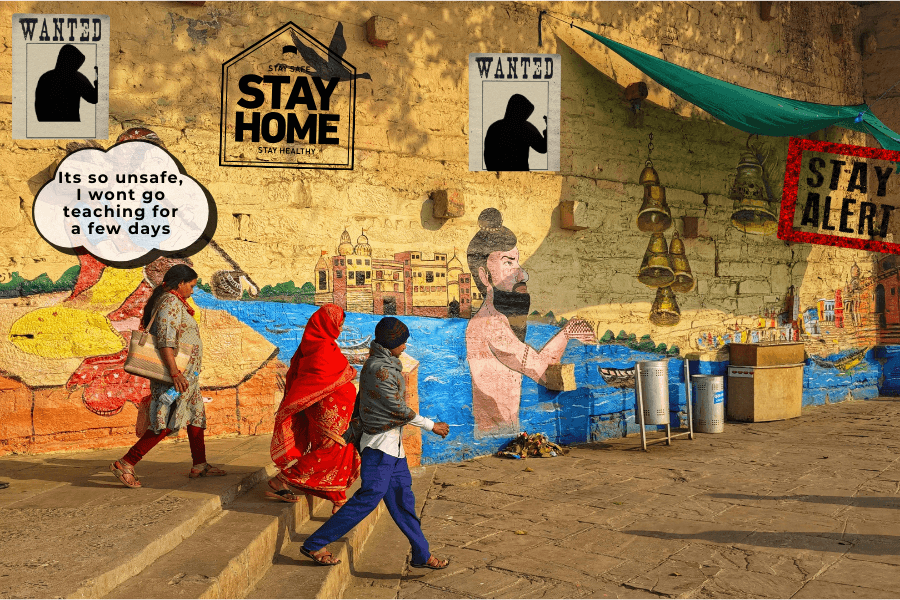
The pathways through which violence affects learning operate on both the household and school sides. Within households, rising violent crime alters behaviour. Primary-school attendance falls as parents restrict children’s movements in response to safety concerns. Adult work participation declines as well, not in ways that immediately reduce income, but in ways that disrupt the regular functioning of households.
Emotional strain is another important channel. Adults living in areas with higher violent crime report worse mental well-being, including higher levels of anxiety and depression. Such stress affects home environments and makes it harder for children to concentrate, engage, and progress in their studies.
Schools face constraints of their own. Teacher availability declines when violent crime rises, and the effect is particularly pronounced for female teachers.
Who Suffers More
The learning costs of violence are not evenly distributed. Children whose mothers have not completed primary education experience larger declines than peers with more educated mothers. Asset-poor households face similarly amplified effects, reflecting limited ability to absorb shocks. Families with greater resources are often able to create buffers – through private tutoring, safer transport or social networks – while poorer households have fewer options. As a result, everyday violence widens existing learning gaps, pushing already disadvantaged children further behind.
Policy Lessons
These findings point to a broader policy lesson. Violent crime is not only a law-and-order concern; it is an educational constraint. Learning depends on stable daily conditions, not just on what happens inside classrooms. When insecurity disrupts routines, attendance, teacher presence, and emotional well-being, educational investments yield lower returns.
Recognising this does not imply shifting education budgets toward policing. Rather, it calls for greater coordination across policy domains. Districts experiencing rising violence may require education-specific responses alongside public safety efforts. Protecting vulnerable households, supporting teacher safety and continuity, and acknowledging the psychological burden of insecurity can help prevent short-term disruptions from turning into lasting learning losses.
A Forward-Looking Opportunity
Human capital is shaped not only by what schools provide, but also by the environments children inhabit. For a country nearing its demographic peak, this connection is critical. The students whose progress is interrupted today will form the workforce of the next decade. Preventing learning losses linked to everyday violence can strengthen the foundations for future growth.
Ensuring that children learn in secure, predictable settings is not separate from education reform; it is a condition that allows such reforms to succeed.