



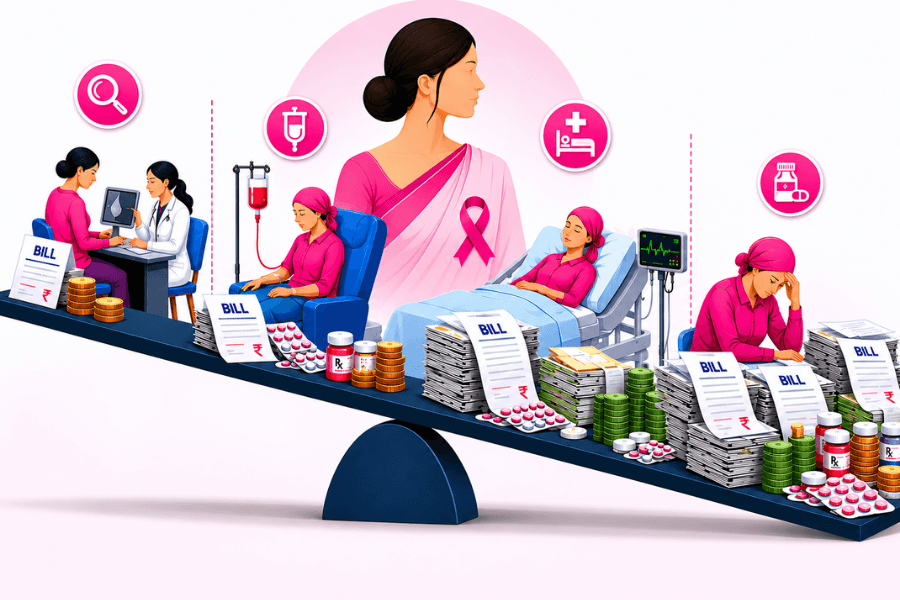
Loan-taking among cancer patients does not spike at a single point; it intensifies as treatment unfolds. Among breast cancer patients, the borrowing rises from 37.8 percent at diagnosis to nearly 69 percent six months after treatment, while the average loan burden expands from 9.2 percent to 47.4 percent of annual household income. What begins as a manageable adjustment gradually turns into a sustained financial obligation.
Evidence from a longitudinal survey of 500 breast cancer patients at a leading public cancer hospital in Mumbai during 2019-23 shows that this financial pressure builds steadily across treatment stages. At the outset, an average loan of ₹20,399 represents a limited share of household income. By the end of treatment, this rises more than fivefold to over ₹108,000, and continues to increase to ₹115,340 during follow-up.
The burden is sharply uneven. For the lowest-income households, borrowing can exceed twice their annual income, effectively converting a health shock into a multi-year financial liability. Distance compounds this effect, with patients travelling over 2000 kilometres incurring significantly higher borrowing.
Access Expands Faster than Protection
Greater access to tertiary care has enabled more patients to enter and complete treatment, marking a meaningful shift in cancer care delivery. Yet financial protection mechanisms have not evolved alongside this expansion.
Support remains concentrated at the point of hospitalisation, while a growing share of costs like diagnostics, medicines, and follow-up care, accrues beyond it. As a result, households are able to access treatment, but not to absorb its financial consequences. Clinical access improves, but economic vulnerability persists and deepens over the course of care.
These shifts reflect a systematic escalation rather than isolated spikes in cost.
Multiple Drivers Reinforce Financial Stress
This trajectory is shaped by a combination of interlocking factors.
First, income disruption and limited savings create early pressure. Treatment often coincides with reduced earning capacity, forcing households to draw down reserves quickly and turn to borrowing.
Second, gaps in coverage and credit constrain financial resilience. Insurance remains largely confined to inpatient care, leaving significant outpatient costs only partially covered. At the same time, access to formal, low-cost credit is limited, pushing households toward informal borrowing with higher and less predictable terms.
Third, geographic and clinical factors amplify costs. Patients travelling long distances incur expenses that fall outside formal billing systems, while advanced-stage disease and multi-stage treatment protocols increase the intensity and duration of spending. Social and demographic factors further shape how households respond, with younger and less-educated patients more likely to rely on loans.
Where Financial Stability Breaks
The shift from manageable expense to long-term debt occurs at identifiable stages.
At diagnosis, households rely on savings and informal networks, and borrowing is limited to a minority. As treatment progresses, households rely increasingly on borrowing as treatment progresses, pushing loan uptake sharply higher.
The most significant financial strain emerges in the post-treatment phase. Even as clinical needs decline, households begin repaying earlier loans before income has fully recovered, while follow-up costs continue to accrue. Financial protection, where available, remains concentrated around hospitalisation and does not extend to this stage. As a result, recovery in health does not translate into financial recovery, allowing debt to become entrenched beyond the treatment period.
Aligning Support with Treatment Phases
Intervention is most effective when aligned with the stages where financial pressure intensifies.
Coverage needs to extend beyond hospitalisation and outpatient visits to include full diagnostics, medicines, and follow-up care, where a growing share of costs now resides. Affordable, regulated medical credit can provide structured borrowing options, reducing dependence on informal sources. Early financial assessment at diagnosis can identify households at risk and enable timely support before liabilities accumulate.
Geographic disparities can be mitigated through travel assistance or decentralised care pathways that reduce distance-related costs. These interventions are most effective when designed as a continuum, reflecting how costs unfold over time rather than as isolated interventions.
Continuity will Determine Outcomes
The trajectory of medical debt points to a broader design challenge. Systems that concentrate financial protection at the point of entry leave households exposed as treatment progresses.
Sustained support across the care journey offers a way to convert expanded access into durable outcomes. The long-term effectiveness of healthcare financing will depend on whether continuity is built into system design, ensuring that health recovery is not accompanied by prolonged financial strain.