


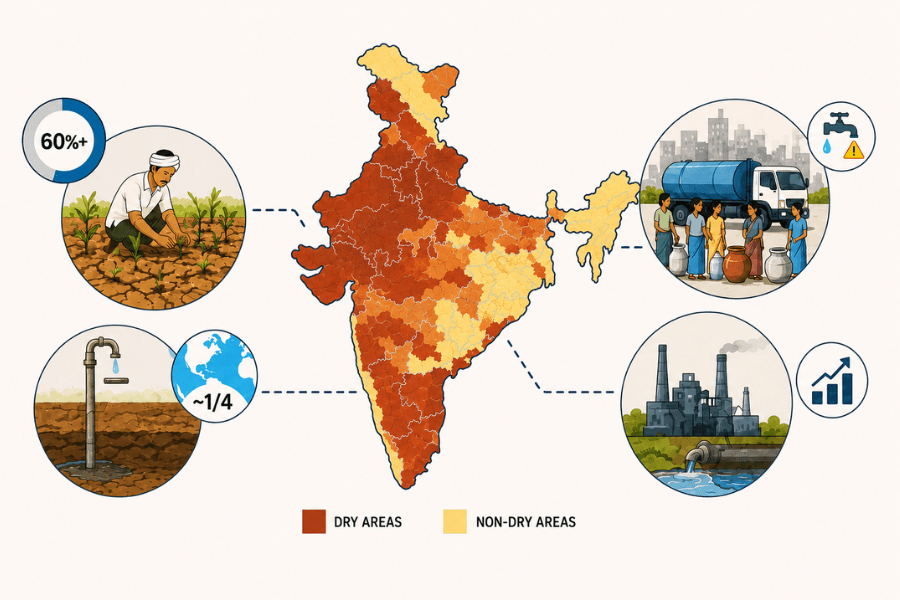
Every summer, India’s water stress returns with familiar signs despite significant annual rainfall and extensive river and irrigation networks. Reservoir levels decline, tanker demand rises, and cities prepare for supply restrictions. What appears as a seasonal disruption is increasingly becoming a structural economic challenge.
The scale of dependence is substantial. India accounts for nearly one-quarter of global groundwater extraction, while more than 60 percent of irrigated agriculture depends on groundwater systems. Expanding cities, industrial growth, and climate variability are placing additional pressure on already stressed water reserves. Water availability is therefore no longer only an environmental concern; it increasingly shapes agricultural stability, urban growth, industrial continuity, and long-term economic resilience.
India Still Lacks Integrated Water Visibility
Yet India still lacks a continuous public accounting system that tracks extraction, recharge, reuse, and long-term stress across sectors in an integrated manner. The system has limited visibility into how quickly groundwater reserves are declining, where recharge capacity is weakening, and which regions are approaching critical stress. Information on water use remains fragmented across irrigation departments, urban utilities, electricity regulators, and local administrations, making it difficult to anticipate stress before shortages intensify.
Fragmented Incentives Are Deepening Pressure
This governance gap is closely linked to how institutions and incentives currently operate. Agricultural policy, electricity pricing, urban planning, industrial expansion, and groundwater regulation are often designed separately even though they shape the same resource system. Farmers respond to procurement security and input costs. Municipalities prioritise immediate supply pressures because urban shortages carry political costs. Industries invest in private extraction because reliable water access affects production continuity. Each decision may appear rational in isolation, but together they generate mounting pressure on shared water systems.
The problem, therefore, is not simply one of conservation. It is also one of institutional coordination.
Why Existing Reforms Struggle to Scale
India has already launched important water-sector interventions over the past decade. Programmes such as Jal Jeevan Mission and Atal Bhujal Yojana have expanded rural water access, strengthened local groundwater management efforts, and improved community participation in several regions. These initiatives have produced meaningful local gains and demonstrated that behavioural and administrative improvements are possible.
However, many of these reforms still operate as programme-level interventions rather than components of an integrated national water governance framework. Local successes often remain difficult to scale because planning around agriculture, groundwater extraction, urban demand, electricity use, and industrial consumption continues to operate through separate administrative systems. India’s challenge is therefore no longer the absence of water reform pilots, but the absence of a shared governance architecture connecting them.
Building a Common Operating System for Water Governance
India’s next phase of water reform may depend on building a common operating system for measurement, forecasting, and coordination across sectors. Satellite mapping, selective groundwater sensors, reservoir monitoring, rainfall forecasts, electricity consumption patterns, and land-use data can together support district-level water budgeting systems capable of identifying stress earlier and improving planning decisions before shortages intensify.
Public visibility will also matter. Open district-level dashboards showing broad categories such as safe, stressed, or critical water conditions can improve accountability across users without creating excessive administrative complexity. Better visibility into aquifer stress can strengthen political support for wastewater recycling, conservation, and demand-management investments across governments and industries.
Aligning Incentives Across Farmers, Cities, and Industry
Information alone, however, will not be sufficient without better incentive alignment.
Crop diversification away from water-intensive cultivation, for instance, will require procurement support, market access, extension services, and predictable income protection for farmers. Several states have already begun experimenting with feeder reforms and solar-linked irrigation systems that reduce excessive groundwater extraction while protecting rural livelihoods. Expanding such approaches can gradually improve water sustainability without imposing abrupt economic disruption.
Urban systems will similarly require incentives that encourage efficiency and reuse. Better metering, reduced leakage, and wastewater recycling can improve supply reliability while reducing pressure on freshwater reserves. Industrial policy can reinforce this transition by encouraging treated wastewater as a baseline supply source for industrial clusters and commercial zones. Over time, these measures can reduce dependence on emergency tanker systems while encouraging more predictable long-term planning across sectors.
Using Pilot Districts to Build Scalable Models
Given India’s varied hydro-geological conditions and economic realities, reforms will also require phased experimentation rather than uniform national implementation. Policy can identify a group of pilot districts representing different climatic, agricultural, and groundwater conditions to test integrated water governance systems in practice.
These pilots can evaluate how district-level water budgeting, groundwater monitoring, public dashboards, and coordinated planning across agriculture, electricity, urban development, and local administration function under different conditions. Successful approaches can then gradually scale through adaptive learning rather than rigid standardisation.
Water Governance as Development Capacity
India already possesses many of the building blocks required for a stronger water governance framework, including expanding digital infrastructure, growing local data systems, improving wastewater treatment capacity, and experience with large-scale public coordination programmes. The larger challenge now lies in connecting these capabilities through institutions that improve long-term planning, accountability, and resource management across sectors and regions.
Water governance is increasingly becoming part of India’s broader development capacity. Building systems that can measure, coordinate, and manage water stress more effectively will shape not only environmental outcomes, but also the resilience of India’s future economic growth.