


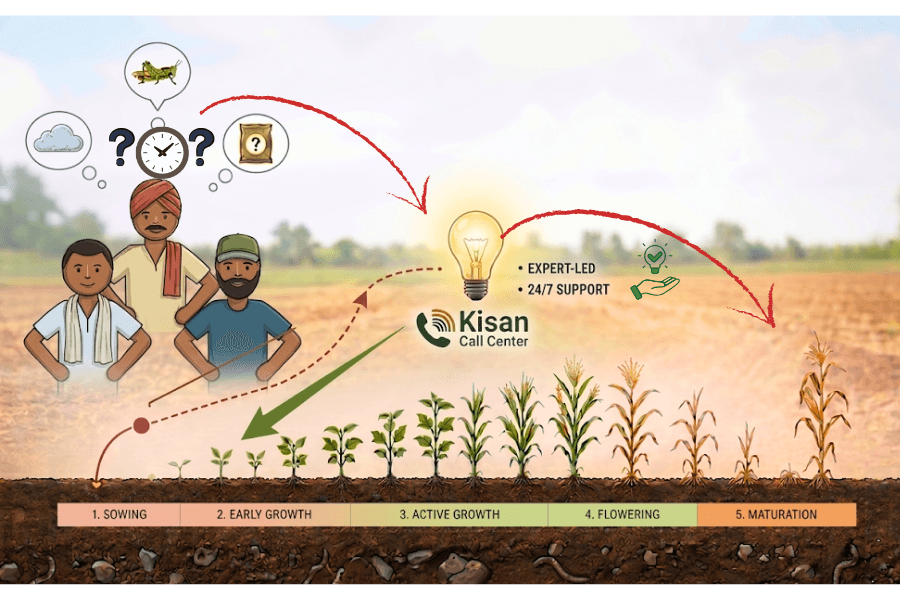
For millions of small and marginal farmers, gaps in information on weather, pests, and input use translate directly into yield losses. These constraints have shaped India’s investment in digital agriculture, with the expectation that better guidance can raise farm productivity at scale. Mobile-based advisory platforms such as the Kisan Call Center have expanded access to expert support across regions, crops, and seasons. The call center experts are trained graduates in agricultural sciences who assist farmers around the clock by providing continuous, demand-driven support in vernacular languages, thereby lowering informational and linguistic barriers to technology adoption and improving farm management.
Despite this expansion and accessibility, results remain uneven across crops, regions, and types of farm decisions. Evidence from over 17 million farmer queries across 10 states between 2009 and 2019 demonstrates that digital extension improves yields, though the magnitude and direction of the impact vary.
Uneven outcomes sharpen the policy question. Which kinds of advisory inputs improve yields, and at what stage of the crop cycle do they matter most? The evidence reveals a clear pattern: productivity gains are strongest when guidance shapes decisions in advance of key risks.
Queries Reveal Decision Points
Farmers’ queries provide a direct view into how decisions are made under uncertainty. At scale, two categories dominate interactions with advisory platforms: weather-related questions on rainfall, temperature, and timing, and pest-related questions on infestations and crop damage. Together, these account for the largest share of queries recorded across regions.
These queries arise at distinct stages of the crop cycle. Weather-related queries typically precede key decisions such as irrigation scheduling, transplanting, and harvesting. Pest-related queries tend to follow visible signs of stress in the field. The distinction reflects whether farmers seek guidance before making decisions or after losses have begun to emerge.
The type of query reflects the stage at which intervention occurs. That stage determines how much advisory inputs can influence outcomes, and explains the differences in crop yields.
Timing Determines Yield Gains
The impact of advisory inputs on crop outcomes varies systematically with when they enter the decision process. Evidence from farmer queries shows that different types of guidance are associated with distinct yield effects. A 1 percent increase in weather-related queries corresponds to an increase of 0.008 tonnes per hectare in paddy yields, or about a 0.3 percent improvement over the average. In contrast, a 1 percent increase in pest-related queries corresponds to a decline of 0.028 tonnes per hectare, or about a 1.1 percent reduction.
This divergence reflects the timing difference observed in query behaviour. Guidance that informs decisions ahead of key risks allows farmers to align inputs and operations with expected conditions, improving outcomes across the season. When queries arise after stress becomes visible, part of the damage has already occurred, limiting the scope for influencing final yields.
Access Does Not Ensure Timing
The contrast between weather and pest queries highlights a broader constraint in digital extension systems. Access to advisory support has expanded significantly, yet the timing of its use remains uneven. Farmers do not always seek or act on guidance at the stage when it can shape key decisions.
Several factors shape this gap. Trust in advisory systems, familiarity with digital tools, and local practices influence when farmers turn to formal sources of information. In many settings, critical decisions continue to rely on interpersonal networks, with digital platforms used alongside rather than in place of them. Differences in literacy, mobile access, and regional conditions further shape how guidance is used across districts.
For policy design, the implication is clear: expanding access improves availability, but productivity gains depend on whether guidance is used early enough to influence decisions.
Designing for Decision Timing
The findings establish a clear direction for strengthening digital extension systems. Current models are largely organised around farmer-initiated queries, where guidance is provided in response to specific concerns. This structure delivers context-specific advice, yet its effectiveness is determined by when farmers choose to seek information.
Improving outcomes requires alignment between information delivery and farm decision points. Advisory platforms can use data on weather patterns, crop cycles, and local conditions to provide guidance ahead of key activities such as irrigation, sowing, and harvesting. Early signals on pest risks, based on local trends and historical patterns, can support preventive action before infestations spread. Linking guidance to these decision points allows digital extension to shape how inputs are used and how risks are managed across the season.
This shift also depends on how advisory systems are embedded within local agricultural networks. Farmer Producer Organizations, extension workers, and community institutions can reinforce timely action by helping farmers interpret and apply guidance in context. Stronger linkages improve both the reach of advisory systems and the likelihood that guidance is acted upon.
Usability remains central to this design. Advisory platforms that operate in local languages, use voice-based communication, and simplify interfaces widen access to timely guidance. When farmers receive and act on inputs at the right stage of the crop cycle, digital extension delivers more consistent improvements in productivity.
From Access to Advantage
India’s experience with digital agriculture demonstrates that the timing of advisory use plays a central role in shaping outcomes. This shifts the focus of policy from delivery to alignment. Advisory systems need to be anchored to when farmers make decisions, so that guidance reaches them at points where it can influence actions across the crop cycle. When this alignment improves, even incremental gains at the farm level accumulate into meaningful improvements at scale.
The next phase of digital agriculture will be defined by how effectively advisory systems are embedded within decision processes. Strengthening this connection can convert widespread access into consistent gains in productivity across regions and seasons.