



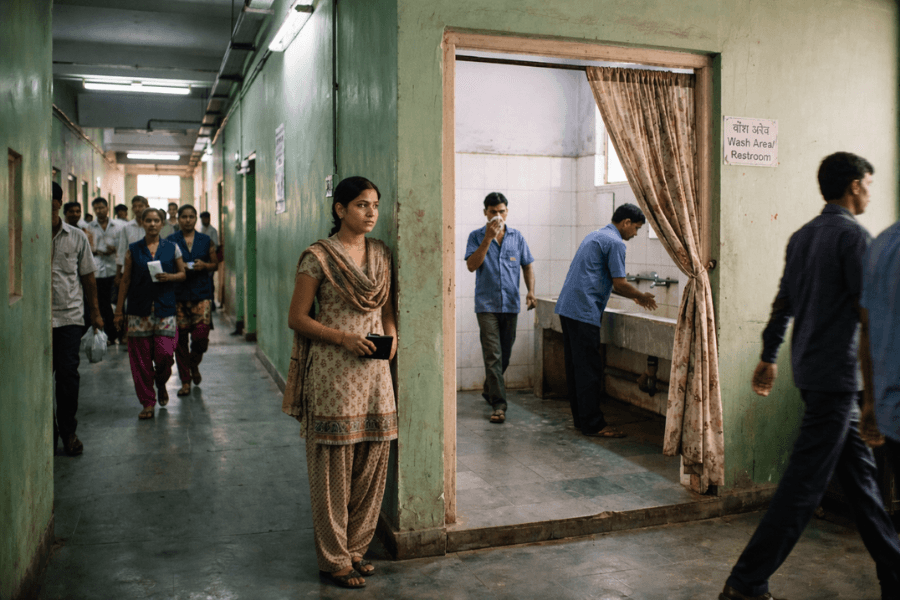
Employment is widely seen as a pathway to women’s empowerment. It is meant to expand choices – what women can earn, where they can go, how they live. Yet for many women going to work can make something as basic as managing menstruation harder. If work is meant to increase agency, why does it seem to limit a basic aspect of health and dignity?
The answer lies in a policy assumption that once access is ensured, women can act on it. Much of the policy focus has been on expanding access through subsidised products, awareness campaigns, and school-based programmes. What this overlooks is whether the environments in which women work actually enable them to do so.
This shifts the question from what women know or use, to the conditions under which they work.
Work Conditions Shape Outcomes
A sanitary pad is only useful if it can be changed in privacy, with access to water, and disposed off safely. When these basic conditions are missing, managing menstruation safely is not a matter of choice, but of constraint.
These constraints are not evenly distributed. Data from the National Family Health Survey (NFHS-5), 2019–21, shows that women employed in non-agricultural sectors are significantly more likely to follow safe menstrual hygiene practices than those working in agriculture.
The difference is structural. Work outside agriculture is more likely to offer basic facilities such as toilets, water, and predictable breaks. Agricultural work, by contrast, is carried out in open or semi-open environments where privacy is scarce and sanitation facilities are absent. Under such conditions, safe practices to ensure menstrual hygiene become difficult, regardless of awareness or intent.
Autonomy as the Multiplier
But conditions alone do not determine outcomes. Even when these conditions exist, outcomes might depend on whether women have the autonomy to use them. This includes the ability to move freely, access markets, visit clinics, or purchase menstrual products without any restriction.
The interaction between autonomy and employment reveals a deeper pattern. Women who are not working but have autonomy are more likely to follow safe practices than those who are employed without it. Participation in the workforce, thus, does not automatically translate into the ability to act.
Autonomy, however, is only as effective as the environment allows. Where sanitation and access are missing, its impact is limited. Where they exist, it becomes a force multiplier.
Workplace as the Real Constraint
The full extent of this constraint becomes visible when work is compared to being at home. Even modest access to sanitation at home, through privacy, water, a place to change, can support safer menstrual practices. Many workplaces, especially in informal and agricultural settings, offer none of these.
This creates a reversal of what employment is expected to deliver. Instead of improving wellbeing, work can impose constraints that are absent in domestic spaces. The result is partial empowerment: income rises, but dignity does not.
Designing Jobs for Dignity
If employment can constrain health in this way, then improving outcomes requires rethinking how workplace itself is designed. Addressing this requires three shifts: fixing the work environment, enabling women to act within it, and redesigning the nature of work itself.
First, sanitation must be treated as core labour infrastructure. Access to a toilet, water, and privacy at the workplace is not a welfare add-on; it determines whether women can participate in work with dignity.
Second, the value of these conditions depends on whether women can use them. The ability to move freely, access markets, and make personal decisions determines whether available resources translate into real outcomes. Policies that expand mobility, through safer transport, local access points, and community-level engagement, are therefore as important as those that expand employment itself.
Third, the nature of employment matters as much as its availability. Expanding opportunities in sectors that offer more structured working conditions can improve outcomes through the environments they create.
Menstrual health cannot be addressed in isolation through products or awareness alone. It sits at the intersection of labour design, infrastructure, and autonomy, and improving outcomes requires aligning all three. Until these are aligned, employment will continue to expand participation without fully delivering the dignity it promises.