

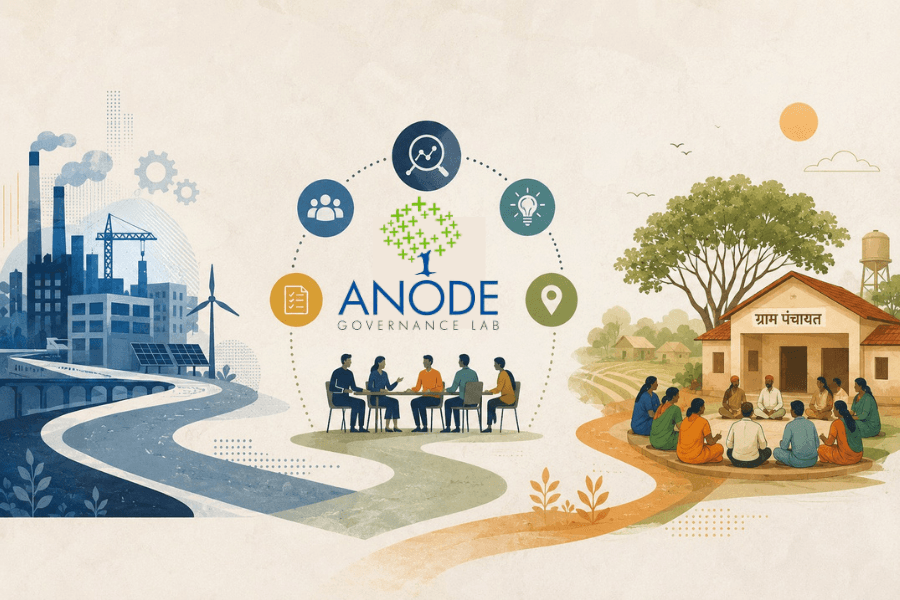
Across rural India, resources, schemes, and institutional structures are already in place. Yet outcomes remain uneven. The issue is not the absence of programmes. It is that the system responsible for implementing them does not consistently function.
This is the problem Sonali Srivastava, the Founder and CEO of Anode Governance Lab, has spent over a decade working through. Not by designing new interventions, but by asking a more difficult question:
“What would it take for existing public systems to actually work as intended?”
Learning to See Systems
That question did not emerge within the development sector.
During her Master’s at the XLRI, organisations were understood not as fixed structures, but as systems shaped by behaviour, incentives, and internal relationships. That lens carried into Sonali’s early work in industrial relations with Asian Paints in the early 1990s, in a volatile industrial belt in western Uttar Pradesh.
This was her first sustained exposure to how systems function under pressure.
The factory was designed and organised as a world class manufacturing facility. However, it sat within a wider field of state, industry, and community tensions. Hiring decisions had to balance skills required with local expectations. Political interference was not incidental. What appeared as an internal management issue was often negotiated outside the factory gates.
A gap became visible here. Corporate assumptions about labour and local communities did not explain what was happening. Behaviour followed a different logic.
“You realise very quickly that what the system assumes is not how people actually behave,” she reflects.
That gap sharpened in subsequent work examining voluntary retirement schemes, often framed as “golden handshakes.” On paper, these were clean exits. In reality, many workers struggled after leaving. Financial instability was common. What had been treated as closure at the firm level continued as uncertainty in people’s lives.
“You sign off on something and it looks complete,” she says, “but people are still figuring out what comes next.”
This raised a more difficult question: If decisions do not end where institutions assume they do, then what happens after they are made? And who absorbs their long term costs?
Her move to the Social Work & Research Centre in Tilonia was to explore some of these questions. Working with rural communities, she began to question the idea of villages as sites of deficit. What she encountered instead were vibrant, fun-filled spaces of capability and dignity. Development, in that light, was not delivery. It was enabling and opening up opportunity.
“There are no poor people, only poor environments,” Sonali says, quoting the development economist, Lant Pritchett.
Where the Constraint Became Visible
This understanding took a concrete form in work with panchayats through Arghyam, beginning with dissemination of ASHWAS, a Study of Household Water and Sanitation, findings across 172 gram panchayats in Karnataka.
The initial approach was straightforward: share data, enable discussion, support local action.
It did not play out that way. Meetings often did not happen. In some cases, the office itself was not accessible. When discussions did take place, they rarely translated into follow up or structured action.
“You would go there thinking we’ll sit and discuss the report,” Sonali recalls, “and then you’re just waiting.”
The issue did not sit with the data. It appeared at a more basic level. “We kept going with data,” she says, “but the panchayat itself wasn’t ready to take any of it forward.”
Over time, this pattern repeated across locations. The constraint was not limited to water or sanitation. It sat within how the institution functioned.
Recognising the Scale Already Present
Around this point, a different question began to take shape.
In a typical block, public spending routed through panchayats and line departments can approach ₹100 crore. Most development programmes operating in the same geography work with budgets in the range of ₹2–5 crore.
The contrast was stark. Even well designed programmes were operating at a fraction of the system they were embedded within. They could demonstrate results, but only within a limited scope. The larger system continued alongside, largely unchanged.
“If you look at what’s already coming into that system,” Sonali explains, “it’s not small. The question is whether we are able to influence how it gets used.”
If that ₹100 crore system begins to function even marginally better, the scale of impact shifts immediately.
Building Institutions, Not Just Interventions
This led to a different approach.
The panchayat was treated not as an administrative unit, but as an organisation that itself needed to be developed. The work came to be structured as Gram Panchayat Organisation Development (GPOD), leveraging Organisation Development principles to strengthen Gram Panchayats.
The starting point shifted from what problem to solve to how the panchayat actually operated.
In practice, this meant sitting with the institution as it was. Roles were often unclear, even to those within it. Decisions were taken, but not carried forward. Planning existed without a clear link to budgeting or follow up. Monitoring, where it happened, rarely informed action.
The GPOD did not introduce a parallel system. It stayed with the existing one. GP members were custodians of change. Roles were clarified in relation to specific responsibilities. Planning and budgeting processes were mapped so they could be used. Regular review mechanisms ensured that decisions moved beyond discussion. Documentation such as baselines, plans, and progress records helped maintain continuity as leadership changed.
“If the institution itself is not holding together,” Sonali notes, “it cannot take up anything else in a sustained way.”
The change was gradual, but visible. Meetings began to serve a purpose. Follow ups became more consistent. Priorities were carried forward rather than revisited repeatedly.
What shifted was how the institution followed through.
From Pilots to System Pathways
As the work expanded across Karnataka, Jharkhand, and Madhya Pradesh through partnerships with organisations such as PRADAN (Professional Assistance for Development Action), TRI (Transform Rural India), APF (Azim Premji Foundation) and Sightsavers, the approach adapted to different contexts.
The entry point was not fixed. In some cases, the work began with institutional strengthening. In others, it started from a specific issue. Work with Sightsavers, for instance, began through eye health.
“You can start from any issue,” Sonali says, “but if the institution doesn’t strengthen alongside, the impact doesn’t stay.”
Even a thematic entry point could bring members into the process and create a shared focus. Across contexts, one principle held. The work did not run parallel to the system. It worked through it. Panchayats identified their own priorities. The role of the intervention was not to substitute decision making, but to enable it.
There are several pathways emerging for deeper engagement with panchayats. In Mandya district of Karnataka, a progressive MLA aims to strengthen the 35 panchayats in his constituency, starting with active engagement in 12. Development plans amounting to approximately ₹12.8 crore have been prepared, with efforts to align them across governance tiers.
At the same time, NGOs with long standing field presence are exploring ways to work more directly through panchayats. CSR programmes are exploring moving away from parallel implementation towards strengthening existing institutions.
The direction is clear. Work is shifting towards systems that already exist.
Where the Gap Remains
At the policy level, the architecture is in place. Panchayats have constitutional backing, defined mandates, and access to funds across multiple schemes.
The gap lies in how these institutions are supported to function. Capacity building is often reduced to periodic training, which addresses only a small part of what institutional functioning requires.
“Training is just 5% of the need,” Sonali notes.
What remains largely unaddressed is how institutions operate day to day: how decisions are taken, how responsibilities are distributed, and how processes hold over time.
A second challenge lies in continuity. Elected panchayat bodies change every five years. Without systems that persist beyond individuals, gains made during one cycle risk being lost in the next. Current responses attempt to address this through documentation, process mapping, and transitioning accountabilities and structures. But these are not yet embedded at a system level.
India’s decentralised governance framework has focused on creating institutions and allocating resources. Less attention has been paid to how these institutions are supported to function over time.
Towards System Activation
The direction that emerges is about enabling existing systems to function more reliably.
This requires attention to how institutions operate day to day: how roles are defined, how processes are followed, and how coordination happens across levels.
“We don’t always need to add more,” Sonali says. “Sometimes the work is to make what already exists start working.”
India’s rural development challenge is not a shortage of schemes. It is a shortage of systems that can carry them. Until that changes, outcomes will continue to depend on where institutions hold and where they do not.