



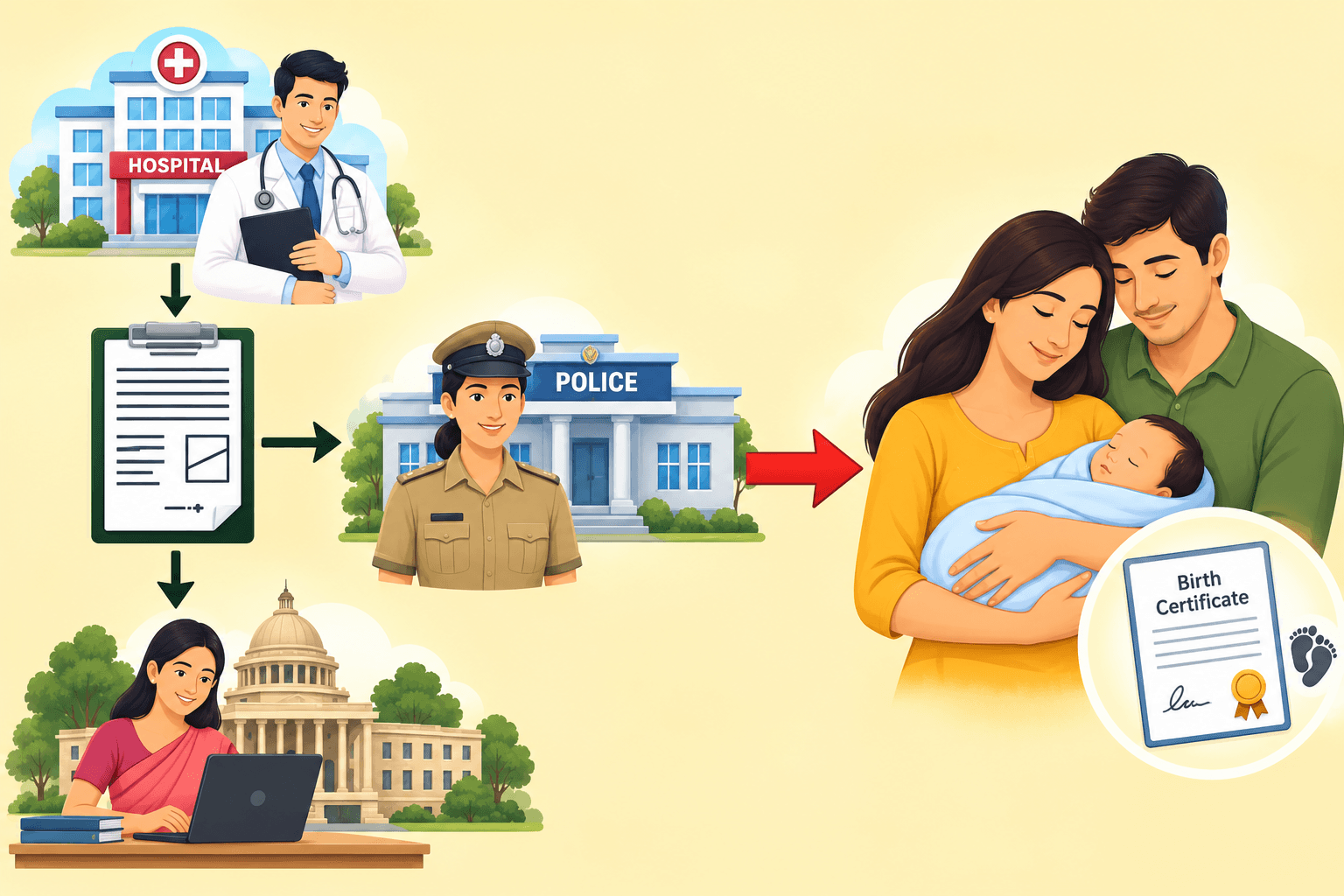
The Registration of Births and Deaths (Amendment) Act, 2023 made the birth certificate the document for establishing date and place of birth, for persons born on or after October 1, 2023, across a range of public and legal purposes, while strengthening the integration of civil registration with the wider administrative system. The Registration of Births and Deaths (Amendment) Act, 2026 now tightens the architecture for delayed registration: events reported after one year but within two years require an order from the District Magistrate, Sub-Divisional Magistrate or an authorised Executive Magistrate, while those reported after two years require an order from a Judicial Magistrate of the First Class.
The objective is to encourage timely reporting. But if timely registration is important, the policy question is not only how delayed registration should be discouraged. It is how births and deaths can be captured closer to their source so that fewer cases become delayed in the first place.
This matters because India is already close to universal registration. In 2024, birth registration completeness reached 99.1 percent and death registration 99.4 percent. The remaining challenge is increasingly one of timeliness. Only about 70 percent of births were reported within the prescribed 21-day period, while around 5.87 million births and 627,000 deaths were registered more than a year after occurrence across states and Union Territories reporting time-gap data.
The Hidden Costs of Delayed Registration
At the time of a birth or death, information is relatively contemporaneous and may already be held by a health facility, frontline functionary or another State-side actor who encounters the event. Registration within the prescribed 21-day period is free and entails virtually no direct cost to the family.
As time passes, however, the nature of the transaction changes. What could have been recorded contemporaneously becomes an exercise in retrospective reconstruction initiated by the household.
The 2026 amendment makes that progression explicit. An event reported after one year but within two years requires an order from the relevant administrative authority; after two years, it requires an order from a Judicial Magistrate of the First Class.
The larger cost of delay is therefore not simply the prescribed fee or penalty. It lies in assembling information and documents, approaching the relevant authorities, travelling, waiting and establishing an event after it has receded in time. Each additional step can impose information, documentation and time costs on the household. Delay simultaneously weakens the contemporaneity of the evidence and raises the cost of proving the event.
Capturing Births and Deaths at Source
The question, then, is whether the same registration architecture can be activated closer to the point of occurrence, so that citizen-initiated transactions after the event become the exception rather than the norm.
For institutional births and deaths, the source is relatively clear: the health facility already encounters the event. The opportunity extends beyond institutional settings and is particularly important for domiciliary deaths, where the event may not generate a contemporaneous record within a health facility but is nevertheless likely to come to the knowledge of actors embedded in the community and local administration.
The existing statutory framework already provides for Informants and Notifiers, including community health workers such as ASHAs and ANMs, Anganwadi workers and other designated functionaries. State rules can also draw upon local governance institutions and public officials who become aware of births and deaths in the course of their duties.
This network can extend beyond the health system to Panchayati Raj and other local governance institutions, land and revenue administration, and government departments whose routine functions bring them into contact with households and with events such as death, including through pensions and other entitlements.
The relevant “source”, therefore, need not be the household. It can be the first State-side institution or functionary with credible, contemporaneous knowledge of the event. That actor can initiate the flow of information, while verification and registration remain with the authorities responsible under the Act.
The potential for such integration has already been demonstrated in Uttar Pradesh through an API-based linkage between the Maa Navjaat Tracking Application (MaNTrA) and the Civil Registration System portal, enabling information generated within the health system to feed into the registration process. The significance is institutional as much as technological: information already generated by one arm of the State need not be recreated and carried by the citizen to another.
A similar principle can extend across community-level functionaries, local governance institutions and government departments. The objective is not to substitute the existing reporting channel for households, but to allow information about an event already encountered by the State to move through the administrative system without requiring the citizen to carry it across institutional boundaries.
Making Registration a State Responsibility
Such a shift does not require India to reinvent the legal architecture of civil registration. The Registration of Births and Deaths Act, 1969 already provides an important statutory foothold.
Section 7(2) requires the Registrar to take steps to inform himself or herself of births and deaths occurring within the jurisdiction and to ascertain and register the required particulars. Read alongside the provisions relating to Informants and Notifiers, this establishes an architecture in which registration need not depend exclusively on a citizen approaching the registration office.
The opportunity is to operationalise this statutory logic through suo-moto (source-initiated) registration. The State institution or functionary that first encounters a birth or death should be able to initiate the process, with verification and responsibility assigned within the registration system rather than the burden of carrying information across institutions falling primarily on the household.
This is not automatic registration. The Registrar's responsibility for establishing the veracity of the event remains. The change is in who initiates the administrative transaction.
India has already come close to universal registration. The next task is to make that registration timely. The 2026 amendment strengthens scrutiny once an event has remained unregistered for too long. The complementary reform is to ensure that fewer births and deaths reach that stage at all.