


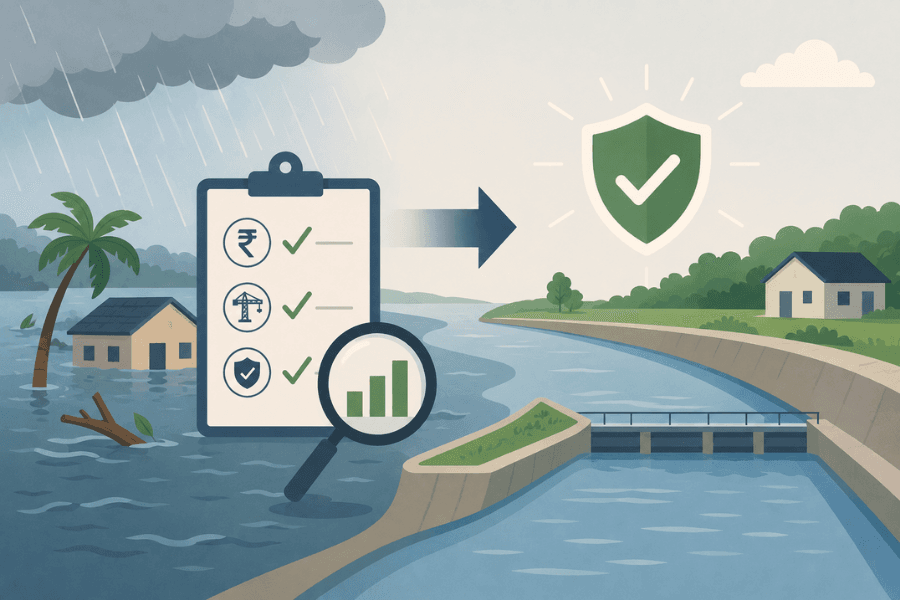
Kerala’s 2026 floods have reopened arguments about warnings, relief and official responsibility. But a deeper policy question predates this monsoon: what protection did the finance mobilised after the 2018 floods actually deliver? Eight years later, Kerala can track what it spends on flood resilience, but cannot consistently measure how much risk that spending reduces.
From Funding to Delivery
The first question is whether resilience finance became implemented projects. The Rebuild Kerala Initiative (RKI), established after the 2018 floods and supported by the World Bank, Asian Infrastructure Investment Bank and Germany’s KfW, was the main vehicle for this reconstruction finance. But its financial record reveals a gap between funding and implementation.
The Comptroller and Auditor General (CAG) found that, of ₹2,648.03 crore received through World Bank and KfW loans, only ₹1,292.24 crore had been released to RKI by March 2022. Only 41 percent of the ₹225 crore transferred for the KfW-supported road programme had been utilised.
Spending subsequently increased, but higher expenditure did not necessarily translate into timely project completion. The CAG's newest State Finances Audit Report, covering FY2024-25, records ₹996.47 crore in capital expenditure under "Rebuild Kerala Initiative - Post Flood Projects" in that year, nearly matching the total amount released to RKI during 2019-20 to 2021-22 combined. Yet the latest consolidated project count, from October 2024, showed only 22 of 113 sanctioned RKI projects complete. The RKI road portal provides no more recent consolidated update, while 2026 reporting documents delays in Cheruthoni and Peruvamoozhi-Moolakkulam. The figures point to a key accountability gap: tracking expenditure shows how much is being spent, but not whether that spending is producing completed projects on time and delivering resilience.
“Room for the River”, a proposed Dutch-model flood-mitigation project, illustrates how planned adaptation can stall before implementation. A 2019 RKI order sanctioned ₹4.5 crore for its detailed project report, which proposed regulators, bypass channels and stronger bunds to reduce flooding in Kuttanad. Yet by the 2026 floods, even the feasibility study remained incomplete amid overlapping departmental responsibilities.
These findings do not negate the progress recorded by the World Bank. Its account of US$525 million committed and US$1.13 billion leveraged demonstrates the capacity to mobilise resilience finance. The CAG’s findings on delayed transfers and execution, at an earlier cut-off, measure a different stage of the same chain. The two accounts show that mobilising finance and converting it into completed projects are separate challenges.
What the 2026 Floods Revealed
The 2026 floods raise the next question: did completed investments perform?
The Alappuzha-Changanassery Road provides the clearest project-level test. Rebuilt with raised and flood-resilient features at a reported cost of about ₹700 crore, sections at Poovam, Kidangara and Manaykkachira became submerged during the 2026 floods, disrupting traffic and causing engine failures.
This alone does not establish that the investment failed. The flooding has been attributed both to the road’s design and to blockage of the AC Canal. Resilient infrastructure should be evaluated against the conditions it was designed to withstand and against what would have happened without the intervention, rather than against an expectation that it will never fail.
An independent review should compare rainfall and river levels, inundation depth and duration, service interruptions, access for essential traffic, and impacts on neighbouring settlements and drainage infrastructure against a pre-project baseline. Without these comparisons, it is impossible to tell whether the road reduced risk, displaced flooding elsewhere or was overwhelmed by conditions beyond its design standard. Project completion is an output; effectiveness requires evidence of performance during floods.
The same distinction applies to early-warning systems. KaWaCHaM, operational since April 2024, connects 126 sirens, cameras and strobe lights with State and district emergency operations centres and integrates 280 risk-data layers. During the 2026 rains, authorities issued warnings and opened relief camps. Yet there is no public comparison in the available evidence of warning lead times, population reached, evacuation speed or avoided casualties against 2018. The number of sirens and data layers measures capacity; whether warnings reached people earlier and enabled faster action measures performance.
Matching Finance to Purpose
Disaster finance also operates across different stages of the risk cycle.
The State Disaster Response Fund (SDRF) and National Disaster Response Fund (NDRF) primarily support immediate relief, while separate mitigation funds support risk reduction. RKI’s externally aided loans serve a different purpose: multi-year reconstruction, institutional reform and resilience investment. Risk-transfer mechanisms can provide additional liquidity when losses occur.
Relief finance should be judged by the speed and adequacy of assistance; reconstruction by the restoration and resilience of services and infrastructure; mitigation by measurable reductions in exposure and losses.
A post-disaster needs assessment covers a broad recovery programme and cannot be compared directly with an SDRF or NDRF release governed by notified relief norms. Kerala needs adequate liquidity for immediate relief and predictable finance for recovery and mitigation.
From Spending to Protection
The next step is to build these distinctions into Kerala’s resilience-accountability system.
First, track finance and delivery. A public resilience ledger should cover every externally aided and State-funded project, reporting sanctioned value, funds received, onward releases, expenditure, physical progress, revised deadlines and responsible agencies. This would make clear where each project stands in the financial and physical pipeline.
Second, strengthen delivery accountability. Large multi-agency projects need a single accountable lead, time-bound clearances and independently verified milestones. Kerala should maintain a project-preparation facility so technical designs, environmental safeguards and procurement documents are ready before financing arrives. Maintenance of drainage, culverts, canals, embankments and other resilience infrastructure should also be tracked rather than treated separately from capital investment.
Third, measure performance and protection. Major projects should have a pre-construction risk baseline, a stated design standard and intervention-specific post-disaster performance indicators. Evaluation should establish whether infrastructure performed against its design standard and whether that performance translated into lower risk for communities and essential services.
Kerala should commission a rapid independent assessment of roads under RKI and a representative sample of completed post-2018 investments, alongside an after-action review of warnings and evacuations during the 2026 floods. The assessment should establish which investments delivered measurable protection, which failed to perform against their design standards, which were overwhelmed by conditions beyond those standards, and where implementation, maintenance or design needs to change.
Eight years after the 2018 floods, Kerala’s resilience architecture needs to move to a harder standard of accountability. The measure of success should no longer stop at finance mobilised, money spent or projects completed. It should extend to the protection those investments delivered.