



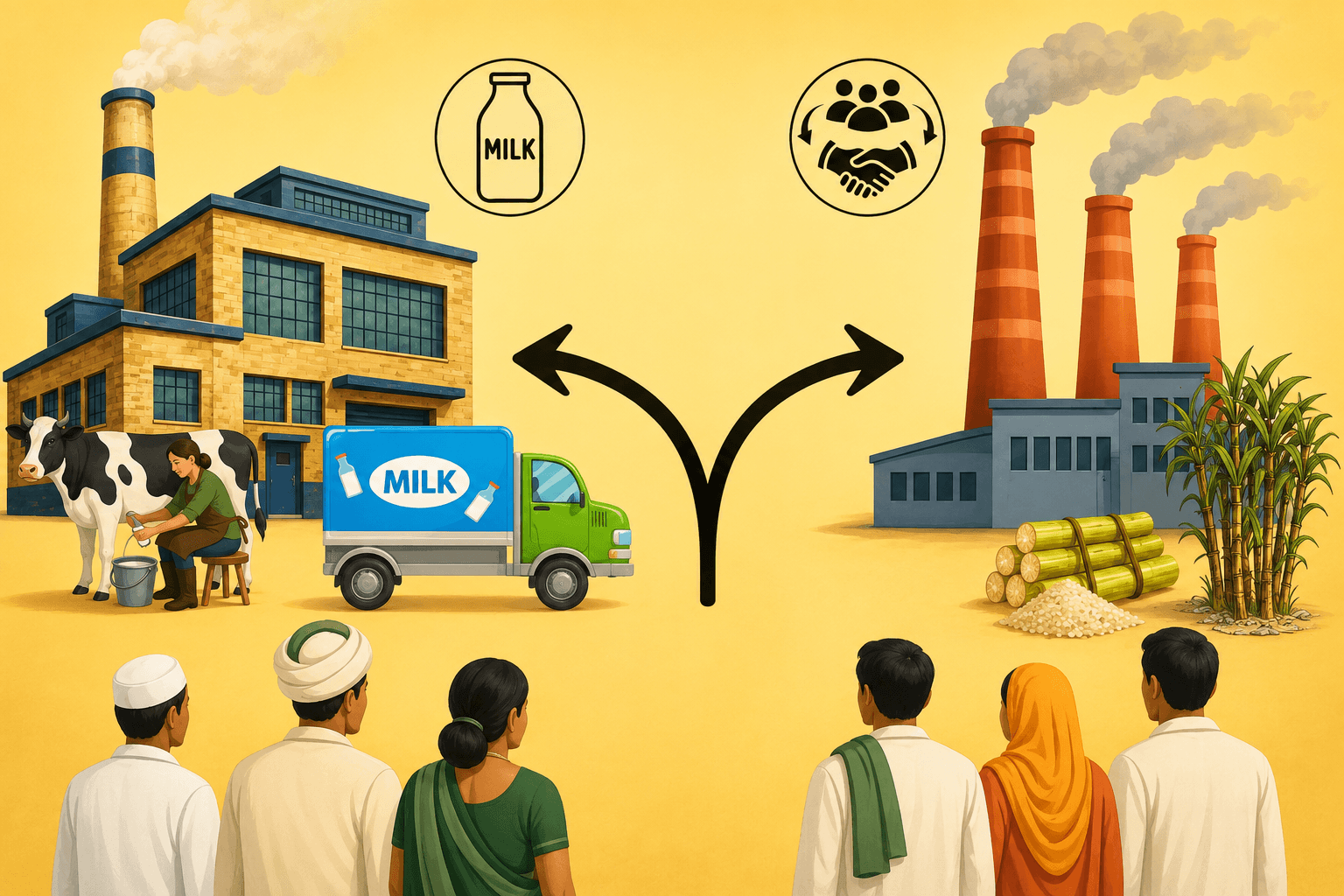
Every discussion on reviving India's distressed cooperative sugar mills eventually returns to the same question: why has sugarcane, unlike milk, never produced its own Amul? Both are rural commodities produced largely by small farmers and well-suited to cooperative organisation. Yet one became a global template for farmer-owned enterprise, while the other remains a byword for politically captured, financially distressed cooperatives. The difference lies less in the crop itself than in the political, social and economic institutions built around it.
Why Amul Worked
Amul's success rested on three mutually reinforcing forms of legitimacy. Political equity was provided by Sardar Vallabhbhai Patel, who in 1946 encouraged Kheda's milk farmers to organise their own cooperative rather than continue selling through a private dairy monopoly. Social equity came from Tribhuvandas Patel, whose patient organisation of village societies ensured that every producer, regardless of caste, community or landholding, had a stake in the institution.
The economic equity – the element sugar cooperatives have struggled to build – came from Verghese Kurien. More than a technologist, Kurien became the professional executive who transformed a farmers' cooperative into a nationally competitive enterprise. He built processing capability, created a nationwide marketing system, institutionalised the three-tier Anand Pattern, and ensured that producers, rather than intermediaries, captured the largest share of consumer value.
No single leader could have built Amul. It required a political leader who established legitimacy, a social organiser who built participation, and an independent professional who converted both into a commercially successful institution.
Sugar's Missing Manager
India's cooperative sugar sector never lacked political leadership. If anything, they produced it in abundance.
Unlike milk, cane must be crushed within a day or two of harvest, making processing inherently centralised. The investment required for crushing, cogeneration and, increasingly, ethanol production runs into hundreds of crores of rupees. Control, therefore, concentrates at the mill rather than remaining dispersed among village-level producer organisations.
Studies of Maharashtra's sugar sector show how this concentration encouraged political capture. Those who controlled access to finance and state support gradually converted cooperatives into vehicles for patronage rather than professionally managed businesses. Chairmanships became stepping stones to political office, while commercially sound management remained secondary to electoral considerations. Politically connected mills also tended to pay higher cane prices during election cycles. The cooperative institutionalised political leadership far more successfully than it did professional management.
Why Sugar Is Harder Than Milk
The crop itself also presents institutional challenges that milk does not.
Milk is relatively homogeneous. A litre supplied by one farmer can easily be pooled with another's, allowing procurement to be decentralised through thousands of village societies while processing and marketing remain collective.
Sugarcane is different. Recovery rates vary with sucrose content, and the economics of milling depend on scale. More importantly, the capital required is concentrated at the processing stage rather than on the farm. Whereas a household can become a dairy cooperative member with one or two animals, sugar production requires expensive industrial infrastructure before value can be created.
These structural differences do not make successful sugar cooperatives impossible. They do, however, make professional management substantially more important than in dairy because decisions involving large capital investments, technology and marketing become concentrated in the mill itself.
Regulation Reinforced Weak Governance
These governance problems have been reinforced by regulation.
Cane reservation areas legally tie farmers to designated mills, while the Fair and Remunerative Price (FRP) and State Advised Prices (SAP) determine minimum procurement prices. Although intended to protect growers, together these policies have weakened competitive discipline while allowing inefficient governance structures to persist for decades. NITI Aayog has documented cane payment arrears exceeding ₹20,000 crore across multiple sugar seasons – money owed to the very farmers the system seeks to protect.
Reform, therefore, requires more than financial support. Gradually easing reservation requirements and moving towards more market-linked pricing would expose inefficient mills to competitive pressure rather than perpetual protection. Evidence from South India suggests that private-mill areas have achieved higher cane cultivation and better access to credit for smallholders than cooperative-served regions, indicating that competition can strengthen rather than weaken farmer outcomes.
Such reform, however, cannot be uniform across India. Tamil Nadu has implemented the Rangarajan Committee's market-linked pricing formula, with the state government absorbing the resulting costs. Maharashtra and Karnataka have enacted enabling legislation but have yet to operationalise it. Uttar Pradesh, where cooperatives remain more significant and private participation is relatively limited, illustrates why governance reform must proceed alongside institutional capacity rather than through deregulation alone.
Professional Management Is the Missing Reform
Ultimately, deregulation can improve incentives only if institutions possess the managerial capacity to respond.
Sugar cooperatives need professional chief executives appointed on fixed, performance-linked contracts rather than executive authority that changes with political leadership – much as Verghese Kurien's professional stewardship provided continuity at Amul.
Balrampur Chini Mills (BCML), operating under the same FRP, SAP and cane-reservation framework as cooperative mills, has consistently reported profits from sugar, ethanol and cogeneration over the past three financial years, according to its quarterly financial disclosures (2023–24 to 2025–26). The example suggests that management quality alone can materially alter outcomes even before broader regulatory reforms take effect.
Professional Management for a New Sugar Economy
The case for institutional reform is becoming stronger.
India's E20 ethanol program, expanding compressed biogas obligations and growing demand for bagasse-based electricity are transforming sugar mills into integrated bioenergy enterprises. Increasingly, the greatest value lies not only in sugar but in the multiple products that emerge alongside it.
Capturing that value requires institutions capable of making commercially disciplined investment decisions while ensuring that the benefits ultimately accrue to farmers. An undercapitalised, politically dominated cooperative is ill-equipped to achieve this. Equally, an entirely private enterprise has little incentive to share the full gains of these new value streams with producers.
A professionally managed, genuinely farmer-owned sugar cooperative – one built on political legitimacy, social participation and independent economic stewardship – is therefore not a nostalgic aspiration but an institutional necessity.
India's sugar sector lacks neither political support nor technological opportunity. NITI Aayog has already documented the structural weaknesses holding it back. What it still lacks is what Amul possessed from the beginning: professional stewardship capable of turning political and social legitimacy into enduring economic value. Until that gap is filled, India's sugar sector will continue asking why it never built its own Amul.