



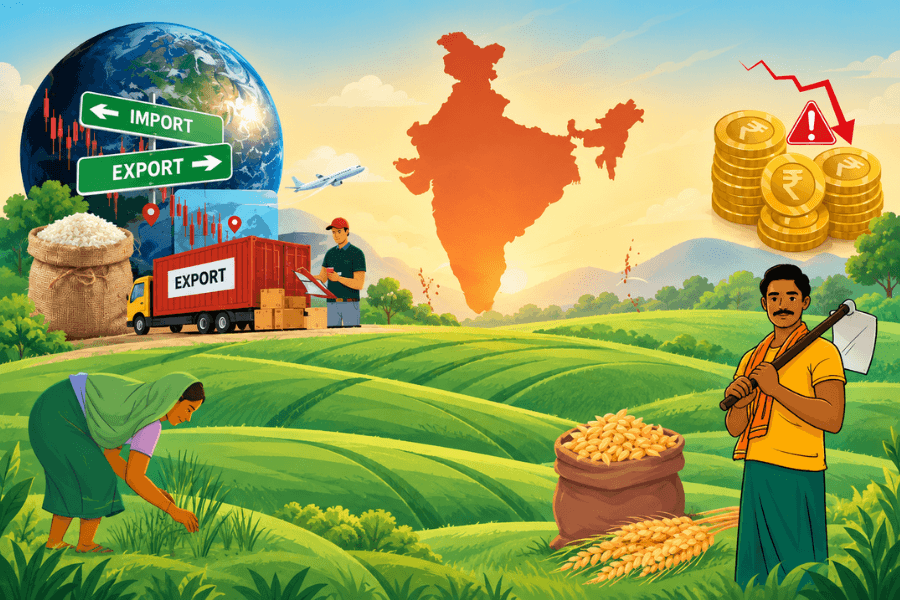
When India's fertilizer subsidy bill jumped from ₹1.31 lakh crore in 2020–21 to ₹2.55 lakh crore in 2022–23, before easing towards ₹1.68 lakh crore in the 2025–26 Budget, none of that movement reflected a policy decision taken in Delhi. It was driven instead by swings in global natural gas, phosphate and potash markets. The subsidy is budgeted as a welfare transfer – yet it functions more like an unhedged position in global commodity markets.
That changes what fertilizer security now means. For much of the past decade, India has responded to fertilizer insecurity as a problem of physical supply, commissioning six new urea plants since 2019 and promoting nano urea to stretch each tonne further. These measures have strengthened domestic production, with urea output reaching a record 314 lakh tonnes in 2023–24. Yet they leave India's fiscal exposure largely unchanged because they do little to reduce dependence on imported raw materials and global fertilizer markets.
Import Dependence Extends Beyond Finished Fertilizer
India's dependence extends well beyond imported fertilizer. It also relies heavily on imported inputs used to manufacture fertilizer, leaving the country exposed at multiple stages of the same supply chain.
Roughly one-quarter of India's urea consumption, and more than half of its di-ammonium phosphate (DAP), came from imports through the 2010s and early 2020s. The upstream dependence is even greater. Close to 90 percent of rock phosphate supply has been imported since 2010, alongside more than half of phosphoric acid requirements, while potash has no meaningful domestic source.
Phosphorus, in effect, is imported three times over: as rock phosphate, phosphoric acid and finished fertilizer. These markets are also highly concentrated. Morocco and Western Sahara dominate global phosphate reserves, potash exports are led by Canada, Russia and Belarus, while traded urea is supplied largely by the gas-rich Middle East, Russia and China. Domestic production has therefore reduced dependence on imported finished fertilizer far more than it has reduced dependence on imported feedstock and minerals.
Global Price Shocks Now Reach India Faster
Import dependence alone would not necessarily create fiscal instability if global price movements filtered slowly into India's import costs. For much of the past five decades, they largely did: import unit values were revised in large, infrequent steps. Before 2010, the month-to-month correlation between global and Indian urea prices averaged around 0.10. Since 2020, however, that correlation has averaged 0.64 for urea and 0.40 for phosphates – the highest recorded in the past half century – with price changes now passing through almost one-for-one. A global price shock can now reach India's import bill within a quarter.
Global fertilizer markets have also become both more volatile and more interconnected. Price volatility has roughly doubled since 2000, fluctuating between 28 and 53 percent through the 2010s and 2020s even when average prices changed only modestly. At the same time, spillovers across gas, phosphate, urea and potash markets have increased, with connectedness rising from about one-fifth to nearly one-third since the mid-2000s. Shocks in one market are therefore more likely to spread quickly across the others.
The Subsidy Bill Carries Two Risks
India's fertilizer subsidy is exposed to two external risks: global commodity prices and the exchange rate. Because fertilizer imports are contracted in dollars, movements in the rupee directly affect the subsidy bill. Between 2020–21 and 2022–23, the rupee weakened from 74.2 to 80.4 against the dollar, with depreciation accounting for close to a tenth of the increase in the rupee import bill. During periods of extreme commodity inflation, exchange-rate movements remain a secondary driver.
Their importance becomes clearer once global prices begin to ease. Measured in dollars, the cost and freight price of imported DAP has fallen about 11 percent from its 2022–23 peak and now sits marginally below its 2021–22 level. Measured in rupees, however, it remains 14 percent higher because the currency has depreciated by almost 20 percent since 2020–21. The weaker rupee has therefore absorbed much of the fiscal relief that lower global prices would otherwise have delivered.
Why Global Price Shocks Become Fiscal Shocks
India's pricing framework deliberately shields farmers from global fertilizer volatility. The maximum retail price of urea has remained unchanged at ₹242 for a 45 kg bag since 2018, while nutrient-based subsidy (NBS) rates for phosphatic and potassic fertilizers are revised only twice a year. Procurement costs, however, move continuously with international markets. The gap is absorbed almost entirely through the subsidy, which approached one percent of GDP at its 2022–23 peak.
The pricing structure also creates unintended agronomic consequences. Because urea is fully insulated while NBS rates adjust only seasonally, global price shocks widen the price gap between nitrogen and other nutrients. Farmers respond accordingly. The nitrogen, phosphorus and potassium use ratio has shifted from 4:3.2:1 in 2009–10 to 10.9:4.1:1 in 2023–24, with successive price shocks reinforcing the imbalance.
This is not an argument against the subsidy. Marginal and small farmers receive a proportionate share of its benefits, and abrupt withdrawal would risk the very instability the policy is designed to prevent. The real question is whether India should continue absorbing global commodity and currency risk without managing it more actively.
From Managing Fertilizer to Managing Risk
If fertilizer subsidy is increasingly shaped by global commodity and currency markets, policy must begin treating it as a fiscal risk as well as an agricultural subsidy.
The first step is institutional. Budget provisioning remains anchored largely on trend forecasts, which is why revised estimates repeatedly diverge from Budget estimates. For example, the allocation for 2024–25 increased from ₹1.68 lakh crore to ₹1.92 lakh crore through supplementary demands. Budgeting should therefore incorporate realistic ranges for commodity prices and exchange-rate movements rather than relying primarily on expected averages.
Procurement strategy should also reflect how different markets behave. Gas and phosphate markets show strongly persistent volatility, so turbulence today often signals turbulence over the following months. This allows agencies to adjust purchase timing through staggered tenders. Urea markets behave differently: prices can move from calm to violent with little warning. Such jump-prone markets are better managed through multi-year formula contracts and working buffer stocks.
Some exposure can also be reduced altogether. The five-year agreement to import 3.1 million tonnes of DAP annually from Saudi Arabia converts part of India's spot-market exposure into contracted supply. Over time, such agreements could be complemented by equity participation in overseas phosphate and potash assets, alongside longer-term gas partnerships that reduce exposure closer to the source of risk.
Risk management also depends on better market intelligence. Following the 2008 food crisis, governments invested heavily in grain market information systems to improve transparency and reduce uncertainty. Fertilizer markets, despite the disruptions of 2021–22, still lack a comparable public system for tracking trade, inventories and contract prices. Better monitoring of upstream markets could provide weeks of advance warning before fiscal pressures emerge.
The Energy Transition Raises the Stakes
The energy transition makes this challenge more urgent rather than less. Nitrogen fertilizer is, in effect, packaged natural gas, and the relationship between gas and urea prices has strengthened markedly since 2020. If gas markets remain structurally volatile, nitrogen prices are likely to remain volatile as well, regardless of their average level. Green ammonia could eventually weaken this link, but the transition itself is likely to introduce fresh volatility before it reduces it.
India cannot change its geology, nor can it quickly alter the concentration of global mineral supply. What it can change is how it anticipates, manages and absorbs these risks. For decades, fertilizer subsidy has been debated primarily as a question of how much support farmers should receive. The evidence now points to a different question: whether India's fiscal institutions are equipped to manage the commodity and currency risks on which that support increasingly depends.