



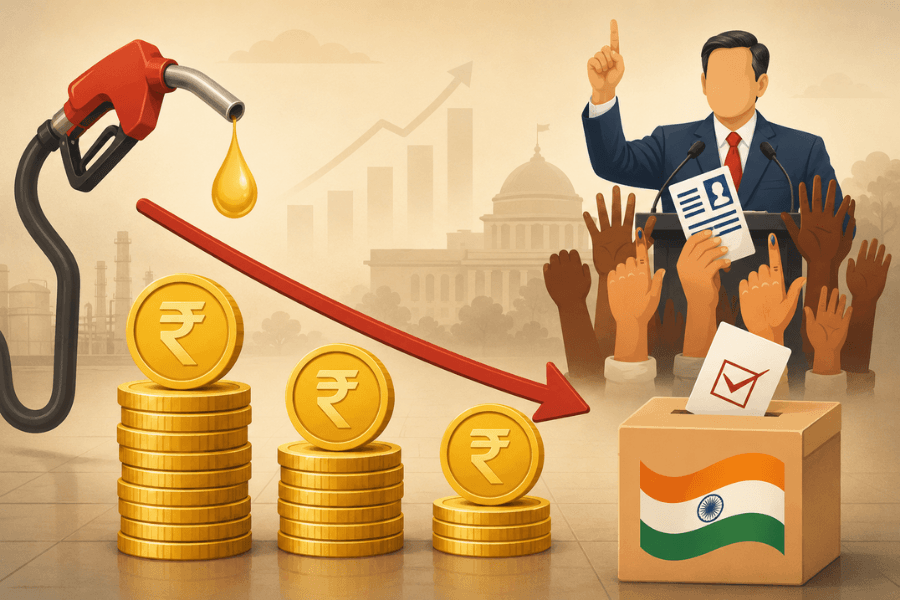
Few fiscal decisions are as visible, or as politically consequential, as changes in petrol and diesel prices. Governments may revise fuel taxes for legitimate economic reasons. But when such revisions repeatedly coincide with elections, a broader governance question arises: what does electoral timing mean for the credibility of fiscal policy?
Why Fuel Taxes Carry Unusual Political Weight
Unlike income tax or the Goods and Services Tax (GST), fuel prices confront citizens almost daily, displayed prominently at every fuel station. A change in fuel taxation combines fiscal consequences with immediate public visibility.
That visibility is reinforced by petroleum taxation’s distinctive place in India’s federal tax system. While the Union government levies excise duties, state governments retain control over value-added tax (VAT) on petroleum products. These taxes are financially significant for the states: taxes on fuel and alcohol together account for roughly 15 to 25 percent of the tax revenue that states raise themselves.
Every reduction in fuel taxes therefore carries a measurable fiscal cost alongside its potential political benefit.
What Four Decades of Evidence Show
Evidence from 29 Indian states between 1978 and 2019 shows that electoral incentives are reflected in fuel-tax policy. State governments systematically reduce fuel sales-tax rates as scheduled elections approach, with the reductions becoming most pronounced immediately before polling.
During the year preceding a scheduled election, petrol tax rates decline by approximately 1.14 percentage points, while diesel tax rates fall by about 0.77 percentage points.
The pattern is concentrated around scheduled State Assembly elections, whose dates governments can anticipate well in advance. Its recurrence across states and electoral cycles suggests more than a series of isolated responses to changing economic conditions.
How Timing, Competition and Pump Prices Shape Tax Decisions
Tax reductions are not distributed evenly across the electoral cycle. They are concentrated approximately two to four months before scheduled elections, when voter attention is likely to be at its highest. This period also typically falls before the Election Commission ’s Model Code of Conduct comes into force, restricting major policy announcements by the government in the immediate run-up to polling.
The electoral calendar is not the only source of political pressure. States facing more intense political competition also tend to impose lower sales-tax rates on petrol and diesel. This relationship becomes particularly pronounced during scheduled election years. Governments therefore appear most responsive when an election is predictable and the contest for votes is close.
Prevailing fuel prices further shape these incentives. When pump prices are already elevated, even modest reductions in state taxes become more visible to voters and potentially more electorally rewarding.
The size of the estimated reduction depends on how the pre-election period is defined. Using the broader pre-election-year measure, the estimated reduction in the petrol sales-tax rate reaches approximately 1.27 percentage points when petrol costs ₹97 per litre, the highest price observed in the sample. Using the more granular two-to-four-month window, the estimated reduction at the same price rises to approximately 1.53 percentage points.
For diesel, at the sample’s highest observed price of ₹88 per litre, the estimated reduction during the two-to-four-month pre-election window reaches approximately 1.64 percentage points.
These are percentage-point reductions in state sales-tax rates, not elasticities. Taken together, the findings indicate that fiscal intervention is strongest when it is likely to receive the greatest public attention: shortly before a predictable election, amid heightened political competition and when consumers are already facing high fuel prices.
The Institutional Cost of Discretion
Fuel taxes provide state governments with a substantial and comparatively stable source of revenue. When electoral incentives repeatedly shape the timing of discretionary tax revisions, fiscal planning can become less predictable and longer-term revenue management more difficult.
The concern is not that every pre-election tax reduction is economically unjustified. High fuel prices can strain household budgets, raise transportation costs and contribute to broader inflationary pressures. Governments must retain the ability to respond.
The institutional issue is whether the costs, duration and fiscal consequences of these decisions are made clear. Stable tax systems allow households, businesses and governments to make longer-term financial decisions with greater confidence. Repeatedly aligning discretionary tax revisions with electoral calendars can weaken confidence that tax policy is guided by consistent fiscal considerations, even when individual reductions have a defensible economic rationale.
Designing Institutions for Fiscal Credibility
Electoral incentives cannot – and should not – be removed from democratic policymaking. But because scheduled elections are known in advance, fiscal institutions can anticipate the pressures they create.
Governments should publish the expected revenue consequences of major fuel-tax revisions and explain how such decisions fit within their medium-term fiscal strategies. Public reporting should also clarify whether a reduction is temporary or permanent, how long it is expected to remain in place and how any resulting revenue shortfall will be managed.
Such disclosure would make the trade-offs visible without preventing governments from responding to changing economic conditions.
Petroleum taxation illustrates a broader institutional challenge within India’s fiscal federal system. Democratic governments will continue to respond to voters, particularly when electoral competition is intense. Fiscal credibility requires such responsiveness to be accompanied by transparent, predictable tax decisions that are consistent with longer-term fiscal objectives. That credibility matters well beyond fuel taxation, shaping public confidence in how governments exercise fiscal authority.