


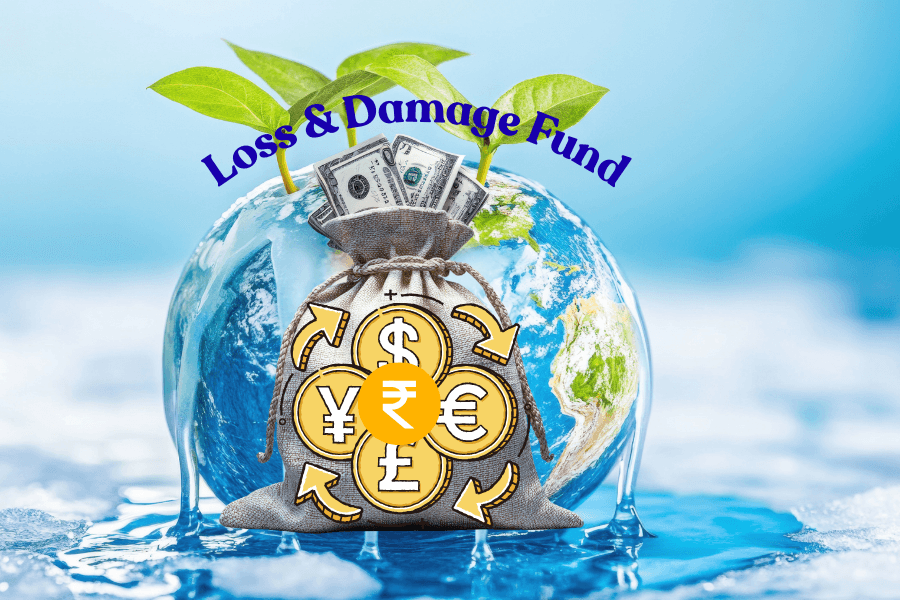
Climate change causes harms that prevention and adaptation cannot always avert. When climate impacts permanently destroy livelihoods, erase incomes beyond recovery, or force long-term displacement, the damage is no longer prospective or reducible – it is already incurred. For decades, developing countries have argued that such irreversible losses fall outside existing climate finance frameworks and therefore require dedicated global support.
The Loss and Damage (L&D) Fund marks the first institutional acknowledgement of this gap. Unlike mitigation or adaptation finance, which aim to reduce or manage future risks, L&D finance is intended to respond when climate impacts overwhelm the limits of adaptation. Its creation transforms loss and damage from a contested moral claim into an operational category of global climate governance.
As the Fund becomes operational, with its first call for proposals at COP30 in November 2025, the focus shifts from recognition to design. Early choices on how loss and damage is defined, assessed, and financed will set precedents that shape access, accountability, and delivery for years to come. The question is no longer whether loss and damage will be financed, but how, by whom, and under whose rules.
Leadership Lies in Rule-Making, Not Receipts
For India, this moment is strategically significant. Climate impacts across the country are already reshaping livelihoods, migration patterns, and development prospects. India therefore must meet the L&D mechanism not only as a vulnerable country, but also as one with the institutional capacity to shape how global climate justice is operationalised.
India is unlikely to be a major beneficiary given limited global resources and the Fund’s prioritisation of least-developed countries and small island states. But that is precisely why its influence matters. India can help determine how loss and damage is assessed, how access is designed, how funds are delivered, and how accountability is ensured – choices that will affect millions across the Global South.
Three strengths position India uniquely for this role. First is its long-standing political leadership on equity, historical responsibility, and climate justice, which continues to resonate across developing countries. Second is its deep scientific and institutional capacity in climate risk assessment, disaster management, and early warning systems. Third – and still insufficiently integrated into global climate finance debates – is India’s experience with digital public infrastructure.
Digital Public Infrastructure as Climate Finance Plumbing
How L&D finance reaches affected communities is not a technical afterthought; it is the core test of the mechanism’s credibility. Speed, verification, and transparency determine whether support mitigates harm or arrives too late to matter.
Platforms such as Aadhaar-linked identification, direct benefit transfers, and interoperable payment systems demonstrate how public finance can reach households quickly, transparently, and at scale. These systems show what effective “climate finance plumbing” can look like – where funds move efficiently from global institutions to affected households.
Consider a coastal district hit by a severe cyclone that destroys fishing equipment and housing. Under a well-designed L&D framework, satellite-based damage assessments could trigger predefined support, and compensation could be transferred directly to verified beneficiaries within days – without layers of intermediaries or leakage. India already operates comparable systems for disaster relief and social protection domestically. Scaling such models internationally could fundamentally change how climate finance is delivered.
Rebalancing Climate Knowledge: Why India Must Lead
India’s leadership in disaster resilience further reinforces its potential role in shaping how L&D is assessed and addressed. Its work on multi-hazard early warning systems, impact-based forecasting, and resilient infrastructure provides practical tools for assessing and anticipating loss and damage. This experience can help the L&D Fund move beyond ad hoc responses toward predictable, evidence-based support – particularly for non-economic losses and cascading impacts that are often poorly captured in existing frameworks. Livelihood disruption, displacement, and social loss often unfold over time and across sectors, making them difficult to capture through damage assessments focused on immediate physical impacts. Without stronger evidence systems, loss and damage frameworks risk privileging what is easily measured over what is most consequential for affected communities.
These are not neutral technical questions. How loss is defined, which impacts are valued, and what evidence is deemed sufficient are deeply political choices that shape who qualifies for support and whose losses remain invisible. Today, loss and damage methodologies are largely shaped by institutions in the Global North, often disconnected from lived realities in vulnerable regions.
India is well placed to challenge this imbalance by convening a South-led network of universities, think tanks, and disaster research centres across Asia, Africa, and Latin America. Such a consortium could strengthen attribution, valuation, and risk frameworks grounded in Southern experience, ensuring that the knowledge underpinning the L&D Fund reflects conditions where climate loss is most acute.
Why Knowledge Leadership Extends Beyond the L&D Fund
Leadership in shaping loss and damage knowledge has implications that extend well beyond this single mechanism. The norms, metrics, and evidentiary standards established through the L&D Fund will travel across adaptation finance, development assistance, and future climate negotiations, influencing how climate risk is recognised and governed.
For India, active engagement in shaping these rules strengthens its broader geopolitical positioning. It complements India’s G20 agenda, reinforces the Global Goal on Adaptation, and enhances its influence in future global stocktakes. Leadership on loss and damage is not just about climate policy; it is a source of soft power that builds trust, credibility, and negotiating leverage across development and trade forums.
A Reformist Moment in Global Climate Finance
As the L&D Fund moves from design to disbursement, the choices made now will harden into precedent. If India limits itself to participation, others will shape the rules, metrics, and delivery systems that define climate justice for decades. If it leads – by setting standards for access, accountability, knowledge, and delivery – it can anchor a more credible and equitable global response to climate loss. The window for influence is narrow, but the stakes are large.
This is not merely India’s moment to engage with loss and damage finance; it is its chance to help decide how the world responds when climate impacts overwhelm the limits of adaptation.