

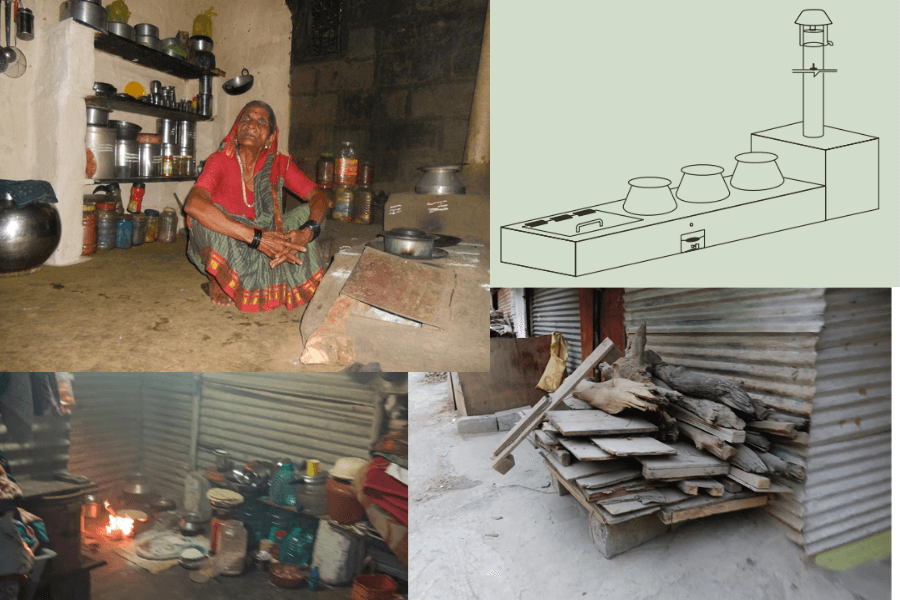
In a Bengaluru labour settlement, a woman cooks roti over a primitive wood fire while smoke fills the shed around her. A photograph was taken in 2025, showing that the practice predates the recent disruption in LPG supplies.
The scale of such cooking in Indian cities is still poorly documented. Its persistence, however, raises an uncomfortable question: why are workers still cooking this way when India developed substantially cleaner and more efficient biomass stoves decades ago?
A Technology That Had Already Travelled
In Shigehalli village in Karnataka's Sirsi taluk, Chandrakala began using an ASTRA OLE smokeless stove in 2017. She found that cooking took less time and required less firewood. Smoke and soot no longer filled the kitchen, while the stove also provided hot water for washing vessels, bathing and cooking.
Field measurements in Uttara Kannada recorded an average efficiency of 35.5 percent for ASTRA OLE, compared with 13.3 percent for traditional stoves, while average specific fuel consumption was less than half.
The stove emerged from the Application of Science and Technology to Rural Areas (ASTRA), established at the Indian Institute of Science (IISc) in 1974 ASTRA was the brainchild of Prof. A.K.N Reddy who strived to take science to the villages, to improve rural livelihoods and promote sustainable development. Prof. R. Kumar and Prof. S. S. Lokras were instrumental in the design of the biomass cook-stoves, based on principles of science and engineering. In later decades, ASTRA’s (now CST – Centre for Sustainable Technologies) work into biomass stoves explored masonry, rammed earth and metal, allowing designs and construction methods to respond to different settings.
It also travelled at scale. Between 1984 and 1997, around 1.5 million ASTRA OLE stoves were built across Karnataka through a government dissemination programme. Scientists, educational institutions and civil-society organisations participated in taking the technology into villages and tribal areas. The wider National Programme on Improved Cookstoves subsequently reported tens of millions of improved stoves disseminated across rural India.
“The lesson was that the technology had to be designed around the circumstances in which people would actually use it. Different settings demanded different solutions, responding to cooking needs and availability of resources and skill to build the stove and biomass to run it” says Monto Mani, Professor at IISc.
That principle makes the history relevant again. Applied to an urban migrant worker, it produces a very different design problem.
The Urban Worker Changes the Design Problem
A migrant worker may live in a temporary labour shed today and move to another construction site a few months later. Cooking may happen in a confined space. Fuel may be free but arrive as discarded construction planks rather than stove-ready firewood. Burning discarded construction planks could release toxic fumes from paints and other additives in them. Ensuring that fumes don’t accumulate indoors is crucial. Storage is limited, and the user may have little time or incentive to maintain a complicated installation.
For this user, “appropriate technology” means something different.
“For a migrant worker, a fixed installation may already be the wrong starting point. The stove has to move with the user, work with the random and odd-sized fuel actually available and remain simple enough so that using it does not create another financial and/or health burden,” says Somashekar H.I., Project Manager at IISc.
The original ASTRA work had already recognised that different users and settings could require different configurations. The challenge is therefore to adapt the original design principle to urban conditions shaped by mobility, constrained space and irregular fuels. Efficient energy use is thus difficult to achieve, and ensuring healthy toxic-free use of the stoves takes precedence.
That also means recognising an economic reality that clean-cooking policy can miss. Around construction sites, discarded wooden planks, tree (branches) material, corrugated boxes and other biomass may be available at no cost.
Biomass remains a less desirable cooking fuel. Yet the availability of free fuel can shape the choices workers make in practice, even where LPG is accessible.
The System Around the Stove
The rural dissemination experience also created capabilities around the technology. Young people were trained to construct and maintain stoves, while organisations such as Technology Informatics Design Endeavour (TIDE) adapted IISc-derived technology through community consultation and trained local entrepreneurs. TIDE reports more than 50,000 biomass-based cookstoves installed across India and work spanning more than 300 villages.
“The stove travelled because people developed the ability to build it, adapt it and keep it working. That surrounding capability was part of the technology's success,” says Vivek, an independent researcher.
The experience of Oorja, a socio-commercial endeavor using gasification and sale of pellets to track usage, shows why this matters. More than 400,000 improved biomass stoves were sold between 2006 and 2010, yet a later study of 998 purchaser households found that only 9 percent were still using them. Pellet prices had risen, availability had fallen and the fuel-distribution network had weakened.
The lesson for an urban programme is stark: a stove can succeed technically and still fail as a system.
For a mobile urban population, that system may need to extend across the full chain of actors who manufacture, supply, service and, where necessary, relocate the product.
This also changes how success should be measured. The number of stoves distributed is less important than whether workers continue to use them, beneficially, after the initial intervention has ended.
From Standards to an Urban Delivery Model
A mobile population may favour greater standardisation than the earlier rural model. Mass-produced combustion chambers and safety-critical components could make performance more consistent, facilitate testing and simplify replacement.
At the same time, the product needs enough flexibility to accommodate different fuels, cooking practices and living conditions. The aim is to standardise performance and safety while retaining adaptability around the user.
India already has IS 13152 (Part 1):2013, Portable Solid Biomass Cookstove (Chulha) – Specification, alongside a testing framework covering parameters including thermal efficiency, carbon monoxide and total particulate matter. Emerging codes need to contend with pollutants such as microplastics and endocrine disrupting chemicals (EDCs) released from scavenged biomass sources that are infused with synthetics.
“A standard can turn terms such as ‘efficient’ and ‘smokeless’ from claims into measurable performance. That matters when governments, employers or CSR programmes have to identify and procure products they can trust,” says Vivek.
The policy problem lies in connecting tested performance with a product and delivery model suited to urban workers.
Fuel preparation is another practical constraint. Construction timber often comes in long, hard planks, while efficient stoves may require much smaller pieces. Chopping or sawing facilities could therefore form part of community or employer support. Safety checks on the likely synthetics (fire-retardants, binders, etc.) in the use of construction planks as fuel source is still unsupervised/overlooked (as it is free).
An urban pilot might combine a portable stove with fuel preparation and storage, basic user training, maintenance and information on correct operation and ventilation. Employers or CSR programmes could support some of these functions.
LPG should remain central to India's clean-cooking transition. Access, however, can coexist with continued biomass use, particularly where workers face very different costs across available fuels.
Where biomass is already being burned, the immediate question is whether primitive combustion can be replaced by tested, substantially more efficient and safe technologies while the shift to cleaner fuels continues.
Making the Technology Travel Again
India can build on decades of work showing that biomass can be burned far more efficiently and with substantially less smoke than in a primitive open fire.
What has changed is the user – and therefore the system that must surround the technology.
“The priority is to understand what prevents a proven idea from reaching this user – and then design that missing link in the chain,” says Somashekar H.I.
The earlier technology travelled because researchers, governments, organisations and users created the conditions in which it could be built, adapted and maintained.
The urban worker now needs a different chain.
The technology has travelled before. The policy challenge is to help it travel again.