

Having grown up across Assam, Kolkata, and Baroda, Sharmishtha Khanapur was exposed early to India’s uneven development realities. Trained in biochemistry, she began her career in India’s emerging biopharma ecosystem. A defining moment came when, as a young student, she wrote to Kiran Mazumdar-Shaw after seeing her on television. The reply led her to Biocon, and into a career that would span nearly three decades across some of India’s leading pharmaceutical firms.
Across organisations such as Dr. Reddy’s Laboratories, Sun Pharma, and Mylan, she repeatedly found herself building from scratch: setting up labs, teams and processes for biopharma/life sciences R&D. It was not a linear progression, but a consistent role: designing systems that could operate at scale.
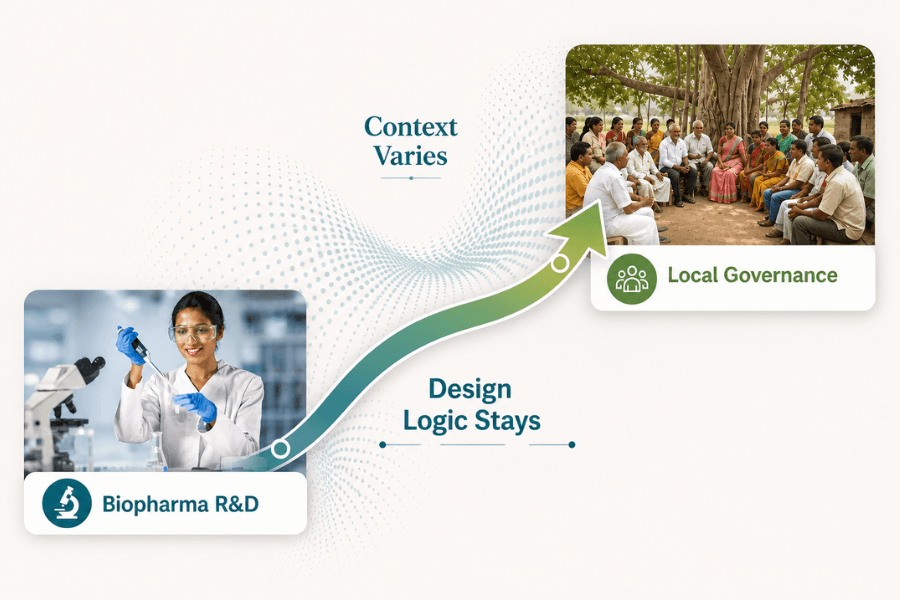
That same orientation later shaped her work in rural development, where she worked on strengthening panchayat-level planning and governance systems with grassroots partners of Mission Samriddhi. The sector has changed. The logic of her work has not.
The shift between the two roles began with a question about what it means to see impact.
Building Systems, Seeing Distance
India’s biopharma sector is globally competitive in development, but less so in original discovery. Much of its strength lies in producing generics and biosimilars at scale, making therapies more widely available and affordable relative to originator drugs.
The model works. It delivers measurable public good and strengthens India’s position in global pharmaceutical supply chains.
But it also creates distance.
The scientist who designs a molecule rarely sees the patient who uses it. Impact is real, but mediated, distributed across systems, institutions, and markets.
“I was doing work that contributes to health outcomes,” Sharmishtha reflects. “But I couldn’t see the impact directly.”
Over time, that distance became the central question.
Why Impact Needed a Different Design
The turning point was not a rejection of the system, but a search for proximity.
Even where costs are reduced, treatments often remain out of reach for large sections of the population. Affordability improves, but access does not fully follow.
“Even if you reduce the cost, it is still not accessible to many,” she notes.
This revealed a deeper distinction. Public good delivered through markets is not the same as experienced impact. One operates at scale; the other is visible, immediate, and relational.
“The question was not whether impact existed,” she says. “It was whether I could see it.”
That question did not remain abstract for long. It led her to step out of the corporate sector and into a space where systems and outcomes were closer together.
From Pharma to Panchayats
The transition was neither immediate nor clearly defined.
For nearly a year, Sharmishtha explored the development sector by speaking to organisations, travelling, and trying to understand a field she had no prior exposure to. Conversations with practitioners such as Mirai Chatterjee of SEWA opened up possibilities, but did not translate into immediate roles.
That unfamiliarity is not unusual. Unlike early-career shifts, mid-career transitions into the development sector remain largely unstructured. There are few institutional pathways for professionals to move from corporate systems into public ones. Learning, instead, is built through immersion.
“I knew very little about Gram Panchayats and even less about what a Gram Panchayat Development Plan is,” she recalls.
Her eventual entry into Mission Samriddhi came at a time when the organisation itself was still evolving. The role was not predefined; it took shape through the work.
Translating Design Across Contexts
Her first major engagement was an action research initiative on gram panchayat planning, in partnership with the National Institute of Rural Development and Panchayati Raj.
Implemented across Assam, Chhattisgarh, and Maharashtra, the project focused on strengthening the community-centric process behind preparing Gram Panchayat Development Plans (GPDPs). While the domain was new, the challenge was familiar: building systems from the ground up.
The transferability of skills became immediately evident.
Designing workflows, building teams, setting up monitoring systems, and structuring operations proved equally relevant in rural development. These capabilities had been honed in biopharma.
“Every new role was like building a startup,” she says. “Operational capabilities travel across sectors, even when domain knowledge does not. What changes is the context; what remains is the logic of design.”
From Projects to Program Design
As Mission Samriddhi expanded its work, a new constraint emerged: fragmentation in how its interventions were organised across geographies and themes.
Interventions were spread across geographies and themes without a unifying structure. The need was not for more projects, but for a programmatic design that could scale.
This led to the development of the Cluster Development Program (CDP), anchored on a broader Community Development Framework (CDF), and designed as a “common minimum program” that could be adapted across contexts while maintaining a shared framework.
Its initial rollout coincided with the pandemic, forcing training and coordination to shift into modular, digital formats. What began as a constraint accelerated standardisation and expanded reach.
“The experience demonstrated that scale is not achieved by expansion alone,” Sharmishtha reflects. “It requires standardisation of processes and learning systems before replication becomes viable.”
Where Policy Breaks Down
Working at the level of panchayats brought her face-to-face with the limits of policy design. The architecture is extensive; the constraint lies in its use.
At the level of elected representatives, awareness is often minimal. Training programmes exist, but are frequently one-time, procedural, and disconnected from lived realities.
“They are often done as a tick-the-box exercise,” she notes. “Capacity-building is treated as an event, rather than a process.”
The consequences are systemic. Schemes remain underutilised, funds unspent, and planning processes weak. The issue is not policy availability, but institutional capacity.
Seeing Change Up Close
If the biopharma system created distance, this work created proximity.
She recalls a woman sarpanch from Sonbhadra, Uttar Pradesh who participated in Samriddhi Yatra: an experiential exposure visit to Kerala. Initially hesitant, she gradually found her voice through peer exchange and facilitation.
That shift translated into action. She contested elections again, articulated development priorities, and began to lead.
Such transformations are small in scale, but significant in implication.
“Exposure can trigger non-linear change when combined with agency,” Sharmishtha emphasises. “It reshapes not just outcomes, but self-perception.”
From Practice to Policy Integration
As grassroots initiatives mature, the question is no longer about isolated success, but systemic integration.
India’s development architecture has expanded the front end: schemes, funding, and intent. The next frontier lies in strengthening the institutional layers that make these usable.
Capacity-building must become continuous and localised, not episodic and centralised. Mentorship must be embedded within governance systems. Cluster-level frameworks can bridge scale and context. Grassroots organisations must be recognised as partners within formal policy structures.
The challenge is not designing schemes. It is designing the institutions that make them work.
For practitioners like Sharmishtha, the journey is not about moving between sectors, but about translating systems thinking across them, until impact is not only delivered, but also seen.