

India plants trees at scale, but the development value of plantation depends on whether public expenditure creates an environmental asset that survives beyond the planting event.
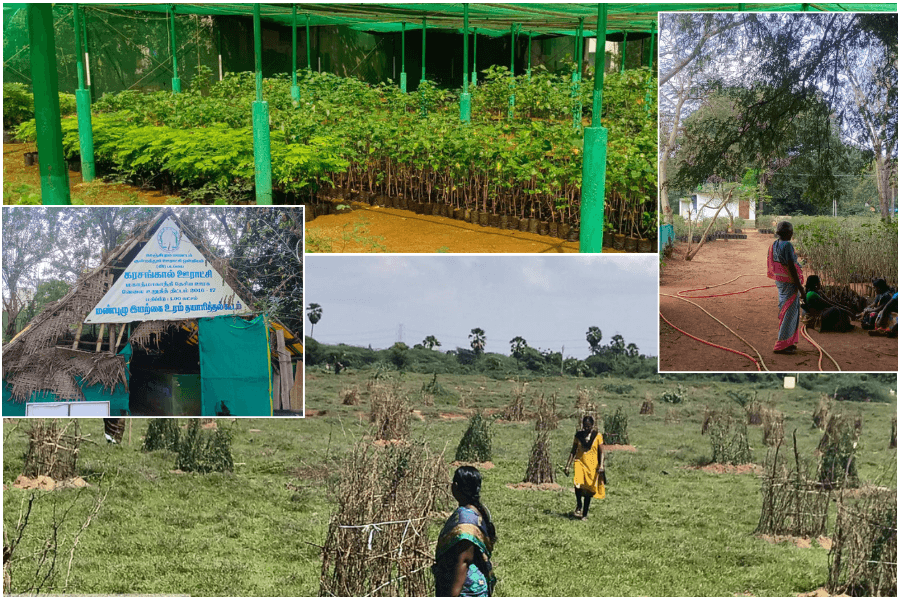
Tamil Nadu's Block Nursery initiative offers an example of how a large public employment programme can pursue this objective. Since 2022-23, the Government of Tamil Nadu has developed 388 Block Nurseries under the Mahatma Gandhi National Rural Employment Guarantee Scheme (MGNREGS), in convergence with the Anaithu Grama Anna Marumalarchi Thittam-II and panchayat funds.
A field study of four nurseries – at Karisangal in Kancheepuram, Gunaramanallur in Tenkasi, Devanallur in Tirunelveli and Morai in Tiruvallur – by Abiya Jose, Shadrach Sharon B. and R. Vijayaraghavan from the Centre for Research in Schemes & Policies (CRISP) examines how the model works in practice. Based on interactions with MGNREGS functionaries, workers, panchayat representatives and community members, the cases show how land use, convergence, maintenance and local administrative choices determine whether the resulting asset endures.
“The important shift is from treating plantation as an activity to treating the tree as an asset. Once that becomes the objective, the question is no longer how many saplings are planted, but whether the public investment creates something that lasts,” reflects Vijayaraghavan.
Nurseries Change How Common Land Is Used
Block Nurseries are developed on panchayat or other government-owned common land, with sites placed before the Gram Sabha for approval. Labour for developing the nursery is covered under MGNREGS, while material costs are sanctioned separately.
The sites show that common land can enter the nursery programme from very different starting points. At Devanallur, two acres previously used for a livestock shelter and for dumping garbage and dung were reclaimed for the nursery. Elsewhere, however, land identified for nurseries was already supporting existing community uses.
“Common land may be formally available to the panchayat, but it is rarely unused. It is already part of village life and often supports livelihoods. Bringing it into a new programme therefore requires understanding how the community uses it,” observes Shadrach.
Convergence Creates a Local Production System
The Block Nursery brings together resources that would otherwise operate through separate rural development activities. MGNREGS provides labour for raising saplings, panchayat resources can support infrastructure, and Micro Composting Centres can supply organic manure.
Karisangal shows how this can work in practice. Organic waste collected by the panchayat is segregated and processed through nine cement tanks used for worm cultivation, manure storage and manure production. The resulting compost is then used in the nursery.
The nursery's local production system can extend beyond the resources formally brought together through convergence. At Devanallur, nearly 300 families were reported to benefit directly or indirectly, including farmers supplying manure, vendors supplying raw materials and drivers transporting saplings. The employment and economic activity associated with the nursery therefore extended beyond workers directly engaged in raising saplings.
“The value of convergence is that one intervention can create the inputs for another. Waste that would otherwise need to be managed becomes compost; that compost supports sapling production; and the saplings eventually become part of the public landscape,” reflects Vijayaraghavan.
The Tree Is Grown Before It Is Planted
The model also builds cultivation time into the plantation process. Government guidelines identify 59 indigenous species suited to Tamil Nadu's agro-climatic conditions. Saplings generally spend six to eight months in the nursery, growing to around six feet before being transplanted for Massive Tree Plantation or Avenue Tree Plantation.
The nursery therefore does more than supply saplings: it allows them to reach a more established stage before exposure to conditions at the plantation site.
Community Becomes Part of the Maintenance System
The investment does not end with transplantation. At the Avenue and Massive Tree Plantation sites visited during the study, more than 90 percent of the plants were found to be well maintained. Community members voluntarily watered trees near their homes and protected saplings from cattle, sometimes using tree branches and dried coconut leaves to provide shade.
“The programme can raise and plant the tree, but it cannot deliver every act of care that follows. The fact that residents were watering and protecting trees near their homes shows that maintenance had become part of community action,” observes Shadrach.
Local Adaptation Matters When Common Land Changes Use
The Morai experience shows why environmental objectives cannot be considered independently of existing uses of common land. Bringing 13 acres previously used for cattle grazing into the nursery reduced the area available to cattle-owning households. The panchayat responded by cultivating fodder crops on a patch of the same land for local cattle farmers.
“Environmental restoration cannot be separated from the livelihoods that depend on common land. At Morai, reclaiming the land for the nursery also changed how cattle-owning households could use it, so the intervention had to respond to both objectives,” notes Vijayaraghavan.
The fodder response was not part of the original nursery design. It emerged locally when implementation altered an existing livelihood use of the land.
Administrative Arrangements Can Shape Outcomes
Creating a living asset also requires administrative arrangements to respond to needs that change as saplings grow and vary across locations.
While labour and some material costs are sanctioned under the programme, infrastructure such as green nets and shade structures may have to be mobilised through Village Panchayat or Union Panchayat resources. At Morai, damaged green nets had not been repaired because dedicated funds were unavailable.
Timing matters as well. Saplings need to be transferred into larger bags as they grow, but delays in local procurement or the unavailability of the required sizes can leave them in bags they have outgrown.
Maintenance requirements can be similarly inflexible. Guidelines provide for watering plantation sites for 68 days a year, but a standard schedule does not account for differences in geography, weather and seasonal conditions across districts.
“The programme leaves room for local institutions to adapt the intervention, but some of the supporting requirements remain standardised. The challenge is that a rule designed for administrative consistency may not always fit the stage of plant growth or the conditions in a particular location,” observes Abiya.
From Planting Targets to Living Assets
The field experience raises a larger question for rural public works: when employment expenditure is also intended to create an environmental asset, how should success be measured?
Each nursery provides 100 days of employment to MGNREGS workers. At the Avenue and Massive Tree Plantation sites visited, more than 90 percent of plants were found to be well maintained. These capture different dimensions of the intervention – employment generated through the programme and the condition of the environmental asset created through that work.
“A programme can report how many saplings it planted, but that does not tell us whether it has created an asset. If the objective is to create trees that remain in the landscape, then survival and continued maintenance have to be part of how success is measured,” reflects Shadrach.
These conditions for durability have wider relevance under VB-G RAM G, whose framework places greater emphasis on convergence and rural infrastructure, including works related to livelihoods, water security and mitigation of extreme weather. The Tamil Nadu cases suggest that convergence in programme design is only the starting point: whether expenditure produces a durable asset ultimately depends on local decisions about land, timely access to inputs and infrastructure, adaptation to livelihood needs and continued maintenance.
For rural public works, the relevant question is therefore not only what is created during the period of employment, but whether programme design and local institutions can sustain the asset after that employment ends.