

In Maharashtra, an issue long raised by women farmers moved unusually quickly through the policy system. The M. S. Swaminathan Research Foundation (MSSRF) worked with the Vidhi Centre for Legal Policy as its legal-policy partner, alongside the Department of Agriculture and the Chief Minister’s Office, as the Maharashtra Women Farmers Empowerment Bill developed. Within about eight months of Soumya Swaminathan’s meeting with the Chief Minister, the Bill was passed unanimously by the Maharashtra Assembly with support across political parties – an unusually short journey for legislation of this scale.
For Soumya, who has led the Indian Council of Medical Research, served as the World Health Organization’s first Chief Scientist and has chaired MSSRF since 2023, the episode illustrates a recurring challenge: producing evidence and getting it used are not the same task.
“Good evidence is necessary, but it is not sufficient for public health or policy impact. It has to be presented in a form that policymakers can use, and issues such as political economy, public perception and feasibility become very important.”
The Maharashtra experience raises a larger question: what has to exist before knowledge from the ground can influence a policy decision?
Evidence Has to Be Built for a Decision
At ICMR, Soumya saw one side of this gap. Research may establish whether an intervention works, but governments must choose among alternatives while weighing affordability, feasibility and competing priorities. That thinking informed the Health Technology Assessment programme established during her tenure as Director General.
“If you have five options, which one do you pick? It cannot simply be an individual preference. You need a scientific way of prioritising among them.”
The larger lesson was that research intended to influence public action has to do more than prove that something works. It has to help institutions make choices under real constraints.
Communities Can Change the Question
The other end of the evidence chain is the community.
Soumya traces her attention to community perspectives partly to early exposure to her parents’ work and partly to what her own research later showed: community participation can alter the framing of a problem before an intervention is designed.
“Communities can see a problem very differently from a researcher. Their priorities may be different, and many of the roadblocks to implementing a programme become visible only when you understand that perspective.”
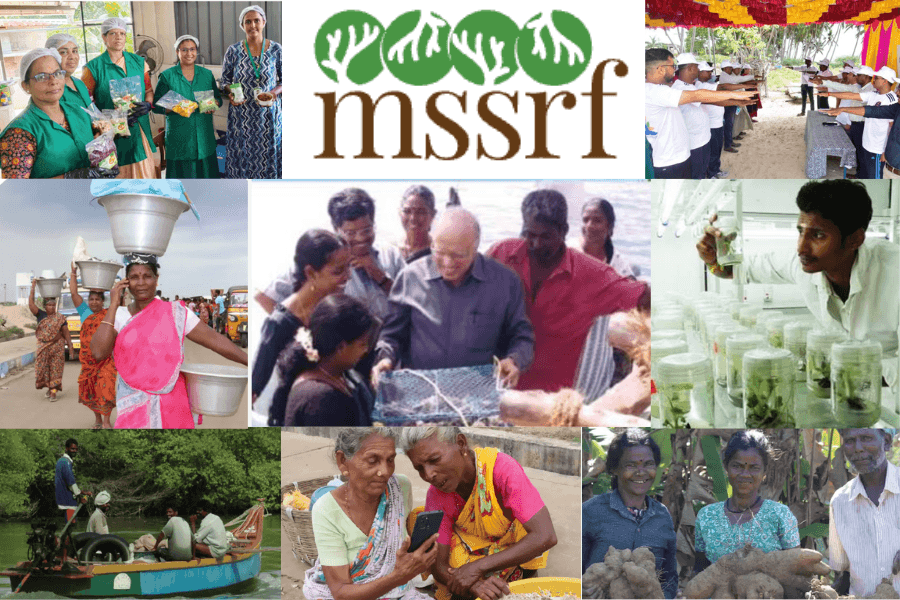
MSSRF’s coastal work makes that principle tangible. The Fisher Friendly Mobile App was developed in 2007, in response to the needs of fishermen after the 2004 tsunami, to provide an early warning in case of extreme weather hazards at sea. It has evolved in a participatory fashion, and over 51 iterations has expanded the scope of information provided to everything from fish sale prices to maritime boundaries. The App won the IUCN Tech for Nature award in 2025 for its feature of an alarm when fishermen come close to Olive Ridley nesting sites on the Odisha coast. The example is modest in scale, but it illustrates a deeper point: community participation can shape an intervention itself, not merely determine whether people accept it afterwards.
Women Farmers and the Politics of Visibility
Agriculture shows how community experience can expose a policy problem that administrative systems do not readily see.
One such case is Vaishali Ghuge, a farmer and community leader from Dharashiv who cultivates 1.5 acres but has been unable to access several government schemes and subsidies because the land is not registered in her name. MSSRF’s consultations with women farmers across Maharashtra surfaced similar barriers around formal recognition, institutional credit, water and government schemes. Soumya points to AgriStack as a contemporary example of the same underlying issue.
“AgriStack is counting farmers who have land. But that means you risk missing millions of women who are actually farming in this country without having the land in their name.”
The issue is not simply a database field. Administrative definitions determine whom the state can identify and, increasingly, who can access services built around those systems.
The Maharashtra Bill represents movement in the opposite direction: a problem experienced on the ground acquiring a route into government. Women farmers’ concerns, legal expertise, administrative engagement and political leadership converged at the right moment. Its rapid passage shows what can happen when an institutional route exists to carry a field-level problem into the policy process.
Trust Is Part of the Evidence
For tribal communities, the challenge looks different.
Soumya points to a persistent contradiction: many tribal populations live in areas rich in biodiversity yet continue to experience poor health and nutrition outcomes. Bridging this gap requires examining livelihoods, food access, ecology, public services, and social disadvantage in unison, rather than viewing indicators in isolation.
Long-term presence matters because the quality of field knowledge depends partly on the relationship through which it is produced.
“In some of our field sites, we have been present for 15 or 20 years, so trust has had time to develop. When you enter a new place, it takes time – you cannot assume that trust will develop automatically.”
She contrasts those established sites with newer geographies such as Gadchiroli, where MSSRF must first build credibility. Long-term relationships allow an organisation to understand more fully how programmes work in practice, where they fail and which problems communities consider most important.
Trust therefore shapes not only the relationship with a community, but also the quality of the knowledge produced through it. That becomes especially important when communities have limited access to senior government officials. An organisation with both a sustained local presence and access to policymakers can carry those concerns and experiences into discussions they may not otherwise reach.
Climate and Health Push the Logic Upstream
Climate-related health risks stretch the same reasoning across sectors.
Air pollution is shaped by transport, energy, industry and agriculture. Diet reflects what farming systems produce and what people can afford. Heat exposure depends on housing, work and the ability to protect oneself. For Soumya, improving health therefore means looking beyond the health sector:
“If you want to improve health, you have to look upstream. Unless air pollution is tackled and unless policies in sectors such as agriculture change, you cannot solve the health consequences downstream.”
This is also where a gender lens matters. A heat action plan, agricultural programme or fisheries policy may appear neutral while affecting women differently because work, ownership, exposure and access to resources differ. The policy response therefore often has to move outside the sector in which the eventual harm becomes visible.
The Institution Between the Two Ends
MSSRF’s role, in Soumya’s formulation, is not that of a conventional academic organisation.
“We publish because we are a science-based organisation and our work has to be rigorous. But we are not satisfied with publications alone. The final test has to be impact at the level of communities.”
The distance between communities and policymakers is often described as an information problem. MSSRF’s experience suggests something more demanding.
Community knowledge has to enter early enough to shape the problem. Evidence must be rigorous enough to command confidence but practical enough to inform a decision. Long-term relationships have to create trust. And institutions must be able to translate what they learn into forms the government can use. Soumya describes the role MSSRF plays between communities and government:
“Many communities do not have access to senior government officials. If we can listen to them, take their concerns and evidence to the government, share suggestions and show what has worked on the ground, that itself can make a difference.”
The bridge between the grassroots and the state is therefore rarely a report, a consultation or a single successful project. It is the institutional capacity to remain credible at both ends – and to make knowledge generated at one end usable at the other.