

India’s expansion of school education over the past few decades has largely been built around a familiar model: construct a school, appoint teachers and bring children into the classroom. The approach has dramatically expanded access to education across much of the country. Yet in many tribal regions, the challenge has never been simply building more schools. Villages are often small and scattered across forests and hilly terrain, making conventional schooling difficult to sustain. Recruiting teachers willing to live in such locations presents another obstacle, while constructing and maintaining formal infrastructure for every settlement quickly becomes expensive.
For organisations working in these regions, the question is how to redesign schooling delivery.
Few organisations have attempted to answer that question at the scale of Ekal Abhiyan, a volunteer-driven movement that has spent more than three decades building community-based education systems across remote tribal and rural India. Among its principal operational organisations is the Friends of Tribals Society, established in 1989 to mobilise volunteers, donors and institutional support for the movement’s work.
For Sajan Kumar Bansal, erstwhile National President and current Patron of Friends of Tribals Society, who is also the Chairman and Managing Director of Skipper Limited, the journey into tribal education began from a very different world.
His father had migrated alone from a small village in Haryana to Kolkata as a teenager, eventually building a business despite the restrictions of the Licence Raj. Sajan Kumar Bansal later joined the family enterprise, but increasingly found himself questioning what meaningful philanthropy should look like.
“If you feed someone today, they will eat today,” he says. “But tomorrow they will need food again. Education changes the future. We felt that if we wanted to create lasting impact, education was where we should begin.”
That belief eventually shaped not only his own involvement but also the philosophy that continues to guide the organisation.
Rethinking the Classroom
Many of the villages where Ekal works are home to only a few dozen families. Some are separated from neighbouring settlements by forests, hills or rivers. Under such conditions, replicating a conventional school in every habitation is neither financially nor administratively practical.
Rather than asking how more school buildings could be constructed, the organisation began asking a different question.
“The question wasn’t how to bring children to school,” Sajan Kumar Bansal recalls. “The real question was how to take education to places where a conventional school was never going to work.”
That shift in thinking led to what became Ekal’s defining innovation: the One Teacher, One School model.
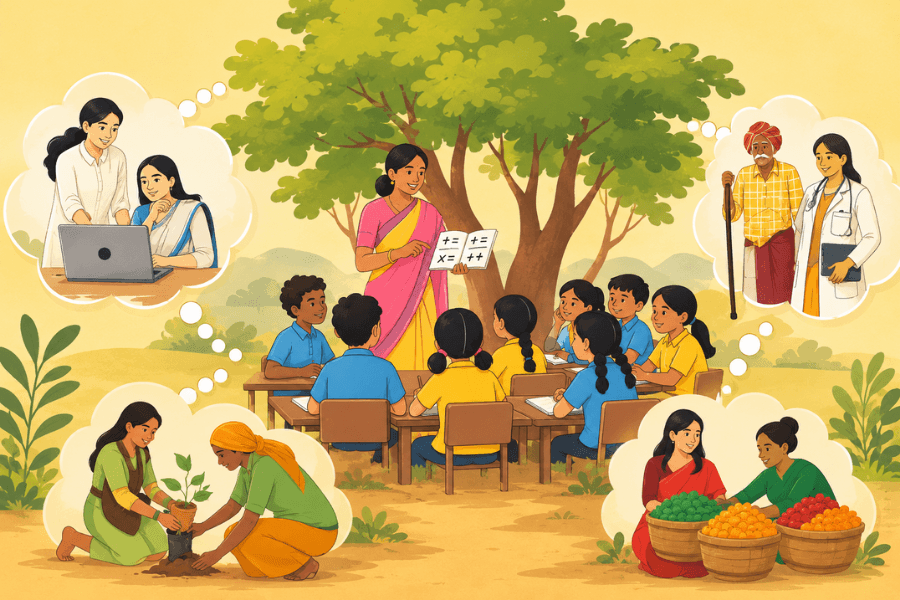
Instead of constructing classrooms, the organisation identifies an educated youth – often a young woman – from the same village or a nearby settlement and trains them to teach local children. Classes may take place under a tree, in a community space or inside the teacher’s home. The objective is not to replicate the infrastructure of a formal school but to ensure that every village has access to foundational education.
The model addresses several challenges simultaneously. Children no longer travel long distances for early education. Parents are more willing to send them because the teacher belongs to the same community. Operating costs remain low enough for the model to be replicated across thousands of villages.
“Our teacher belongs to the same village,” Sajan Kumar Bansal explains. “Parents know them, children trust them and the community accepts them. That trust is something an outsider cannot easily build.”
Scaling Through Simplicity
Designing a workable model was only the first challenge. The greater test lay in expanding it across India’s vast tribal landscape.
Friends of Tribals Society became one of the organisations responsible for building the volunteer and donor networks that enabled the movement to grow. Rather than depending on large institutional infrastructure, the organisation focused on standardising the model while keeping delivery decentralised through local communities.
“If every school required a building, permanent staff and large infrastructure, we could never have reached this scale,” says Sajan Kumar Bansal. “Keeping the model simple made expansion possible.”
Today, Ekal operates more than 89,000 one-teacher schools, serving approximately 2.34 million children, while over 10 million children have passed through its education programmes since the movement began. Its work now extends across tribal and rural regions in the Northeast, central India, Himachal Pradesh, Jammu & Kashmir, Kerala and several other states.
The scale is significant, but Sajan Kumar Bansal believes the real achievement lies elsewhere. By placing local communities at the centre of delivery rather than treating them merely as beneficiaries, the organisation has been able to expand without fundamentally changing its operating model.
When Education Becomes Community Development
As the network matured, the organisation noticed something unexpected.
“Education was only the beginning,” Sajan Kumar Bansal says. “Once the teacher became part of village life, people started coming with questions about health, sanitation, government schemes and many other issues.”
Awareness campaigns, healthcare initiatives and community mobilisation increasingly flowed through the same local relationships that had originally been created for education. This insight gradually transformed Ekal from an education initiative into a broader rural development movement.
Alongside its education programme, the organisation now works in healthcare, women’s empowerment, digital literacy, entrepreneurship and livelihood development. Its programmes have provided healthcare services to over 1.6 million people, vocational training to more than 67,000 women, digital literacy to around 92,000 young people, and livelihood support to over 1.35 million individuals.
The strength of the model became particularly visible during the COVID-19 pandemic. Existing networks of teachers and volunteers worked alongside local administrations to spread public health information, support vaccination drives and connect remote communities with essential services.
Beyond Literacy
As more children completed primary education and entered formal schools, another challenge emerged. Education raised aspirations, but employment opportunities within many villages remained limited.
For Sajan Kumar Bansal, that meant the organisation had to evolve once again.
“If children study but eventually have to leave their villages because there is no work, then our responsibility is only half done.”
That thinking has led to a growing emphasis on vocational training. Skill centres now offer courses in electrical work, plumbing, tailoring, mobile phone repair, computer literacy and spoken English. The objective is not simply to improve employability but also to help young people build livelihoods within or near their own communities.
The shift reflects a broader philosophy that education should create capability rather than simply prepare people to leave rural India.
“Our effort now is to ensure that young people can build livelihoods where they live,” Sajan Kumar Bansal says. “Education should give them choices, not simply encourage migration.”
Building Institutions Around Communities
Despite its scale, Sajan Kumar Bansal does not see Friends of Tribals Society as a substitute for government education or welfare systems. Instead, he sees its role as strengthening community capacity where state delivery often struggles to reach consistently.
“The government has its own role and its own processes,” Sajan Kumar Bansal says. “Our work is to build communities that can make better use of those systems.”
The movement does not rely on government funding for its core operations, although it has worked alongside public authorities on initiatives such as healthcare outreach and COVID-19 vaccination campaigns. Its contribution was recognised nationally when Ekal Abhiyan received the Gandhi Peace Prize in 2017.
Looking ahead, the organisation’s focus is shifting from expanding schools to strengthening integrated village development by connecting education with livelihoods, health, women’s empowerment and digital inclusion.
The evolution of the Friends of Tribals Society reflects a broader reality of last-mile development. It is often constrained not only by the availability of programmes but also by the absence of trusted local institutions that can connect communities with those programmes. What began as a one-teacher school model has gradually evolved into such an institution, suggesting that investments in community capacity can create platforms through which multiple development interventions take root.