

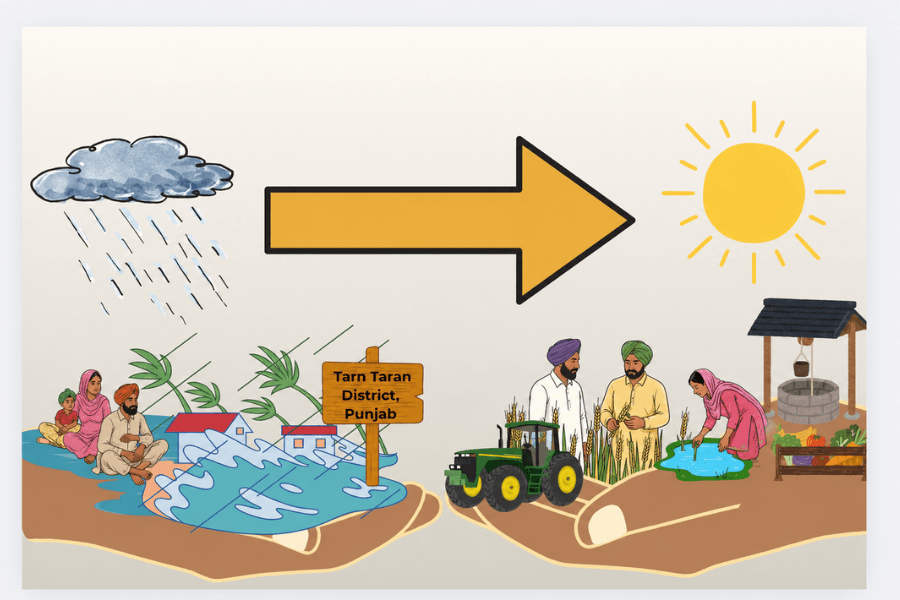
When floods swept through the downstream belt of the Sutlej and Beas river systems in Punjab in 2025, the damage was immediately visible. Across villages in Tarn Taran district, standing crops were destroyed, fertile land disappeared beneath layers of sand and silt, embankments weakened, and access routes became difficult to navigate.
In response, Shramik Bharti initiated relief and rehabilitation efforts across several flood-affected villages, supported by partners including LIC Housing Finance Limited, ATE Chandra Foundation, and PwC India Foundation. The intervention was coordinated on the ground by Varinder Pal Singh, Director of Punjab Interventions, and Prabhjeet Kaur, Manager at Shramik Bharti, who worked closely with village communities as the response evolved from immediate relief to longer-term recovery.
Yet as relief efforts began, it became clear that the crisis extended beyond damaged fields.
"What we encountered was not simply crop loss. The floods exposed fodder shortages, household expenses, debt obligations, and the uncertainty of returning to cultivation," says Varinder.
Recovery, therefore, could not be confined to rehabilitation alone. It also raised a broader question: could rebuilding reduce some of the conditions that had made the floods so disruptive in the first place?
Recovery Has a Narrow Window
The first days after the flood were dominated by immediate needs. Local youth, farmers, and village institutions helped organise distribution efforts and reach affected households quickly.
As discussions shifted from relief to livelihood recovery, one concern surfaced repeatedly across villages: how quickly damaged land could be restored and farmers could resume agricultural activity..
"After floods, the difference between recovery and prolonged distress often depends on how quickly farmers can resume cultivation," explains Varinder.
The observation carries wider implications for disaster recovery. Every agricultural season regained is a season of income, food security, and financial stability that does not need to be rebuilt later.
Approximately 1,600 acres of agricultural land were rehabilitated and more than 325 farming families were supported in resuming cultivation. The significance of these efforts lay not only in the numbers. Delayed rehabilitation can deepen financial stress and prolong dependence, while timely recovery can prevent temporary disruption from becoming sustained distress.
Recovery Creates Space For Change
As farmers reclaimed damaged land, conversations increasingly shifted from restoration towards questions about farming itself. Flood recovery created an unusual moment for reflection.
Concerns around yields, cultivation costs, and market uncertainty often leave little room to reconsider farming practices, even when farmers recognise their limitations. The disruption altered that dynamic.
“Many farmers were asking whether rising input costs and dependence on external inputs had made cultivation more fragile even before the floods. Recovery created space for those questions to surface,” recalls Varinder.
Natural farming emerged as one possible response. By reducing dependence on external inputs, improving soil health, and encouraging diversification, it offered a practical framework for strengthening preparedness while rebuilding livelihoods.
Resilience Starts Before Income Returns
Even where fields were ready for cultivation, the experience highlighted an important distinction: recovery at the farm level and recovery at the household level do not always occur at the same pace.
"When a household depends on a single source of income, every shock becomes existential. Diversification is often the first layer of resilience," says Varinder.
This understanding informed efforts to support kitchen gardens and backyard poultry alongside agricultural rehabilitation.
Kitchen gardens helped families improve dietary diversity and reduce dependence on market purchases while incomes remained uncertain. Backyard poultry provided a modest but regular source of income that was not tied to crop cycles. Women often played a central role in maintaining poultry and marketing eggs through local networks.
The experience pointed to a simple but important reality. Agriculture, nutrition, and livelihoods are often treated as separate programme categories, while households experience them as closely connected parts of everyday survival. Multiple livelihood pathways can help families navigate the period before agricultural income fully returns.
Social Capital Is Disaster Infrastructure
Throughout the flood response, another lesson became difficult to ignore.
Disaster preparedness often centres on physical infrastructure such as embankments, roads, shelters, and drainage systems. These investments remain essential, but the experience in Tarn Taran highlighted another form of infrastructure that receives far less attention: local social capacity.
"Disasters do not wait for external agencies to arrive. The first responders are almost always the people who are already there," says Varinder.
In village after village, recovery depended on relationships of trust, local leadership, and informal communication networks. The rehabilitation process therefore focused on strengthening village-level youth groups and coordination mechanisms. WhatsApp-based communication systems were developed and volunteers were organised around preparedness activities.
The objective was not to build entirely new structures, but to strengthen capacities that already existed within communities.
Preparedness Is Built Between Disasters
As rehabilitation progressed, the most important shift was not only physical, but conceptual.
The flood demonstrated that vulnerability rarely emerges from a single event. Fragile livelihoods, ecological stress, limited income diversification, and weak preparedness often interact long before disaster strikes. By the same logic, recovery cannot depend on isolated interventions alone.
Land rehabilitation, natural farming, livelihood diversification, and youth mobilisation addressed different challenges, but together they strengthened communities’ capacity to absorb and recover from future shocks.
"Preparedness is not a programme; it is the cumulative result of investments in livelihoods, institutions, ecological systems, and community capabilities," reflects Varinder.
As climate-related disasters become more frequent, restoring the status quo may not always be enough. Communities can recover from one shock while remaining vulnerable to the next.
The experience in Tarn Taran points towards a different possibility. Recovery is also a moment of diagnosis – a period when underlying vulnerabilities become visible and communities have an opportunity to ask what needs to change before the next crisis arrives.