

Across much of rural India, access to basic healthcare remains uneven. Patients often ignore early symptoms until conditions worsen, travelling long distances to reach care only when illness becomes serious.
But the difficulty is not only medical. Many villages also offer few avenues for stable local livelihoods beyond seasonal or informal work. The absence of local health services and the absence of stable work often reinforce each other.
For Meena Ganesh, an IIM Calcutta alumna who has built companies across India’s technology, education, and healthcare sectors, these realities were not abstract policy concerns but patterns she had observed across the health ecosystem. She now serves as a trustee at Bahaar Foundation, which seeks to address both challenges together.
When Meena and her colleagues began shaping the foundation after the pandemic, their starting question was straightforward: could improving healthcare access also create local livelihoods?
Their answer was to build healthcare access around local entrepreneurship: training trusted villagers to deliver basic screenings and preventive services, and ongoing monitoring for chronic conditions within their own communities.
“Healthcare in India has long operated between two extremes: either you go to a hospital, or you do nothing at all,” Meena observed. “What is missing is a layer of care inside the community itself.”
Testing the Model in Bastar
Bahaar Foundation’s approach to linking healthcare access with local livelihoods began as an experiment. The team chose Bastar district in Chhattisgarh for its first pilot, a region known for difficult terrain and limited public services.
For Meena and her colleagues, Bastar offered a demanding test: if the model could work where healthcare access was especially constrained, it could travel elsewhere.
The pilot benefited from early collaboration with organisations already active in the region and from engagement with local Panchayati Raj institutions. These partnerships helped the foundation navigate local conditions, and build initial community acceptance.
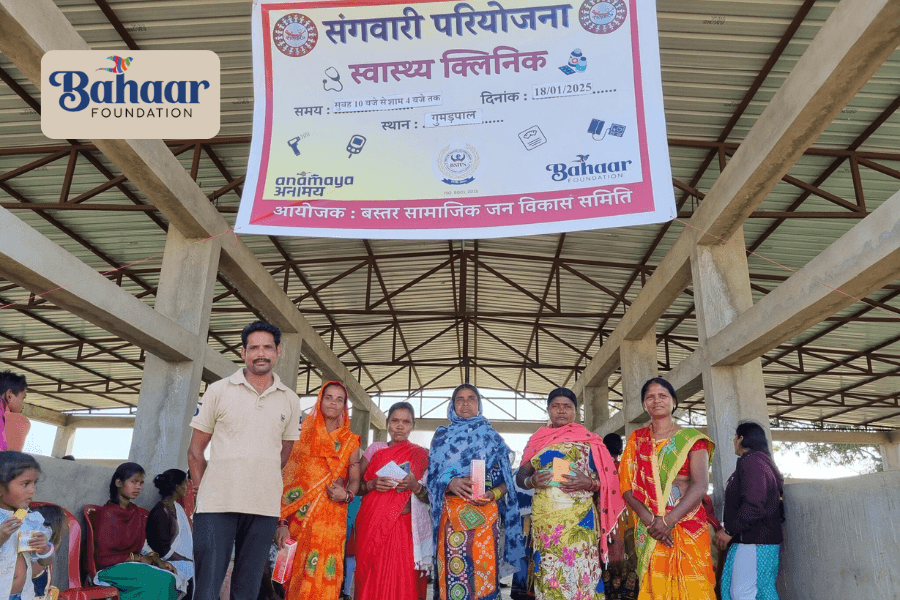
The first phase focused on identifying local women who could become community health entrepreneurs. With training and simple diagnostic tools, they began visiting households and conducting screenings such as blood pressure, blood sugar, anaemia, and vision tests, and supporting follow-up monitoring for chronic conditions.
The process required considerable experimentation. Building trust within communities, identifying suitable entrepreneurs, and ensuring that services remained both useful and financially viable took time
“We made mistakes along the way,” Meena acknowledged. “But those early lessons helped us refine how we select villages, identify the right entrepreneurs, and build local support systems.”
Over time, those lessons crystallised into what Bahaar now calls its Community Health Entrepreneur (CHE) model.
The Community Health Entrepreneur Model
The CHE model identifies women with strong standing in their villages and trains them not only in basic health awareness but also in communication and entrepreneurship.
Equipped with simple diagnostic devices and supported by a digital platform, these entrepreneurs provide doorstep services within their communities. For many households, these screenings represent the first point of contact with basic healthcare.
The Bastar experience clarified three design principles.
First, the entrepreneurs needed to be local women already known within their communities. Familiarity helped build trust and encouraged families to adopt preventive health practices.
Second, services needed to be priced modestly rather than offered free of charge. Charging small fees allowed the entrepreneurs to earn income while ensuring the services remained affordable. For Bahaar, this distinction was important: the goal was to create livelihoods, not charitable outreach.
Third, the network needed to remain flexible, allowing additional services – such as referrals, patient transport, and government health campaigns – to be layered onto it as entrepreneurs built relationships within their communities.
For Meena, this philosophy is central. “The whole idea is to enable women with skills they can monetise.”
The model’s impact is visible in both healthcare access and livelihoods. Communities gain easier access to basic diagnostic services, while women create new livelihood opportunities within their own villages.
In Bastar alone, Bahaar’s CHEs – locally known as Sangwaris – serve roughly 50,000 people across multiple villages. Their monthly earnings typically range between ₹1,500 and ₹5,000, depending on their level of activity.
Scaling Through Partnerships
Building on the Bastar pilot, Bahaar started extending the approach to other regions. Expansion does not follow a fixed template – the model adapts to local institutional contexts through collaborations with district administrations, research institutions, and state-level livelihood programs.
Within Chhattisgarh, the initiative now operates beyond Bastar in districts such as Raipur and Jashpur. In Raipur, Bahaar works with local administrative structures to train community workers – known as Swachhata Sakhis – as healthcare entrepreneurs, building on existing networks of community engagement.
In Jashpur district, the model incorporates a research dimension. Bahaar collaborates with St. John’s Medical College in Bengaluru and AIIMS Raipur to investigate the causes of anaemia beyond iron deficiency, including infections, dietary patterns, and nutrient absorption. The effort combines community screening with research to inform more effective public health responses.
Outside Chhattisgarh, the model is being introduced through partnerships with development organisations. In Bareilly, Uttar Pradesh, Bahaar works with the social impact organisation MRIDA to integrate the Community Health Entrepreneur approach into existing rural development initiatives.
The most extensive expansion is currently underway in Punjab. There, the initiative operates through a partnership with the Punjab State Rural Livelihood Mission (PSRLM) and the state’s development commission. Self-help group networks help identify potential entrepreneurs, while public health institutions provide technical training and support.
“Every region teaches us something new,” Meena reflects. “The model works best when it adapts to local realities.”
Policy Lessons from Bahaar
Bahaar Foundation’s experience suggests that expanding basic healthcare does not always require building entirely new institutions. In many cases, it involves organising capabilities that already exist within communities and linking them more effectively with public systems.
One lesson lies in the role of livelihood networks. Across India, large-scale programs such as self-help groups and rural livelihood missions already connect millions of women through organised community structures. Training members of these networks as community health entrepreneurs offers a way to strengthen healthcare access while creating local livelihoods.
Another insight concerns the value of community-level data. Through Bahaar’s Saath mobile application, community entrepreneurs record screenings, referrals, and follow-up visits. When aggregated responsibly, such information can help local health authorities identify emerging patterns – from anaemia prevalence to chronic disease risks – adding a new layer of local public health intelligence.
For Meena, the broader implication is straightforward. “Community entrepreneurship can serve as a distributed frontline for preventive healthcare, extending the reach of public systems while remaining rooted in local economies.”
Together, these lessons suggest that community-based entrepreneurship can act as an adaptive layer within the healthcare system – strengthening access to care while creating new pathways for local economic opportunity.
The Path Forward
For Bahaar Foundation, the objective extends beyond running individual projects. The larger aim is to demonstrate an approach that others – governments, nonprofits, and social enterprises – can adapt across regions.
Replication does not mean copying a fixed template. The experience across Bastar, Chhattisgarh, Uttar Pradesh, and Punjab suggests that the model works best when it evolves through local partnerships and institutional contexts.
For Meena, that openness to adaptation is central. “Like in startups, this idea should be replicated by others. If more people adopt it and improve it, that is success for us.”
The Bahaar experiment points to a broader possibility: the missing link between households and healthcare systems may not always be another facility, but a trusted entrepreneur embedded within the community.