



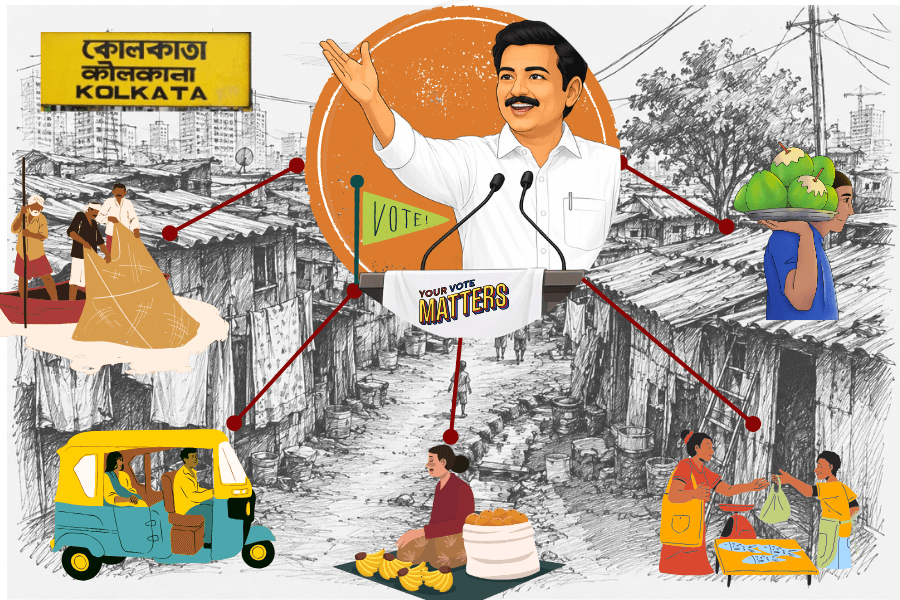
In many of India’s urban slums, access to work depends not only on skills or education, but also on political networks, local leaders, and how closely elections are contested. A daily wage job, a small shop, or a contract-based role can hinge on the connections linking households to local representatives. Evidence from Kolkata’s slums suggests that electoral incentives shape who gets work, what kind of work becomes available, and how households navigate the informal economy.
This matters because it shifts the question from how jobs are created to how access to them is mediated.
How Electoral Incentives Shape Work
Three features of municipal elections influence how work is distributed within slums.
Where elected representatives enjoy strong electoral mandates, local economic networks tend to stabilise. In such settings, households are more likely to move into petty businesses or private sector work. The probability of running a petty business rises significantly as electoral margins increase, alongside a modest rise in women’s participation in the workforce.
This pattern changes when elections become closely contested. Representatives facing tighter competition have stronger incentives to spread work more broadly, particularly in forms that can be offered quickly. Unskilled labour becomes easier to access in such contexts. It becomes a quick way of distributing livelihood support across a wider group of households.
However, these gains do not expand uniformly when competition becomes fragmented across many candidates. Under highly competitive and fragmented conditions, the probability of working as an unskilled labourer declines sharply by about 19.8 percentage points. At the same time, occupations that rely more heavily on networks, such as truck driving and related work, become more likely, increasing by about 5.6 percentage points.
Political alignment between municipal representatives and the ruling party at the state level further shapes labour access. Aligned councillors are better positioned to connect households to opportunities beyond the slum itself, including work linked to wider political or administrative networks. Where such alignment is absent, households rely more heavily on local informal activities such as petty trade and neighbourhood services.
From Labour Access to Household Welfare
Differences in labour access translate into measurable differences in household welfare. Both stronger political clout and greater electoral competition are associated with higher per capita expenditure and food spending. An increase in electoral margin is linked to a rise of roughly ₹200 in per capita expenditure and about ₹500 in food spending. Competitive and fragmented political settings also increase household expenditure by roughly ₹100 to ₹190 per capita.
These effects extend beyond consumption to inequality within slums themselves. Greater political competition is associated with lower inequality, suggesting that representatives facing tighter electoral pressures distribute opportunities across a broader section of residents. By contrast, political misalignment with the ruling party at the state level is associated with higher inequality, reflecting weaker access to public resources, employment networks, and state-linked opportunities.
Why Redistribution Does Not Ensure Mobility
Yet politically mediated access to work does not necessarily improve the quality of employment. The strongest effects are concentrated in unskilled and informal occupations where entry barriers are low and opportunities can be distributed quickly through local networks.
Between 2012 and 2021, the share of households engaged in labour-based work declined from 44 percent to 37 percent, while participation in petty business rose by about 9 percent. These changes indicate movement within informal work categories rather than transition into higher-productivity employment.
Skilled and semi-skilled occupations remain largely unaffected by electoral conditions. Access to such work continues to depend more heavily on education, training, and capability formation than on political incentives. As a result, households may experience short-term improvements in income and consumption without securing long-term mobility.
The distinction is important because redistribution and mobility are not the same. Political mediation can widen access to livelihoods, but without sustained investment in skills and capability, households remain concentrated in low-return informal work.
Moving Beyond Patronage-Based Access
India’s urbanisation is increasingly shaped by informal growth, giving municipal institutions a larger role in determining who gains entry into work and small-scale economic activity. As electoral competition intensifies, the economic influence of local political networks is likely to deepen further.
The policy challenge is therefore not simply job creation, but reducing dependence on discretionary allocation. This requires building systems where entry into work does not depend heavily on proximity to political intermediaries.
Urban employment programmes can be linked more closely to skill development rather than short-term labour distribution. Municipal bodies can simplify and formalise entry into petty businesses and informal services through clearer licensing and registration systems, reducing the need for local political mediation in everyday economic activity. Greater coordination between municipal institutions and state-level employment or welfare programmes can also widen access to work beyond neighbourhood political networks.
Without that transition, political access may improve short-term livelihoods without enabling long-term upward mobility.