


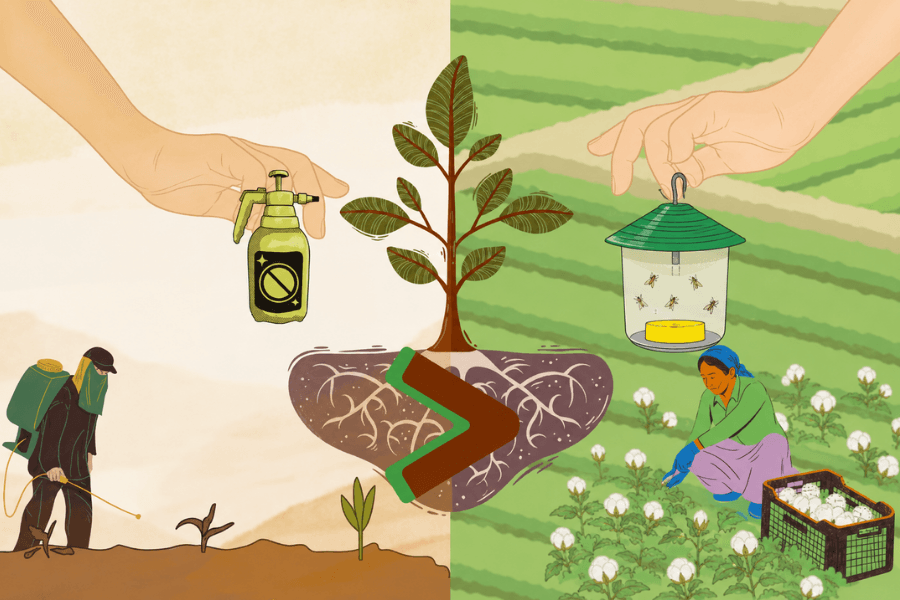
India consumes nearly 62,000 tonnes of chemical pesticides annually, and pesticide-intensive cultivation continues to shape farming practices across much of the country. Crop losses from pests, diseases and weeds are still estimated at 10-20 percent across major crops, costing the economy between Rs.1.7 lakh crore and Rs.3.42 lakh crore annually. Resistance in pests such as pink bollworm and whiteflies is already exposing the limits of chemical-heavy farming systems. Yet for millions of farmers operating under debt pressure and climatic uncertainty, chemical pesticides continue to offer speed, visibility and a degree of predictability during crop stress. Indian agriculture, as a result, remains structurally dependent on chemical pesticides.
At the same time, policymakers and agribusiness firms are increasingly promoting biological alternatives such as microbial pesticides, pheromone traps, neem formulations and other bio-based crop protection systems. India now has more than 1,500 registered biopesticide products, while the domestic biologicals market is expanding by nearly 15-20 percent annually. Export-oriented agricultural clusters are also showing greater interest in residue-free cultivation as international standards tighten around pesticide use.
India’s push toward sustainable agriculture is entering a difficult transition. Even as policymakers promote biological pest control, natural farming and residue-free production, the institutions governing cultivation continue to favour chemical-intensive production systems.
The problem extends beyond awareness or technology adoption. It reflects a deeper mismatch between ecological transition and the systems that continue to shape Indian agriculture.
Biologicals Are Not Plug-and-Play Technologies
The Indian policy conversation often treats biological pest control as a cleaner replacement for chemical pesticides. Biologicals, however, do not behave like industrial inputs. Their effectiveness depends heavily on ecological conditions, pest cycles, timing and field-level management.
A microbial pesticide that performs well in Karnataka’s humid vegetable belts may produce inconsistent results in the hotter and drier conditions of Rajasthan. Temperature, UV exposure, humidity and spraying schedules all influence efficacy. Unlike synthetic pesticides, biological controls rarely produce an immediate “knockdown effect”. Their success depends on continuous monitoring, repeated application and ecological balance.
This makes biological pest control far more knowledge-intensive than conventional pesticide use. Farmers must understand pest thresholds, beneficial insects, trap crops and application timing. Biologicals are therefore not “plug-and-play” technologies. They require coordinated advisory support and local adaptation.
That distinction matters because India’s current agricultural system was built around standardised chemical responses. Input dealers, spray practices and farmer expectations evolved around technologies that promised visible and immediate control. Ecological technologies require a different support ecosystem.
Farmers Are Managing Risk, Not Rejecting Sustainability
Policy discussions frequently assume that farmers hesitate to adopt biologicals because they are conservative or insufficiently aware. Smallholder behaviour, however, often reflects economic vulnerability and the need to manage production uncertainty within a single crop season.
Consider cotton farmers in Vidarbha, where Integrated Pest Management programmes promoted pheromone traps and biological controls against pink bollworm. Many farmers initially adopted these methods because they reduced pesticide expenses. Severe infestations, however, often pushed them back toward chemical spraying because biological methods did not deliver immediate visible results.
For a farmer cultivating two acres under debt pressure, delayed efficacy creates exposure with direct consequences for household income. When a single crop season determines annual earnings, speed frequently matters more than sustainability.
India’s ecological transition encounters its central constraint here. Biological agriculture places greater transition costs and crop-loss exposure on farmers at a time when farm incomes remain fragile and climate-related risks are intensifying. Adoption is therefore likely to remain uneven unless advisory systems, markets and public institutions absorb part of this burden.
Sustainable Farming Still Operates Inside a Chemical System
Even where farmers are willing to experiment with biologicals, surrounding support systems often reinforce chemical dependence.
One major problem is product credibility. Scientists and extension workers increasingly acknowledge that many biopesticides sold in rural markets suffer from low microbial viability, contamination and weak storage conditions. A single failed application can permanently erode farmer confidence, particularly when pest pressure is already high.
The extension system is equally poorly aligned with ecological farming. Biological control requires pest scouting, threshold monitoring and integrated field management. Yet in many regions, the most influential village-level advisor is an input retailer rather than a trained extension officer. Retailers naturally promote products that generate quick and repeated sales, usually synthetic pesticides.
Government programmes advocate reduced chemical dependence, yet cultivation remains embedded in commercial systems that reward rapid chemical response. Farmers are therefore expected to navigate ecological transition individually even though cultivation practices, advisory networks and input markets continue to favour conventional pesticide use.
The result is clear: sustainability receives strong rhetorical support, but cultivation systems continue to reward pesticide-intensive farming.
Farmers Adopt Biologicals When Incentives Align
Export-oriented agriculture offers a useful counterpoint to the idea that farmers resist biological alternatives.
In Maharashtra’s grape sector, biological pest management has expanded rapidly because export markets impose strict pesticide residue standards. Similar trends are visible in pomegranate clusters and high-value vegetable supply chains linked to organised buyers. Markets that reward residue-free production create stronger incentives for farmers to invest in ecological practices despite the additional management complexity.
Farmers growing crops for export markets receive clearer economic rewards for reducing chemical dependence. Farmers cultivating rice, wheat or soybean for domestic commodity markets rarely receive comparable signals.
Adoption therefore rises when institutions lower transition costs and reward ecological outcomes through procurement systems, market access and price incentives.
Climate change is widening this divide. New pest outbreaks, shifting pest ecology and rising resistance are increasing dependence on repeated spraying even as pesticide effectiveness declines. Excessive chemical use, in turn, destroys beneficial insects and weakens natural pest regulation, creating a cycle of escalating vulnerability.
India’s current agricultural model is becoming harder to sustain both economically and ecologically.
Sustainability Requires Institutional Risk-Sharing
Biological pest management cannot function as a drop-in substitute for chemical agriculture because it depends on ecological coordination rather than chemical certainty. A viable transition therefore requires stronger quality regulation for biological inputs, field-level extension systems capable of ecological advisories, digital pest surveillance, locally adapted demonstrations and market incentives that reward residue-free production.
Ecological agriculture becomes more viable when institutions share transition burdens, build trust and align incentives across markets, advisory systems and regulation.
The key challenge is no longer identifying biological alternatives. It is building regulatory, advisory and market institutions that allow farmers to adopt them without bearing the full cost of transition.