



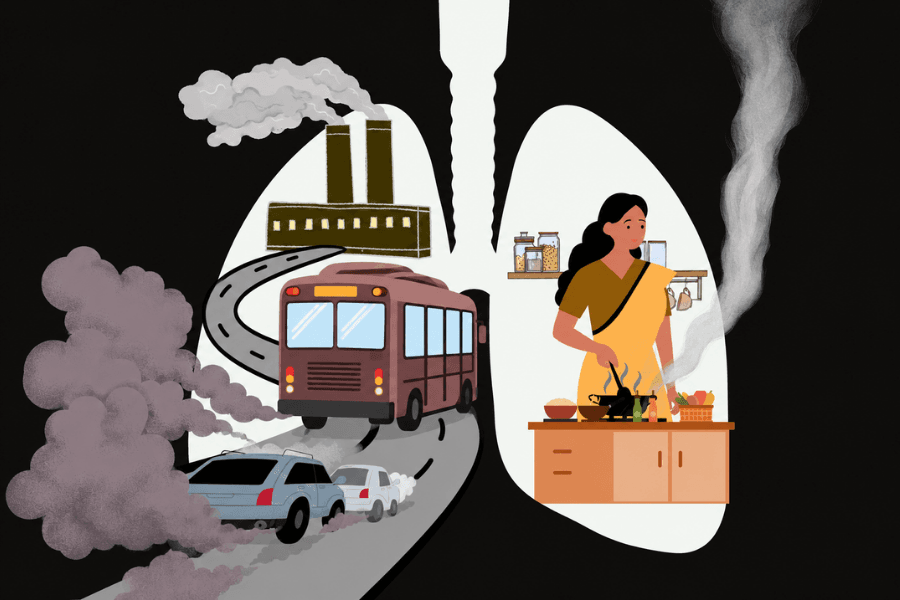
India’s air pollution policy is primarily built around outdoor air quality. But health risk depends on total exposure – what people breathe both outside and inside the home. That distinction matters because household air pollution (HAP), generated by the use of solid fuels for cooking, remains a major source of exposure.
Reducing fine particulate matter (PM2.5) to India’s current standard of 40 μg/m³ would avert about 118,000 deaths annually. Tightening this to the World Health Organization’s interim targets would raise that to 264,000 deaths at 25 μg/m³ and 397,000 at 15 μg/m³. These are substantial gains. But they still understate what is at stake in India, where pollution exposure is shaped not by outdoor air alone, but by the combination of outdoor and household sources.
In 2019, over 70 percent of Indians faced unsafe outdoor air, while 56 percent of households used polluting fuels at home – exposing many people to pollution both outside and indoors.
Cleaning Outdoor Air Isn’t Enough
At high levels of combined exposure, reducing pollution from one source alone does not produce proportionate health gains. This is why even large declines in outdoor PM2.5 – over 45 μg/m³ in Uttar Pradesh and 37 μg/m3 in Bihar – translate into only modest reductions in mortality risk when HAP remains high.
The point is not that outdoor air policy does not work. It does. But when household exposure remains elevated, a large share of the health gains from cleaner outdoor air remains unrealised because reductions in damages are smaller at higher exposure levels and larger at smaller exposure levels. A policy framework focused only on outdoor concentration therefore captures only part of the benefit.
The Biggest Gains Come From Tackling Both Sources Together
The picture changes sharply when reductions in outdoor air pollution are paired with a 50 percent decline in solid fuel use. Under India’s current PM2.5 standard, avoided deaths rise from 118,000 to more than 310,000 annually. Under the WHO’s 25 μg/m³ target, they rise from 264,000 to more than 500,000. At the most stringent level, combined action could save nearly 680,000 lives each year.
This is not simply an additive effect. Because health risks do not rise in proportion to exposure, reducing pollution across multiple sources moves people out of the highest-risk range far more effectively than acting on one source alone.
The economic gains are equally striking. Meeting outdoor air standards alone yields benefits of about 0.85 percent to 2.9 percent of GDP, depending on stringency. When combined with reductions in HAP these gains rise to 2.2 percent, 3.6 percent, and 4.9 percent of GDP – effectively doubling or tripling the economic payoff. These estimates are conservative: they capture only reductions in premature mortality, not wider gains from reduced illness or improved productivity.
Policies Targeting Total Exposure, Not Just Outdoor Air Would be More Effective
India does have programmes for both outdoor and household air pollution. However, there is potential to improve their gains by aligning them with each other.
The National Clean Air Programme (NCAP) targets outdoor PM2.5 reductions in non-attainment cities, while the Pradhan Mantri Ujjwala Yojana (PMUY) has expanded access to clean cooking fuels. But these schemes still operate largely in silos, even though both shape the same public health outcome: how much pollution people are exposed to overall.
Combining the two policies would yield higher gains.
First, air quality planning under NCAP can be strengthened by moving beyond outdoor concentration targets and incorporating HAP into exposure assessment. This would require inventories and monitoring frameworks that better capture indoor exposure, especially in peri-urban and low-income settlements.
Second, achieving clean cooking outcomes requires policy approaches that extend beyond connection expansions to sustained use of clean fuels. PMUY has expanded LPG access, but continued reliance on solid fuels limits its health impact. Refill affordability, supply reliability, and behavioural transition now matter as much as initial access.
Third, the largest total gains from combined policies can be realised in regions where combined exposure is highest, particularly across the Indo-Gangetic Plain and states such as Uttar Pradesh, Bihar, and West Bengal. In several of these regions, combined indoor and outdoor exposures exceed 125–150 μg/m³, among the highest levels globally. This is where integrated action can deliver the largest health and economic returns.
Finally, air quality and household energy policy can benefit from shared incentives, shared monitoring, and shared evaluation of outcomes. As long as these remain institutionally separate, policy will continue to target individual sources rather than total exposure.
Clean air policy in India is still anchored to what can be measured more easily. But health outcomes are shaped by total exposure, not outdoor air pollution alone. Until that distinction is built into policy design, India will continue to underestimate both the scale of the problem and the gains from solving it.