



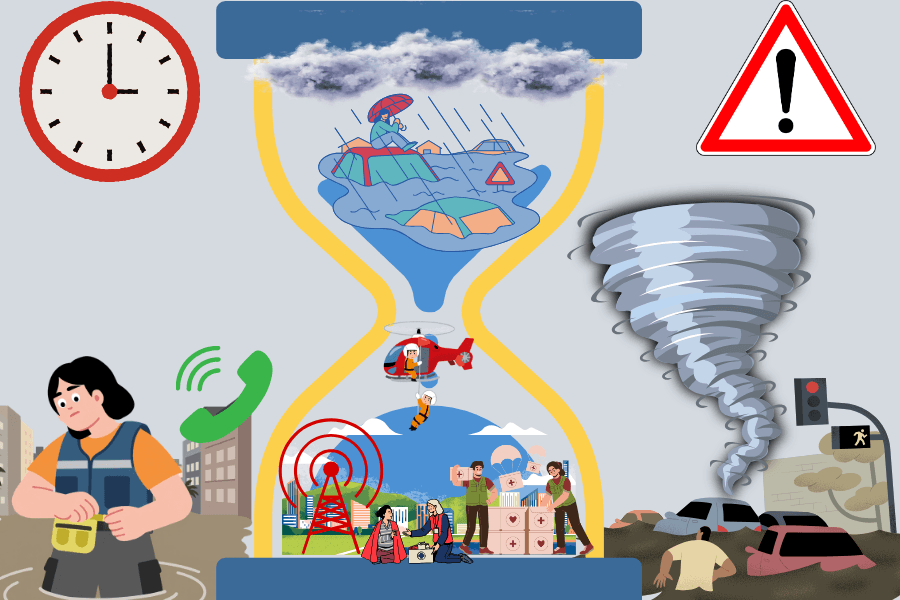
Disasters are often judged by their scale: how intense a cyclone was, how widespread a flood became, or how many districts were affected. Yet the real determinant of disaster outcomes is often not scale, but timing. The first hour after a hazard strikes frequently determines whether risks remain localised or evolve into cascading failures involving infrastructure disruption, water contamination, livelihood losses, and public health stress.
At the centre of this challenge lies a critical but under-recognised policy variable: response latency, which is the time between hazard onset and organised action reaching affected populations. India has made substantial progress in forecasting systems, early warning dissemination, and institutional response capacity over the past decade. However, the time gap between impact and effective response remains uneven, especially in regions where terrain, infrastructure damage, communication disruption, or the scale of impact delays mobilisation.
Designing for Time Gaps
Response latency is not incidental; it emerges from the structural design of disaster response systems themselves. Professional response agencies depend upon mobilisation, transport, communication networks, and physical access, all of which inevitably introduce delays between hazard onset and operational action on the ground.
These delays are not necessarily failures of governance; rather, they are structural characteristics of disaster response systems operating across large and geographically diverse settings. In a country like India, with dispersed populations, difficult terrain, dense urban centres, and multi-hazard exposure, some degree of delay is unavoidable even when institutional capacity exists.
The policy challenge, therefore, is not merely to strengthen professional response forces, but to reduce the functional gap between impact and action. This requires a response architecture in which some level of operational capability is already present at the point of impact before external mobilisation arrives.
Such an approach implies a layered response model that combines specialised national and state-level forces with locally available responders capable of functioning during the earliest and most time-sensitive phase of disasters.
A Distributed Response Layer
India’s response to this challenge has taken institutional form through the Aapda Mitra and Yuva Aapda Mitra programmes. These initiatives embed trained community responders within the formal disaster management framework, creating a distributed layer of local response capacity across hazard-prone regions.
Over time, this has evolved into a nationally coordinated and spatially distributed response network. By 2024, more than 337,000 trained responders had been deployed across over 400 districts exposed to floods, cyclones, landslides, heatwaves, and other climate-related hazards.
These responders are trained in essential early-response functions such as evacuation assistance, basic first aid, hazard awareness, crowd management, and facilitation of access for authorities. Their dependence on local knowledge, community familiarity, and minimal equipment enables them to function even under conditions where roads, communications, or transport systems have been disrupted.
This locally embedded presence changes the operational dynamics of the first hour after impact. High-risk populations can be evacuated earlier, injuries can be stabilised more quickly, and locally relevant information can be communicated before external response teams arrive. Rather than substituting formal disaster response systems, this distributed layer complements them by extending operational reach into the most time-sensitive phase of emergencies.
When Response Is Already Present
Between 2018 and 2024, more than 140 response operations involved these community responder networks, with approximately 3,600 trained volunteers mobilised during major disaster events and over 80,000 individuals assisted.
Administrative records also suggest indicative reductions in early coordination time: from roughly 60 minutes to around 40–45 minutes in selected cases following programme expansion. While causality may vary across events, these trends suggest improvements in early-stage coordination and faster initiation of organised response.
Even incremental reductions in this interval can significantly influence outcomes. Earlier evacuation reduces exposure, quicker stabilisation of injuries lowers mortality risks, and faster coordination improves alignment between local conditions and formal response systems. The evidence increasingly suggests that community responders are becoming operationally integrated within India’s disaster governance architecture.
The Scale-Preparedness Trade-Off
Expanding a distributed response system across a country as large and diverse as India inevitably introduces a trade-off between geographic coverage and preparedness depth. Wider coverage increases the probability that trained responders are available across hazard-prone districts, but maintaining consistent readiness across such a large network becomes institutionally more complex.
Administrative records indicate that approximately 65 percent of trained responders have participated in refresher training or simulation exercises. This points to uneven continuity in preparedness engagement, particularly for skills that require periodic reinforcement and practical rehearsal.
The policy challenge therefore lies not only in expanding networks, but also in institutionalising preparedness through regular drills, district-level integration, simulation exercises, and operational feedback from actual deployments. A distributed network remains effective only when scale is matched with sustained preparedness.
India in Comparative Context
Community-based disaster response systems exist globally. The United States operates Community Emergency Response Teams (CERT), Japan has highly developed Bosai community preparedness systems, and several European countries integrate volunteer structures within civil protection frameworks.
India’s approach differs in its emphasis on large-scale geographic coverage across a highly diverse risk landscape. While many international systems prioritise training intensity and frequent local drills, India’s model prioritises the geographic availability of basic response capacity across districts.
This reflects a context-specific governance choice. In a country characterised by population scale, climatic diversity, uneven infrastructure, and recurrent multi-hazard exposure, ensuring the early availability of response capability across space becomes a foundational requirement.
Making Latency a Policy Variable
Treating response latency as a formal policy variable requires a shift in how disaster governance systems are evaluated. Existing performance metrics often focus on post-disaster losses, aggregate response capacity, or relief distribution. While these indicators remain important, they do not adequately capture how quickly organised action begins after hazard onset.
More meaningful indicators include the local availability of trained responders, continuity of refresher engagement, early-stage coordination efficiency, and integration between community networks and district administration.
Embedding such metrics within district preparedness audits and disaster governance frameworks would enable systems to be evaluated not only by capacity, but also by responsiveness during the most time-sensitive phase of disasters.
This also carries broader governance implications. Integrating trained community responders more systematically into early warning dissemination, local planning mechanisms, and district-level coordination structures can significantly improve responsiveness without altering institutional hierarchies.
From Programme to Infrastructure
As climate-related risks intensify, the systems that act first, not merely those that respond best, will increasingly determine resilience outcomes.
India’s experience suggests that community-based response, when institutionally embedded and scaled, can function as a foundational component of disaster governance. By enabling immediate stabilisation and early coordination at the point of impact, such systems reduce the likelihood that initial shocks escalate into wider infrastructure, health, economic, or governance failures.
The next phase lies in consolidation: transforming community response networks from programme-based interventions into permanent layers within national response architecture. Without this transition, delays during the first critical hour will continue converting manageable hazards into large-scale disasters.