



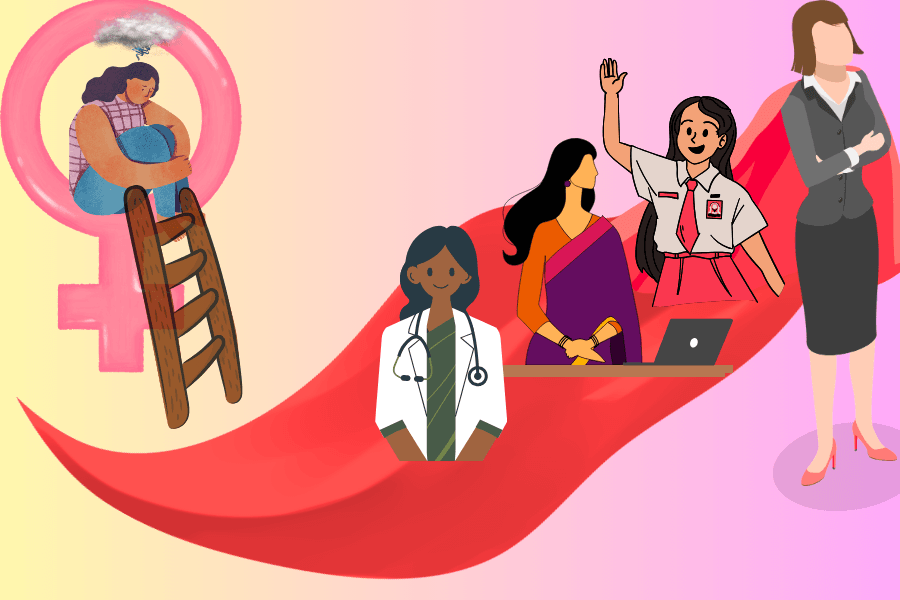
India has expanded access to education, public health systems, and political representation over the past five decades. These gains are visible in wider service coverage and deeper institutional reach. Yet improved access has not produced comparable gains in outcomes. Structural inequality continues to shape who benefits from these systems, how, and to what extent.
This gap is reflected in the Global Gender Gap Index 2025, which measures disparities across economic participation, education, health, and political representation. India ranks 131 out of 146 countries, slipping two places from 129th position in 2024. The contrast points to a persistent constraint: policy expansion has not kept pace with the social and institutional conditions that determine real outcomes.
Why the Gap Persists: Design and Social Norms
Over time, India has built an extensive network of schemes across health, livelihoods, and social protection. These programmes have expanded access and improved baseline indicators. But disparities in outcomes remain, indicating limits in how these systems are designed and delivered.
The Gender Social Norms Index provides part of the explanation, showing that a majority of India’s population holds at least one bias against women. The constraint, therefore, lies in how services are accessed, negotiated, and used within unequal social structures.
Policy design reinforces this limitation. Women are often treated as a uniform category, even though their experiences are shaped by caste, education, age class, geography, religion, and other socioeconomic and demographic markers. These factors influence access to services, decision-making power, and economic opportunity. When policy design does not account for this variation, similar interventions produce uneven results.
Understanding inequality as layered rather than uniform clarifies why expanding access alone cannot resolve disparities.
Health Outcomes Reflect Social Norms
Women’s health outcomes are shaped not only by the availability of services, but by the conditions under which those services are used. Social norms within households and communities influence when women seek care, what resources they can access, and how much autonomy they exercise.
Public health policy has historically prioritised maternal and reproductive health, contributing to improvements in institutional deliveries and immunisation. However, areas such as menstrual health, mental health, and reproductive autonomy remain unevenly addressed.
Community-based interventions illustrate what changes outcomes. Accredited Social Health Activists and self-help groups have improved outreach, built trust, and reduced information gaps. These efforts indicate that outcomes shift when interventions reshape information flows, trust, and decision-making within communities.
Climate Risk Is Structurally Gendered
The same dynamics extend beyond health. Climate vulnerability is often framed in environmental terms, but exposure is mediated by social and economic roles. In many parts of India, women are central to agriculture, water collection, and household energy management. These roles increase their exposure to risks such as water scarcity, erratic rainfall, and resource depletion.
While policy frameworks recognise these vulnerabilities, women’s participation in climate decision-making remains limited. This creates a gap between those most affected by climate change and those shaping responses to it.
Evidence from the ground suggests a different pathway. Women-led initiatives in climate-resilient agriculture, including the revival of millet cultivation, have strengthened food security while adapting to worsening climatic conditions. Community-led water management has improved access and reduced vulnerability to drought. Training programmes enabling women to assemble and maintain solar energy systems have expanded both energy access and livelihoods.
In these cases, participation shapes how climate strategies are designed, adopted, and sustained.
What This Evidence Reveals About Policy Design
Across both health and climate, a common constraint emerges in how policy engages with social context. Outcomes improve when interventions engage with how people access, interpret, and use services within their social context.
Community-based organisations have developed approaches across sectors that align more closely with lived realities. These models draw on local knowledge, collective action, and sustained engagement. In health, participatory education strengthens women’s ability to understand and articulate their needs. In climate action, locally driven initiatives integrate environmental sustainability with livelihood security.
Cross-sectoral policy reforms in health and climate action need to incorporate intersectional frameworks that recognise how gender interacts with caste, class, disability, and other forms of social disadvantage. Embedding this understanding into programme design can help marginalised groups overcome barriers and participate more effectively in development processes.
Current policy design still tends to deliver solutions into communities rather than building on existing social structures, local knowledge systems, and lived realities. While intersectionality has increasingly shaped global and local feminist discourse over the past two decades, it remains insufficiently integrated into mainstream policy and programme design for gender equality.
From Uniform Delivery to Layered Policy Design
Addressing this gap requires a shift from uniform delivery to policy design that reflects variation across communities.
Women’s collectives, self-help groups, and community networks already function as institutional platforms that extend the reach of public programmes. They enable women to share information, build capabilities to access resources, and engage with governance processes. In doing so, they improve programme uptake and create feedback loops that make implementation more responsive.
This approach has three implications. First, policy must recognise diversity within its target population, rather than treating women as a homogeneous group. Second, it must incorporate local data and community participation into planning processes. Third, it must expand how success is measured.
There is also a need to embed an intersectional approach into policy and programme design. An intersectional approach emphasises the importance of addressing multiple overlapping issues and highlights the interconnectedness of various socioeconomic and demographic factors. Women’s access to resources, rights, and opportunities is shaped by multiple and overlapping social factors, including caste, class, geography, age, and disability. Recognising how these layered identities influence lived experiences can help design interventions that are more responsive to variation across communities.
Current evaluation frameworks prioritise outputs such as coverage, enrolment, or infrastructure. These indicators are necessary, but incomplete. Outcomes such as agency, participation, and resilience provide a more accurate picture of whether policy is working. For instance, changes in decision-making power within households can influence health-seeking behaviour, while participation in local governance can strengthen climate adaptation.
An intersectional approach to design and measurement allows policy to respond to variation rather than overlook it.
Toward a More Responsive Policy State
Expanding access has been a necessary phase in India’s development trajectory. The next phase depends on aligning policy design with the intersectional realities of women.
This requires embedding gender responsive participation in planning, strengthening partnerships between government and grassroots organisations, and investing in long-term local capacity. It also involves recognising local knowledge as a core input into policy design.
Policies grounded in social context are more likely to deliver durable improvements in health outcomes, climate resilience, and gender equality. As development and climate pressures intensify, integrating local intelligence into policy design will determine both effectiveness and equity.