



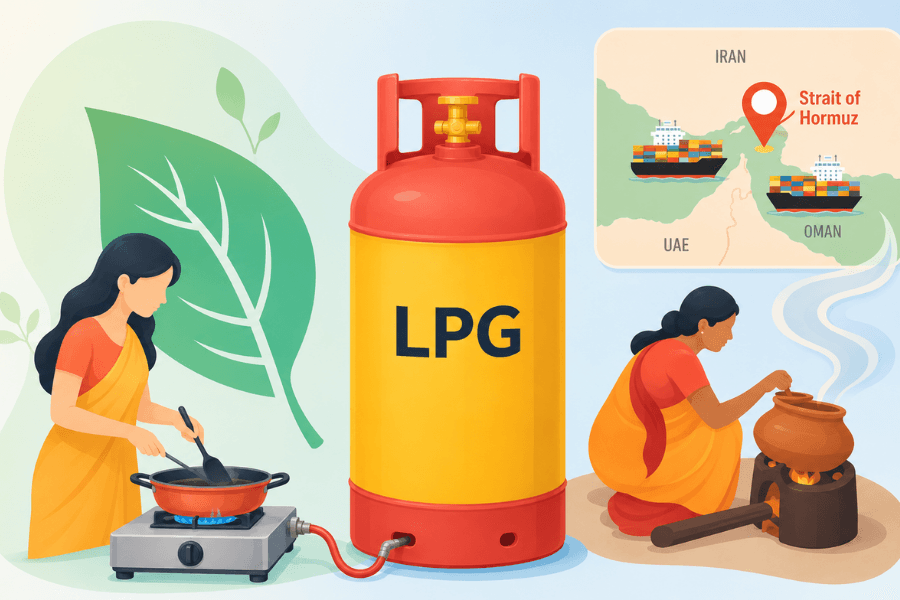
For more than a decade, India’s clean cooking transition was presented as one of the country’s most significant welfare successes. Through schemes such as the Pradhan Mantri Ujjwala Yojana (PMUY), millions of households shifted away from biomass-based cooking, making LPG central to everyday household life.
But the recent disruptions linked to the Iran conflict and uncertainty around the Strait of Hormuz have exposed a structural fragility within this model. Long refill delays, panic buying, disruptions in restaurants and community kitchens, and growing anxiety around fuel availability reveal how quickly a welfare architecture dependent on uninterrupted imports can enter the domain of household risk calculations.
The challenge before India has therefore moved from expanding access to clean cooking fuels to ensuring that households can remain within clean cooking systems during prolonged geopolitical disruption.
When Supply Disruptions Become Structural
India imports close to 90 percent of its LPG requirements, much of which passes through the Hormuz corridor. The current instability therefore represents more than a temporary geopolitical shock. It exposes the risks of dependence on a fuel system vulnerable to external supply disruptions.
Such disruptions change household behaviour in important ways. Temporary shortages are often absorbed through delayed purchases or short-term spending adjustments. But when supply instability begins appearing prolonged, households start prioritising continuity alongside affordability. Refill timing, appliance purchases, and fuel combinations increasingly reflect attempts to reduce exposure to disruption rather than simply minimise costs.
At the same time, LPG also functions as a foundational input across food systems, welfare programmes, informal services, and urban consumption networks. Restaurants, hostels, school meal programmes, food delivery chains, and small commercial establishments all depend on uninterrupted refill systems. A prolonged disruption therefore carries broader economic consequences, including pressure on food prices, urban services, and informal livelihoods.
How Countries Reduce Energy Exposure
Countries vulnerable to recurring energy shocks are increasingly reducing not only fuel dependence, but also exposure to disruption.
Japan maintains extensive strategic reserves and redundancy systems because it treats maritime energy shocks as recurring structural risks. European economies, following successive geopolitical disruptions, have accelerated electrification and decentralised renewables not only as climate strategies, but also as instruments of strategic autonomy. Several Southeast Asian economies are simultaneously expanding biofuels, distributed cooking alternatives, and domestic substitution pathways to reduce import dependence.
Across countries, four capabilities increasingly shape energy resilience: absorbing shocks, enabling rapid fuel switching, decentralising supply systems, and shortening the time households require to adjust during disruption.
India is already witnessing early signs of similar adjustment. Demand for induction stoves has risen across several urban markets, while piped natural gas (PNG) networks continue expanding in metropolitan regions. These shifts underline an important reality: households often respond to supply instability earlier than formal policy systems do.
India’s Uneven Substitution Capacity
The speed of transition depends not only on whether households are willing to shift fuels, but also on whether substitute systems can expand quickly enough to maintain reliability and affordability.
Urban households are better positioned to adopt induction cooking or PNG because substitute infrastructure already exists to some extent. Rural households face a different reality. Electricity reliability remains uneven across several regions, PNG networks are largely absent, and upfront appliance costs create additional barriers.
This creates a mismatch between household adjustment and system-wide substitution capacity. Consumers may begin searching for alternatives quickly, but grid expansion, delivery systems, and affordability support mechanisms cannot scale at the same speed.
As a result, many households continue relying on multiple fuel sources simultaneously. Under stable conditions, fuel stacking is often interpreted as evidence of incomplete transition. During supply disruption, however, it can also function as a practical buffer against dependence on a single vulnerable system.
The slower the substitution capacity, the longer households remain exposed to imported LPG volatility.
The Real Transition Test
India’s clean cooking architecture was designed primarily around expanding access, supported by subsidy systems intended to improve affordability. But systems designed for access expansion are not automatically equipped for prolonged supply disruption.
This requires a different policy logic. The immediate priority remains stabilising supply through strategic reserves, import diversification, and delivery assurance systems. Over time, however, the larger objective is reducing the degree to which clean cooking depends on a single imported fuel pathway.
That transition will not follow a uniform national model. Urban regions may shift faster toward induction cooking and PNG because supporting infrastructure already exists. Other regions may depend for much longer on hybrid energy arrangements shaped by electricity reliability, distribution gaps, and local affordability conditions.
The larger policy challenge is therefore not simply accelerating one fuel transition, but building a more flexible clean cooking ecosystem capable of absorbing disruption without forcing households back toward unreliable or polluting alternatives.
India’s next phase of clean cooking transition will be judged not only by how many households gain access to clean fuels, but by how reliably they can remain within those systems when global disruptions reshape energy supply chains and household choices.