


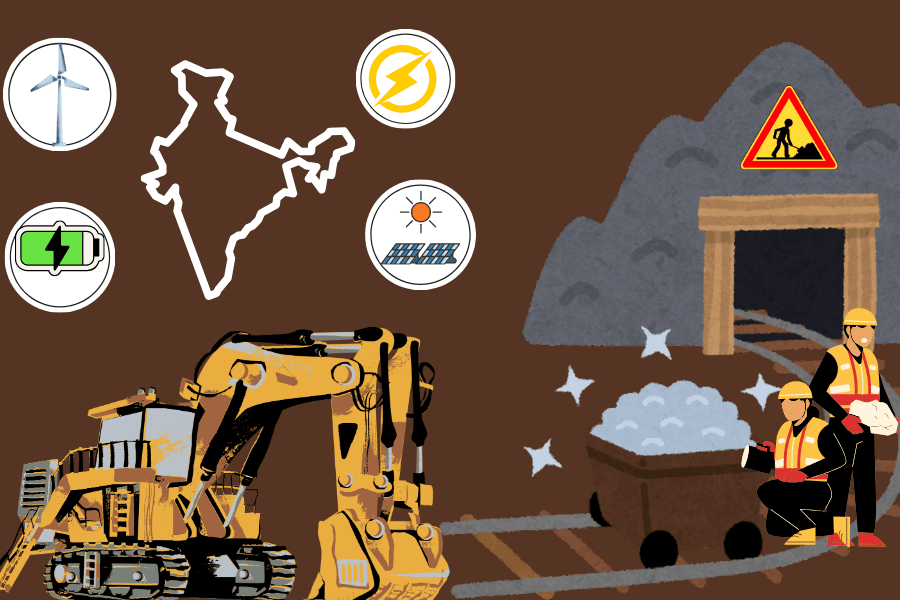
The evolution of the Mines and Minerals (Development and Regulation) Act from its 1957 origins to the 2025 amendment reflects a shift from administrative control to strategic governance. The early framework focused on licensing and state oversight, with significant discretion in allocating mineral blocks. Over time, this led to opaque allocation, under-utilised deposits, and weak incentives for exploration. Reforms since 2015 have reoriented the system toward transparency, revenue capture, and the institutional foundations required for critical minerals and advanced manufacturing.
This shift matters because minerals underpin sectors such as renewable energy, electronics, and electric mobility, where supply security and value-chain integration increasingly shape economic policy.
Allocation Reform and Public Value
The 2015 amendment marked a structural turning point. By introducing auctions as the primary mechanism for allocating mineral concessions, the law replaced discretionary allocation with a system that reveals economic value more transparently. This strengthened state revenues through auction premiums and improved investor confidence.
At the same time, two institutional innovations reshaped how mining interacts with society and future supply. The District Mineral Foundation created a dedicated funding stream for mining-affected communities, financed as a percentage of royalty payments. The National Mineral Exploration Trust established a pooled fund, initially set at 2 percent of royalty, to finance systematic exploration.
These mechanisms address two long-standing gaps: mining districts receive a more predictable share of resource value, and exploration is no longer dependent solely on sporadic public funding. They also reflect a deeper shift in design: allocation is no longer treated as a one-time decision, but as part of a system that must sustain both social legitimacy and future supply.
Production Stability and Asset Use
While allocation reforms improved transparency, they exposed a second constraint: the system required greater operational continuity. Mining is capital-intensive and sensitive to regulatory discontinuity, and the reforms between 2016 and 2021 responded to this.
Transferability of leases allowed firms to mortgage or sell mining assets, improving access to finance and enabling investment in technology and productivity. The 2020 amendment addressed the risk of supply disruption when multiple leases were due to expire simultaneously, allowing advance auctions and temporary transfer of clearances to maintain production continuity. The 2021 reforms further allowed captive mines to sell part of their output in the open market, increasing flexibility and improving resource utilisation.
These changes reduce the risk of regulatory breaks interrupting production, allowing mines to operate as long-term assets rather than fixed-term licences. In a sector where investment horizons are long and sunk costs high, continuity is a precondition for capital formation rather than a regulatory preference.
Exploration as the Core Constraint
As production stabilised, a deeper constraint became more visible: India’s limited exploration base. Exploration is the high-risk, data-intensive phase that determines whether mineral resources are discovered. A weak exploration pipeline constrains downstream supply regardless of later-stage reforms.
The 2023 amendment introduced an Exploration Licence, allowing private firms to undertake reconnaissance and prospecting for deep-seated and critical minerals through an auction-based mechanism. This shifts part of the discovery risk outward, signalling that the state alone cannot underwrite the uncertainty inherent in early-stage exploration.
Building a Mineral Strategy Stack
With allocation, production, and exploration frameworks in place, the 2025 amendment marks a shift from reforming individual stages to coordinating the full mineral value chain.
This coordination begins upstream. The National Mineral Exploration Trust has been expanded and renamed the National Mineral Exploration and Development Trust, with contributions increased from 2 percent to 3 percent of royalty. Its mandate now includes overseas exploration, signalling a more outward-looking approach to securing supply chains.
The same logic extends into extraction, where regulatory frictions have been reduced. Leaseholders can include additional minerals, particularly critical ones such as lithium or cobalt, within existing leases without paying additional auction premiums, accelerating development. For deep-seated deposits, leases can be expanded by up to 10 percent for mining and 30 percent for composite licences, enabling access to resources that were previously outside lease boundaries.
Downstream, the introduction of mineral exchanges creates regulated electronic platforms for trading minerals and processed products. These platforms improve price discovery and make transactions more transparent.
The system is no longer organised around mining alone; it is being aligned with how minerals are processed, traded, and used in industry. What emerges is the outline of a supply-chain strategy that links resource extraction to industrial capability, not just a regulatory framework.
Implementation as the Binding Constraint
Despite this policy momentum, three structural constraints will shape outcomes.
First, geological data remains limited. Without granular, high-quality data, exploration risks remain elevated and private participation constrained. Second, downstream processing capacity remains underdeveloped for many critical minerals, limiting domestic value addition. Third, implementation capacity varies across states, affecting auctions, approvals, and local governance.
Reform also introduces new risks. Mineral exchanges will require oversight to prevent market concentration and manipulation. Faster approvals and lease expansions increase the need for robust environmental assessment and community consultation. District Mineral Foundations, despite substantial funding, continue to show uneven performance across regions.
The gap will emerge in execution, particularly in how consistently states manage auctions, approvals, and local governance. At this stage, institutional capacity becomes the primary determinant of outcomes.
From Extraction to Capability
India’s mineral policy is now structured to support more than extraction. It can enable supply-chain security and industrial capability.
Whether this transition materialises will depend on execution, particularly in data generation, institutional capacity, and downstream integration. The framework now exists; the question is whether it can be translated into coordinated action across exploration, extraction, and industry.
Without this, the framework may change on paper without translating into output, investment, or industrial depth.