



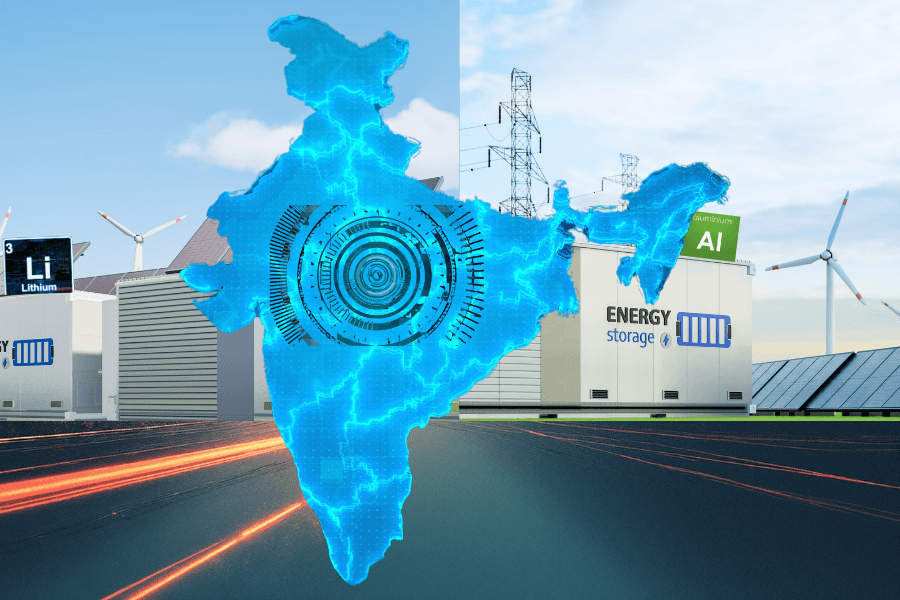
India’s energy transition is as much about generating more clean power or selling more electric vehicles, as it is about systems that store, stabilise, and integrate energy into everyday use. Today, much of this conversation is anchored to lithium-ion batteries. That focus has advantages, but it also embeds long-term risks tied to imports, climate stress, and supply concentration. Aluminium-ion batteries offer an alternative storage pathway that aligns more closely with India’s resources, dominant use-cases, and development priorities.
Aluminium batteries will not displace lithium everywhere or anytime soon. Rather, India’s transition will require a portfolio of storage technologies, each matched to specific needs and time horizons. Aluminium batteries are useful in those segments where safety, cost, and durability matter more than maximum energy density. Seen this way, the question is not whether aluminium outperforms lithium, but whether policy recognises where each technology best fits.
Storage Risk as the Core Policy Question
India’s battery debate often centres on chemistry and performance metrics. Policymakers, however, confront a broader set of risks: exposure to volatile imports, safety failures in dense urban environments, and the fiscal burden of scaling storage across transport and power systems. Lithium supply chains remain geographically concentrated and increasingly contested. For a country targeting 500 GW of non-fossil capacity by 2030 and rapid electrification of mobility, this concentration introduces systemic vulnerability.
Aluminium alters this risk profile. India is among the world’s top aluminium producers, with established mining, refining, and smelting capacity. Aluminium is also fully recyclable without loss of quality, unlike lithium systems where battery material becomes difficult-to-process waste. From a policy perspective, this affects not only long-term costs, but also environmental management and the credibility of circular economy ambitions embedded in India’s development plans.
Matching India’s Dominant Use-Cases
Aluminium-ion batteries (AIBs) operate on a different physical principle. Each aluminium ion carries three electrical charges, compared to one in lithium. In simple terms, more charge can be transferred per unit of metal. Many AIB designs also use non-flammable electrolytes, sharply reducing fire risk – an important consideration in India’s hot climate and congested urban settings, where lithium-ion batteries have shown greater susceptibility to overheating and fires.
These characteristics align with India’s actual demand profile. Two- and three-wheelers, which dominate electric vehicle adoption, prioritise safety, fast charging, and affordability over long driving range. Rural microgrids, telecom towers, and grid-balancing applications value reliability and long cycle life more than compactness. In such settings, aluminium batteries’ ability to deliver thousands of charge–discharge cycles can translate into lower lifetime costs, even if headline energy density remains lower than lithium-ion alternatives.
This is a question of use-case segmentation, not performance competition. Aluminium batteries are not positioned for premium electric cars. They are better suited to storage applications where robustness and cost discipline matter most.
Constraints Are Real – but Concentrated and Addressable
Aluminium-ion batteries today lag lithium-ion systems in practical energy density. Much of the reported performance for aluminium-ion systems remains at the laboratory or material level, typically in the range of 60–150 mAh/g, whereas lithium-ion benchmarks of 180–250 Wh/kg represent mature performance at the commercial full-cell level. This gap arises because aluminium ions move relatively slowly within the battery materials. In addition, the electrolytes that enable their transport are often corrosive, making durability and large-scale deployment challenging.
These limitations are frequently portrayed as fundamental. The evidence – expert assessments based on inputs from over 200 researchers, industry practitioners, and policymakers – suggests otherwise. They are engineering bottlenecks concentrated in specific stages of the value chain, not structural dead ends. Crucially, they matter less for stationary storage and short-range mobility than for long-range vehicles.
The main constraints to growth lie in cathode materials (identifying materials that can handle aluminium ions repeatedly without wearing out), electrolyte stability (liquids inside the battery can reliably support charging and discharging without damaging the battery or becoming unstable over time), upfront investment costs, and the absence of dedicated supply chains. Together, these explain roughly 44 percent of the uncertainty in industry growth potential. Standards and regulation, by contrast, do not yet emerge as binding constraints – indicating that the challenge is not regulatory resistance, but targeted capability-building.
Mapping with India’s Innovation Base
These constraints matter, but they do not confront India as an empty starting point. India is not starting from scratch. Research institutions have demonstrated aluminium-based battery prototypes with long cycle life, while public laboratories have worked on catalysts and materials directly relevant to aluminium systems. At the same time, startups and joint ventures are testing aluminium-based storage in niche applications, including two-wheelers and microgrids.
Importantly, aluminium producers – both public and private – already provide a strong upstream base. This reduces the coordination challenge that often hampers alternative battery chemistries. Policy architecture is also evolving: advanced battery manufacturing incentives, viability gap funding for storage, and early-stage standard-setting signal institutional openness to diversification.
What remains missing is not support in principle, but clarity of intent – whether aluminium-based systems are viewed as peripheral experiments or as part of a deliberate, multi-chemistry storage strategy.
Signalling Strategic Focus
When incentives and procurement implicitly assume lithium-ion dominance, emerging chemistries struggle to move from laboratory demonstrations to field pilots. A modest shift in emphasis would have outsized effects. Explicitly accommodating AIBs within existing manufacturing incentives, supporting shared pilot manufacturing and testing facilities, and underwriting early demand in public applications would directly address the constraints in this ecosystem.
Such steps would not displace lithium investments, but would broaden the set of storage options able to progress through pilots and early deployment.
The potential regional implications of this shift follow naturally from India’s industrial geography. Aluminium-based systems would draw on existing production clusters rather than requiring entirely new mineral supply chains, offering a pathway for cleaner industrial growth that builds on established capabilities rather than creating fresh dependencies.
Sequencing, Not Leapfrogging
AIBs remain a medium- to long-term complement to lithium-ion systems, not an immediate replacement. Most designs are still at early technology readiness levels, and commercial viability will depend on sustained progress in materials, manufacturing, and system integration.
A phased approach is therefore essential. Through the late 2020s, the focus may remain on demonstration projects – telecom towers, institutional microgrids, and hybrid storage systems – where safety and durability are paramount. In the 2030s, as materials mature and supply chains stabilise, aluminium-based systems could expand into grid-support roles such as peak shaving and renewable smoothing. Over the longer horizon to 2047, they could form part of a diversified storage ecosystem supporting India’s clean energy ambitions.
Designing for Advantage
The real question is whether India’s energy transition will be shaped by selective leadership grounded in domestic strengths, or by perpetual catch-up along a single global technology path. Aluminium offers a rare alignment of resource availability, industrial capability, and system-level need. Treating it as a complementary pillar rather than a silver bullet keeps expectations realistic while preserving strategic optionality. The choice is not about backing one chemistry over another, but about structuring policy, incentives, and deployment pathways to reflect India’s actual use-cases and constraints.
For a country planning toward Viksit Bharat 2047, that design choice matters – not just for batteries, but for how India designs its future energy systems.