



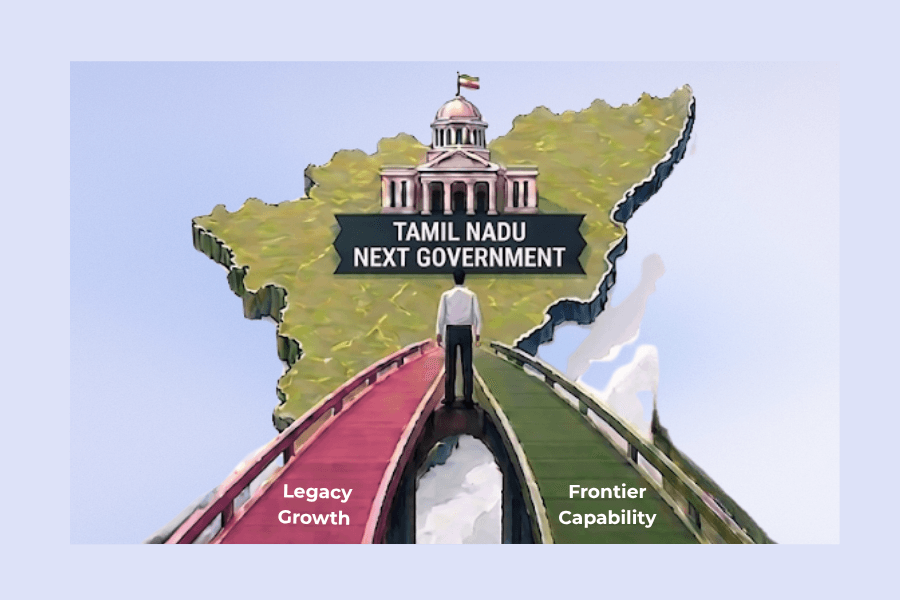
Tamil Nadu’s election outcome delivers a mandate at a moment when the state’s growth model is approaching an inflection point. The headline numbers remain strong, with real GSDP growth of 11.2 percent in 2024–25, the highest among major states, manufacturing growth of 14.74 percent, and merchandise exports that have nearly doubled to $52.07 billion. These gains reflect a model that has combined industrial expansion with social stability, allowing Tamil Nadu to sustain both economic momentum and political continuity.
The question now is whether that model can carry the state through the next phase of global competition. Supply chains are reorganising, production is becoming more technology-intensive, and competitiveness is increasingly shaped by ecosystem depth rather than investment incentives alone. A strategy built primarily on expansion risks slowing as these pressures intensify.
The next phase of growth will depend less on attracting capital and more on strengthening the capabilities that allow industries to scale, upgrade, and remain globally competitive. Tamil Nadu must now move from expansion-led growth to productivity-led growth.
A Growth Model Facing Fiscal Limits
The real constraint is not ambition, but fiscal room. Welfare expansion and women-focused social programmes have strengthened household resilience and reinforced social stability, but these commitments have increasingly relied on borrowings. This has coincided with major industrial expansion across EVs, semiconductors, and advanced manufacturing, creating visible investment momentum alongside rising pressure on public finances. Fiscal space is narrowing precisely when future growth requires sustained investment in infrastructure, skills, technology, and industrial upgrading.
As competitive populist pressures intensify, the challenge shifts from sustaining expenditure to directing public resources where they generate the highest long-term returns. The policy question is whether fiscal priorities can shift towards education, healthcare, skilling, and productive infrastructure without weakening the social foundations that have supported Tamil Nadu’s development.
The Constraints That Will Define the Next Phase
Global supply chains are being reorganised, creating opportunities in advanced manufacturing and electronics. Investment decisions increasingly depend on ecosystem depth rather than incentives alone. Integrated infrastructure, logistics efficiency, regulatory responsiveness, and execution speed now shape competitiveness more than subsidy-led attraction. Tamil Nadu’s industrial base offers a strong foundation, but competing destinations are rapidly strengthening these capabilities.
The energy transition has become central to industrial competitiveness. Global buyers increasingly prefer low-carbon supply chains, while energy-intensive industries require reliable 24×7 power to remain viable. Tamil Nadu’s wind and solar base offers a strategic advantage, but grid congestion, storage gaps, land constraints, and ageing assets limit the availability of stable green power.
Tamil Nadu also faces a structural skills constraint. It has one of the highest Gross Enrolment Ratios in higher education, around 50 percent, and a large engineering base, yet employability remains uneven. Industry estimates suggest that only about 42–56 percent of graduates are readily employable, with lower rates across several non-computer science disciplines. This reflects a widening mismatch between education outputs and labour-market demand. Without stronger industry-linked curriculum reform, cluster-based apprenticeship systems, and targeted reskilling linked to emerging sectors, investment inflows may coexist with persistent graduate underemployment.
Where Capability Will Be Tested
Semiconductors and advanced electronics present one of the clearest opportunities within global supply-chain restructuring, but they also expose the gap between investment ambition and execution capacity. Investment decisions in this sector depend on infrastructure certainty, including contiguous land availability, ultra-pure water supply, and uninterrupted high-quality power. Without these conditions at scale, Tamil Nadu risks remaining outside the most capital-intensive and technologically strategic segments of the value chain.
The EV ecosystem anchored in Hosur and Thoothukudi faces a similar test. Moving beyond assembly towards battery chemistry, power electronics, and component manufacturing requires stronger research infrastructure, deeper MSME integration into supply chains, and incentives linked to domestic value addition rather than production volume alone. Without this transition, growth risks remain concentrated in lower-value manufacturing rather than building long-term industrial capability.
Green energy and hydrogen can position Tamil Nadu as a low-carbon industrial hub, but only if storage constraints, grid reliability, and land availability are resolved at scale. Without reliable and scalable green energy systems, the state’s ability to attract energy-intensive industries will remain limited.
Digital public infrastructure, including data centres, fibre connectivity, and AI compute capacity, underpins productivity gains across sectors and enables technology adoption at scale. Gaps in this foundational layer can slow diffusion across firms, particularly MSMEs, and weaken the broader productivity impact of industrial policy.
AI Will Determine Productivity and Employment
Artificial intelligence functions as a productivity layer across manufacturing, logistics, services, and governance. In automotive and EV systems, it improves predictive maintenance and quality control. In IT and services, demand is being reshaped towards data engineering, applied AI, and governance systems. In MSMEs and traditional manufacturing, it enables efficiency gains that strengthen competitiveness in global markets.
At the same time, AI creates a tension between productivity gains and employment outcomes, particularly in labour-intensive sectors. Faster adoption without workforce transition can displace labour, while delayed adoption can erode competitiveness. The policy challenge lies in managing this transition so that workforce augmentation keeps pace with technological upgrading.
This requires support for AI adoption among MSMEs, expansion of reskilling systems aligned with emerging technologies, and stronger coordination among industry, academia, and government to scale applied research, implementation, and workforce transition, so that adoption influences productivity across sectors rather than remaining concentrated in a few large firms.
The Agenda and the Window Ahead
The next government’s performance will be judged less by the number of schemes it announces and more by whether it can convert these structural priorities into measurable outcomes. Progress towards a $1 trillion economy, sustained real GSDP growth of 8–9 percent, expansion of manufacturing to over 30 percent of GSDP, and the creation of 8–10 million quality jobs will depend on whether Tamil Nadu can shift from growth driven by expansion to growth sustained by productivity.
This is ultimately a question of governance and fiscal choice. The state must preserve the social stability that welfare systems have helped build while creating enough fiscal room for long-term investment in human capital, industrial capability, energy reliability, and industry-linked skilling systems. The central challenge is not choosing between welfare and growth, but ensuring that public expenditure supports both social protection and productive transformation.
Tamil Nadu’s competition is no longer only with other Indian states, but with emerging industrial hubs such as Vietnam and Malaysia that are moving rapidly in electronics, semiconductors, and advanced manufacturing. Its strengths in human capital, MSME networks, and policy continuity remain significant, but the window to consolidate these advantages is limited.
The next five years will determine whether Tamil Nadu remains a successful manufacturing state or emerges as one of Asia’s defining capability-driven industrial economies.