



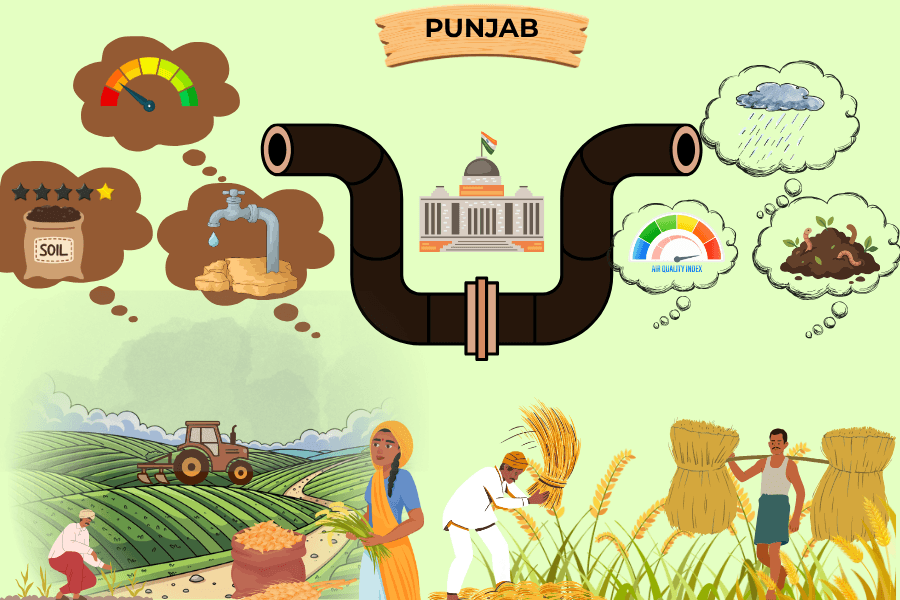
Decades of procurement support, input subsidies and risk protection helped transform Punjab into a cornerstone of India's food security. That achievement remains one of Indian agriculture's most consequential policy successes. Yet the same support architecture also shaped a cropping pattern that has contributed to groundwater depletion, residue burning and mounting ecological stress.
As governments search for pathways towards sustainable agriculture, the question is no longer whether alternatives exist. A more difficult question now confronts policymakers: can agricultural support systems reward environmental outcomes as effectively as they once rewarded production?
Punjab may already be spending almost as much to sustain environmentally costly rice cultivation as farmers would require to adopt more sustainable alternatives. If so, the challenge is less about finding new resources and more about rethinking how existing public expenditure is used.
The Success Model Is Producing New Costs
Punjab's agricultural transformation was built on a clear policy logic. Public investment, subsidised inputs and assured procurement reduced production risks, encouraged output growth and secured grain supplies for the country.
These policies worked. But they also shaped cultivation choices in ways that increasingly strained natural resources.
Rice expanded from roughly 7 percent of Punjab's cropped area in 1970–71 to 38 percent in 2022–23, despite agro-climatic conditions not naturally suited to its large-scale cultivation. Groundwater dependence deepened alongside this expansion. The share of groundwater-irrigated agriculture rose from 55 percent to 72 percent, while groundwater levels declined by more than eight metres after the late 1990s.
These developments are often described as environmental externalities. They were also institutional outcomes. Free electricity lowered the cost of groundwater extraction, while assured procurement reduced market uncertainty. Together, these measures created a highly productive agricultural system but one that rewarded resource-intensive cultivation more consistently than resource conservation.
The residue-burning problem followed a similar trajectory. Policies designed to conserve groundwater delayed paddy transplantation and compressed the period between rice harvesting and wheat sowing. Faced with narrow planting windows, farmers increasingly turned to mechanical harvesting and residue burning to clear fields for the next crop.
An intervention intended to address one ecological challenge thus intensified another.
Farmers Are Responding to Incentives, Not Ignoring Sustainability
Public debates on sustainable agriculture often assume that farmers are reluctant to change. The evidence suggests a more practical explanation: farmers usually respond rationally to the incentives and risks built into agricultural policy.
The environmental case for alternatives such as direct-seeded rice and crop diversification is well established. Direct-seeded rice can reduce water use, lower greenhouse-gas emissions and improve soil conditions. Legume cultivation can reduce irrigation demand, strengthen soil fertility and lessen dependence on residue burning.
The difficulty lies elsewhere.
Many of the gains generated by sustainable agriculture – groundwater conservation, cleaner air and carbon sequestration – benefit society more broadly than individual farmers. Farmers, meanwhile, bear the immediate costs and uncertainties associated with changing established production systems.
This matters because agriculture is fundamentally an exercise in managing uncertainty. Long-term environmental gains do not automatically translate into attractive economic choices. The issue, therefore, is not whether farmers recognise sustainability. It is whether agricultural systems reward the public goods that sustainable farming generates.
Why Sustainable Transitions Remain Risky
The transition to sustainable agriculture is often described as an awareness problem. In practice, it is more often a problem of risk.
Direct-seeded rice, for instance, has been associated with concerns over yield performance in some settings, even where it reduces water use and production costs. Crop diversification presents a different uncertainty. Legumes and other alternatives may offer ecological advantages, but they lack the ecosystem of procurement support, market assurance and policy attention historically associated with rice cultivation.
Agricultural decisions are made before prices are known, before weather outcomes become clear and before yields are realised. Under such conditions, uncertainty frequently outweighs average long-term benefits.
Evidence from Punjab suggests that willingness to experiment is not the primary obstacle. When presented with alternative production systems, farmers selected direct-seeded rice in more than half of all choices and crop diversification in over one-third. Only around 13 percent preferred maintaining the status quo. The constraint, then, appears to lie less in resistance to sustainability than in the risks associated with transition.
These risks are also unevenly distributed. Farmers with greater access to information, stronger educational backgrounds and higher tolerance for uncertainty are generally more willing to consider alternatives. Larger farmers are often better positioned to absorb temporary income fluctuations, while smaller farmers operate with narrower margins for experimentation.
The transition to sustainable agriculture therefore raises a broader policy question: how should agricultural systems share the costs and risks of adjustment?
Punjab May Already Be Paying for the Transition
The most revealing insight emerges when the economics of sustainable adoption are compared with the economics of existing support.
Estimates suggest that farmers would require compensation of approximately Rs 29,223 per hectare to adopt direct-seeded rice and around Rs 29,178 per hectare to shift from rice cultivation to legumes. These figures represent the incentives needed to offset the perceived risks and trade-offs involved in moving away from established cultivation systems.
What makes these estimates significant is their proximity to the support already embedded within Punjab's rice economy. Existing subsidies, including electricity and fertiliser support, amount to roughly Rs 28,960 per hectare.
This comparison points towards an uncomfortable but important possibility: the resources needed to incentivise environmental outcomes may already be present within the agricultural system.
The difference lies in what public expenditure is designed to reward. One model subsidises resource-intensive production. Another could reward outcomes such as groundwater conservation, reduced pollution and improved ecosystem health.
From Production Support to Ecosystem Support
India's agricultural policy will increasingly be judged not only by the food it produces but also by the ecological systems it sustains.
A more adaptive support framework could incorporate incentives linked to measurable environmental outcomes, including groundwater conservation, residue management, soil improvement and carbon sequestration. Such mechanisms would complement rather than abruptly replace existing support, gradually broadening agricultural policy from production support towards ecosystem stewardship.
The success of this transition will depend on institutional design. Farmers differ in their resource endowments, exposure to risk and access to information. Incentive structures will therefore need to recognise these differences while ensuring that small and marginal farmers are not excluded from emerging opportunities. Extension systems, information support and credible risk-sharing mechanisms will remain as important as financial incentives.
The central question is no longer how to persuade farmers to behave differently. It is whether public support can reward ecological stewardship as consistently as it once rewarded output.