



Debates on India’s climate change and forest governance increasingly emphasise indigenous communities as natural environmental stewards. Stronger local tribal control over forests is often assumed to enable better conservation outcomes. Yet forest governance rarely involves conservation alone. Forest-dependent communities must balance long-term ecological concerns against immediate livelihood needs. Moreover, institutions operating at different political scales possess unequal authority, resources and incentives to conserve.
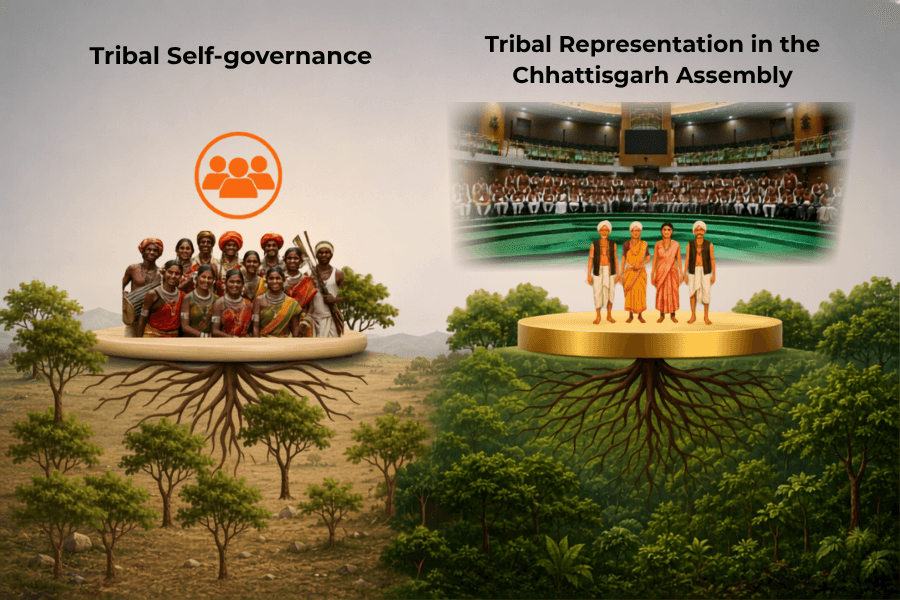
Analysis based on Chhattisgarh’s 20,000 odd villages over 2001-2019 complicates simple assumptions about representation and conservation. Areas with sustained Scheduled Tribe (ST) representation in reserved Assembly constituencies recorded significantly stronger gains in forest cover than villages without such representation, while village-level tribal self-governance under the Panchayat Extension to Scheduled Areas (PESA) produced weak outcomes.
The contrast matters because forest conservation is shaped not only by who is represented, but also by how political authority itself is organised and at what scale.
Two Forms of Tribal Political Influence
India’s governance framework created two distinct levels of Scheduled Tribe political participation. Reserved Assembly constituencies ensured tribal representation within state legislatures, while PESA strengthened tribal decision-making within village councils across Scheduled Areas.
Although both mechanisms were designed primarily to deepen democratic inclusion, they operate at different political scales and exercise unequal influence over development priorities, land use and local resource governance. This distinction creates an important opportunity to examine how different levels and forms of political authority shape forest outcomes.
Chhattisgarh presents an especially important case for examining this institutional contrast. About 41 percent of the state’s geographical area remains under forest cover, while nearly one-third of its population belongs to Scheduled Tribes. The overlap between forests and tribal-majority regions creates conditions where political authority can directly influence ecological outcomes.
Evidence drawn from some 20,000 villages over almost two decades enables an examination of this relationship across different forms of tribal political participation. Villages that came under any form of ST political reservation during this period recorded an aggregate increase of 22.7 hectares of forest cover per village compared with 5.4 hectares in never-reserved villages. On average, ever-reserved villages recorded forest-cover gains more than four times larger than never-reserved ones.
The strongest outcomes emerged where Assembly constituency reservation remained continuous. These villages recorded average forest-cover gains of nearly 28 hectares per village. By contrast, villages only under PESA averaged roughly 6.9 hectares, close to the outcomes in never-reserved villages.
Political inclusion influenced forest outcomes, but institutional authority and governance scale shaped how conservation and development pressures were negotiated.
Why Institutional Scale Can Matter in Outcomes
The contrast between Assembly reservation and PESA points toward a broader institutional question: how do motivation, authority, and implementation shape conservation outcomes across different levels of governance?
Assembly-level representation provides forms of influence that village institutions often struggle to exercise independently. Members of Legislative Assemblies command wider administrative access, greater influence over land-use decisions, more funding, and stronger leverage over development priorities. They also operate at the constituency scale where developmental outcomes and political accountability extend beyond village-level concerns. These conditions can allow for greater balance between ecological goals and competing developmental pressures.
Village-level institutions function under tighter economic and administrative constraints. Many regions with tribal concentrations continue to face poverty and limited livelihood options, thus increasing their dependence on forests for fuelwood, farm inputs, and other non-timber forest produce essential for survival and income security. These conditions create extraction pressures. Moreover, there can be divergence in economic and social priorities between tribal and non-tribal households and between economically differentiated tribal households themselves, even within PESA-reserved villages. This creates conflicting pulls that play out in institutions of local governance in ways less likely at the assembly level.
Further, institutional implementation matters. PESA implementation remained uneven for years. In Chhattisgarh, the framework became operational only gradually after 2005, and rules expanding local jurisdiction over forest produce emerged even later.
In contrast, tribal MLAs proactively used their greater political leverage with the forest department to curb neighbouring-village encroachments, and utilised their funds to promote reforestation, including culturally and ecological-valuable schemes such as restoring sacred groves. There was also notable continuity in this regard, despite changing political regimes at the state level.
The evidence therefore points to a broader institutional lesson. Conservation outcomes depend not only on democratic inclusion or proximity to forests, but also on clear conservation goals, administrative capacity, implementation strength, and the political authority to manage divergent developmental pressures.
Climate Governance Requires Careful Institutional Design
India’s climate and development priorities increasingly cover forested and tribal-dominated regions. Forest restoration, biodiversity protection, climate adaptation and rural livelihoods are often pursued through the same landscapes, where ecological objectives and developmental pressures tend to intersect directly.
This makes forest governance more than a technical or administrative challenge. Policies centred only on conservation targets or bureaucratic regulation are unlikely to resolve the underlying tensions shaping forest use. Environmental outcomes depend not only on stewardship or participation, but also on whether institutions possess the authority, incentives, and administrative capacity to manage competing priorities.
Chhattisgarh’s experience suggests that democratic inclusion and ecological resilience can work in tandem. When historically marginalised communities gain meaningful political voice within institutions capable of shaping development decisions, positive environmental outcomes can emerge alongside better representation.
Institutional design should thus be seen as a key aspect of effective climate governance.