



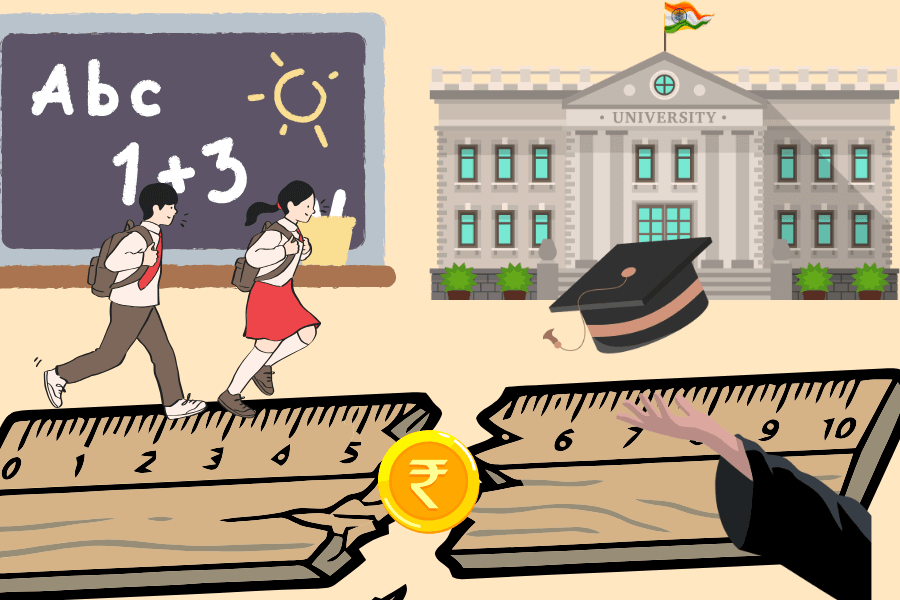
Secondary education increasingly determines educational mobility, employability, and access to higher education in India. Since the launch of the Rashtriya Madhyamik Shiksha Abhiyan (RMSA) in 2009 and later Samagra Shiksha, India has widened the institutional footprint of secondary schooling through higher expenditure, school expansion, and integrated policy support. Yet financing has not expanded proportionately with the growing role secondary education now plays in mobility and workforce preparation. Public expenditure on secondary education has remained between 1 and 1.5 percent of GDP, while household spending on schooling, coaching, and supplementary learning has steadily increased. India has therefore expanded the institutional reach of secondary education without fully strengthening the financing structure needed to support equitable educational opportunity across caste, gender, and geography.
Expansion Without Financing
India’s financing priorities continued to favour elementary and higher education even as secondary schooling became more central to educational mobility and workforce preparation. Elementary education received sustained policy attention because universal schooling remained unfinished for decades, while higher education expanded alongside India’s services economy and rising demand for professional degrees. Secondary schooling absorbed larger student cohorts emerging from expanded elementary access and carried growing expectations around higher education and skilled work, yet financing did not expand proportionately with these responsibilities.
This imbalance was also shaped by India’s fiscal structure. Nearly 75 percent of education expenditure is borne by state governments, making the quality and expansion of schooling heavily dependent on state-level fiscal capacity. States with stronger revenues are better positioned to improve infrastructure, recruit teachers, and expand access, while poorer states often confront larger educational deficits alongside tighter budgets. Financing outcomes therefore remain uneven not only across institutions but across regions.
RMSA (2009) and Samagra Shiksha (2018) marked a significant policy shift toward strengthening secondary education through expanded infrastructure, expenditure, and administrative focus. Their effects were visible in both spending and institutional growth.
Secondary education expenditure as a percentage of GDP increased from 0.54 percent in the pre-RMSA period (2006–09) to 1.09 percent during the RMSA years (2010–18) and further to 1.45 percent in the post-Samagra Shiksha period (2019–22). Over the same period, the number of secondary schools increased from about 1.7 lakh before RMSA to 2.1 lakh during the RMSA years and further to 2.70 lakh after Samagra Shiksha.
The structural shifts, however, were more limited. Expenditure and institutional capacity expanded significantly, but financing remained uneven relative to the scale of rising enrollment and transition pressures. The schemes strengthened the institutional presence of secondary schooling without fully resolving the financing disparities shaping participation and progression.
The Shift to Household Financing
As public financing remained uneven across states and insufficient relative to growing demand, households gradually absorbed a larger share of educational costs. Spending on school fees, coaching centres, transport, digital access, and supplementary learning increased as families sought stronger educational outcomes and more secure pathways to mobility. Private Final Consumption Expenditure on education now remains between 2 and 3 percent of GDP. Urban households spend nearly 6 percent of their monthly consumption expenditure on education compared to roughly 3 percent in rural India, indicating how educational opportunity increasingly tracks household financial capacity.
The school system adjusted steadily to this financing pattern. At the secondary level, the share of private unaided schools rose from 31 percent in 2005–06 to over 44 percent by 2022–23, while at the higher secondary level it increased from nearly 35 percent to more than 43 percent. Competitive examinations, English-medium instruction, and aspirations for upward mobility reinforced demand for privately financed education.
This shift altered not only where students studied but also how educational opportunity was distributed. Financially secure households could sustain coaching, digital access, and higher-performing institutions more easily than poorer families relying on uneven public systems. As schooling costs rise, the risk of educational discontinuity becomes sharper for students from financially constrained households. Financing increasingly shapes who can remain within the education system and under what conditions.
Expansion With Unequal Access
India’s secondary education system has expanded more inclusively over time, particularly for girls. Gender gaps in schooling have narrowed steadily, and in higher secondary education the gross enrollment ratio for girls has exceeded that of boys for several years. These gains reflect meaningful improvements in retention and access.
Inclusion at the aggregate level, however, has not translated into equal conditions of participation across social groups and regions. Scheduled Castes and Scheduled Tribes continue to record lower enrollment levels than General and Other Backward Class students in secondary education. Geographic disparities persist through uneven infrastructure and institutional capacity across regions. Rural India has more secondary schools in absolute numbers, yet urban areas often record higher population per school, reflecting uneven access pressures and distribution patterns. Access to libraries, electricity, internet connectivity, and digital infrastructure also varies substantially across schools and states, producing markedly different educational environments at the same grade level.
These inequalities accumulate over time. Students with stable schooling conditions are far more likely to continue into higher education and skilled employment than those facing interruptions in access, financing, or infrastructure. Secondary education has therefore become the stage where differences in financing, institutional quality, and learning conditions increasingly shape long-term economic participation.
Financing the Next Transition
India has already demonstrated that large-scale educational expansion is institutionally possible. The more difficult question now is whether equitable participation within that system can be sustained without growing dependence on household financing. The challenge is therefore no longer expansion alone, but whether secondary schooling continues to function as a public pathway to mobility or increasingly reflects privately financed opportunity. How India resolves this financing question will shape not only educational access, but the distribution of opportunity across generations.