



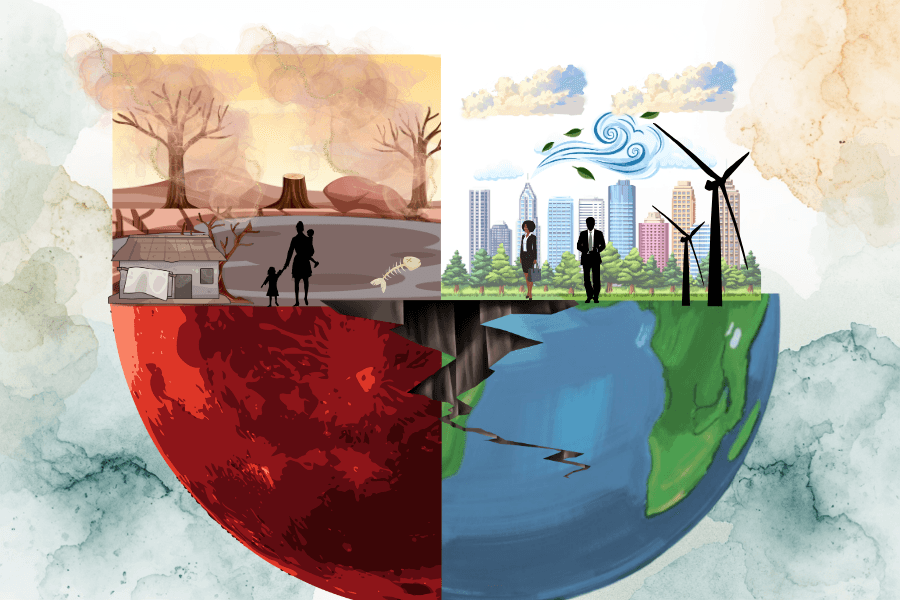
Rising temperatures do not affect all regions equally. Regions with weaker infrastructure, fragile public systems, lower household savings, and high dependence on outdoor labour face deeper economic losses under sustained warming. Climate vulnerability, in this sense, is increasingly becoming a form of economic inequality. Its most enduring effect is not simply environmental disruption, but the growing divergence in who can accumulate wealth, preserve assets, and recover from shocks.
Across more than 1,000 subnational regions in 97 countries, a 1°C increase in temperature is associated with roughly a 0.54-point rise in wealth inequality, measured through the regional Gini index on a scale of 0 (perfect equality) to 100 (extreme inequality). While the yearly increase may appear modest, its cumulative effects become economically significant under prolonged warming. The implications are especially serious for developing economies such as India, where infrastructure quality, healthcare access, and economic resilience remain uneven across regions.
Climate shocks are increasingly shaping not only who loses income, but who can preserve wealth and recover economically.
From Heat Exposure to Wealth Erosion
The economic effects of sustained warming extend far beyond temporary income disruptions. Heat exposure weakens the foundations through which households and regions build long-term economic security.
Extreme temperatures reduce agricultural productivity, weaken labour capacity, increase healthcare expenditure, damage physical assets, and disrupt educational continuity. In regions heavily dependent on informal employment or climate-sensitive sectors, repeated heat exposure steadily erodes the ability of households to accumulate savings and productive assets over time.
A 1°C rise in temperature is associated with more than a one-percentage-point increase in the share of households falling into lower-wealth categories. Households facing repeated environmental shocks frequently respond by liquidating savings, selling productive assets, reducing healthcare expenditure, or withdrawing children from education. These strategies may stabilise short-term consumption, but they weaken future earning capacity and long-term resilience.
Wealth inequality matters differently because wealth functions as a long-term buffer against uncertainty. Income losses can often be recovered gradually, but erosion of savings, assets, education, and health weakens economic security across years and generations. Climate change is therefore affecting not only present consumption, but the long-term capacity to accumulate and preserve wealth.
Why Recovery Capacity Determines Inequality
Climate shocks become inequality shocks when recovery capacity is unequal.
Regions with stronger infrastructure, wider insurance coverage, greater access to credit, and more diversified economic structures are generally better positioned to absorb environmental disruptions. They are more capable of rebuilding assets, protecting labour productivity, and sustaining investment during periods of stress.
Poorer regions, by contrast, often operate with a far narrower recovery margin. Areas dependent on climate-sensitive sectors, informal labour, or weak public systems face repeated economic erosion after successive shocks. Limited fiscal capacity further constrains their ability to invest in cooling systems, healthcare resilience, water management, labour protections, and adaptive infrastructure.
The long-term effect is cumulative divergence. Regions with greater adaptive capacity continue investing in productivity and resilience, while vulnerable regions experience repeated depletion of savings, assets, and public capacity. Over time, climate exposure begins to reshape broader development trajectories.
The implications extend beyond households alone. Regions with weaker asset bases often struggle to attract investment, upgrade infrastructure, or finance adaptation measures. Environmental stress then reinforces pre-existing regional disparities by weakening both public and private capacity for long-term economic upgrading.
The Geography of Unequal Warming
The economic effects of climate change are also geographically uneven in ways that aggregate averages often conceal.
Some regions already experience annual temperatures exceeding 32°C, while others remain below freezing. Regions with high baseline temperatures and weaker institutional capacity face structurally greater economic exposure under sustained warming. In low-income, high-temperature regions, a 1°C increase in annual temperature is associated with roughly a 0.3-point rise in wealth inequality.
This unevenness is reinforced by differences in fiscal capacity and public infrastructure. Wealthier regions are generally more capable of financing adaptive systems such as cooling infrastructure, healthcare resilience, water security, and social protection. Poorer regions frequently confront rising climate exposure with weaker institutional buffers.
Globalisation amplifies these pressures further. Climate shocks increasingly travel through supply chains, labour markets, food systems, commodity networks, and trade flows. A heatwave in a major agricultural or manufacturing region, for instance, can disrupt food prices, production costs, labour demand, and inflation patterns across multiple economies. Environmental disruption in one region can therefore generate broader distributional consequences elsewhere, particularly in tightly interconnected economies.
How Heat Weakens Human Capability
One of the most profound consequences of sustained warming is the gradual weakening of human capability itself.
Heat stress reduces both physical endurance and cognitive performance, especially in sectors dependent on outdoor work, informal employment, or poorly cooled workplaces. Climate-linked disease burdens and nutritional stress further weaken labour productivity and long-term health outcomes.
Educational attainment is also affected when extreme heat disrupts attendance, concentration, and learning conditions. Repeated exposure to such disruptions weakens the human capital foundations on which long-term economic mobility depends.
Climate change is therefore not only damaging infrastructure or reducing output; it is weakening the human capabilities through which societies generate productivity, resilience, and long-term wealth.
Climate Policy Is Becoming Distribution Policy
The relationship between climate change and wealth inequality carries major implications for economic policy. Adaptation can no longer be viewed narrowly through the lens of physical infrastructure or disaster response alone. Cooling access, labour protections, healthcare systems, education continuity, social insurance, and urban planning are increasingly central to economic resilience.
The implications are especially significant for countries such as India, where climate exposure, labour-market vulnerability, healthcare access, and public infrastructure remain uneven across regions. Sustained warming could deepen regional economic divergence by weakening productivity and slowing wealth accumulation in already vulnerable areas. Climate adaptation, therefore, increasingly requires region-specific investments in labour resilience, public health systems, urban infrastructure, and social protection frameworks. The state-level targets for zero carbon emissions need alignment with the national goal. This cannot be pursued unless states with ecological abundance receive sufficient incentives through ecological fiscal transfers in a federal setting.
The defining climate divide of the coming decades may extend beyond the distinction between high emitters and low emitters. The central economic divide of the climate era may increasingly depend on which societies can prevent environmental vulnerability from hardening into permanent inequality.