



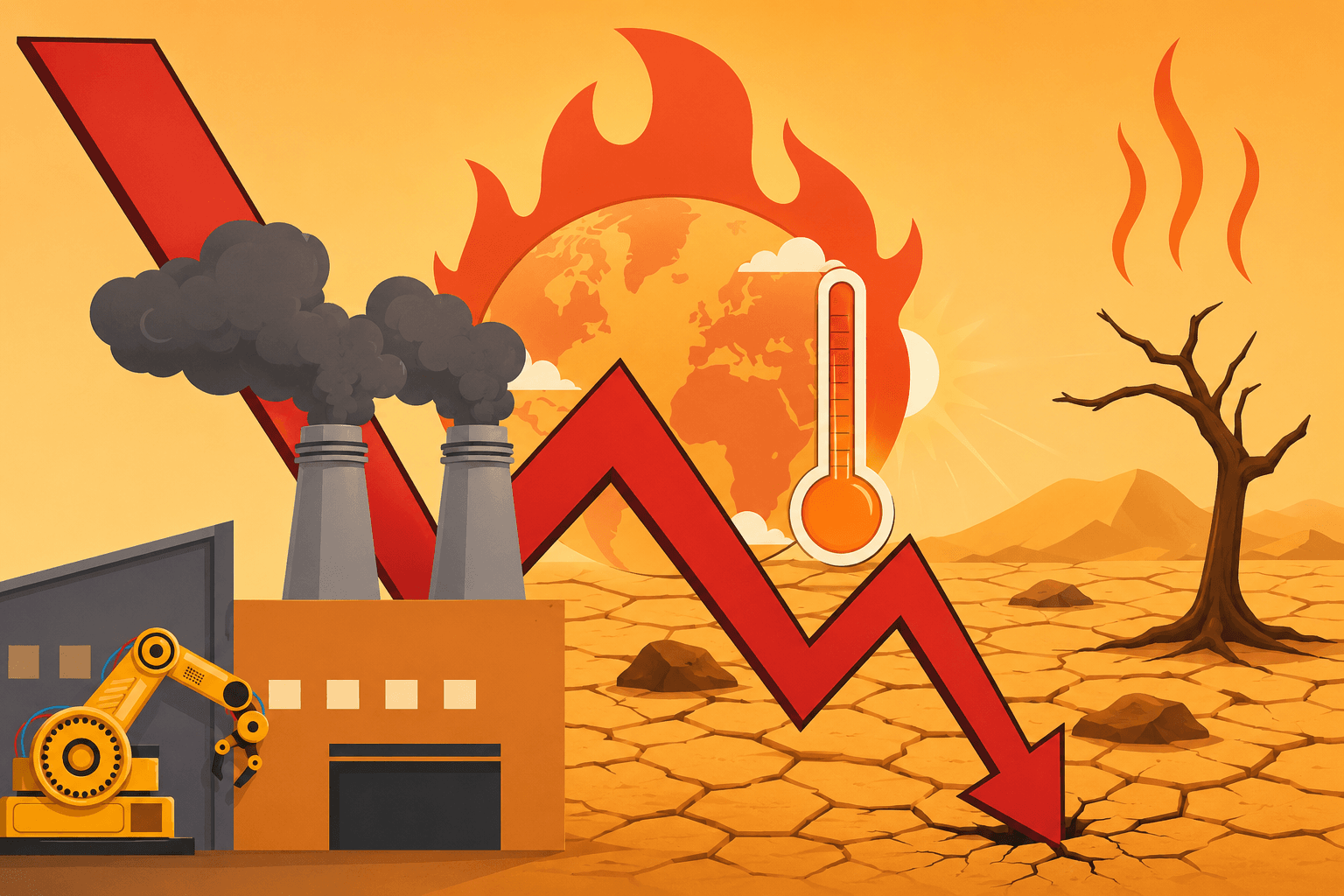
Public debate on climate policy has largely centred on emissions, disasters and adaptation, with far less attention paid to its impact on long-run growth. Much of that growth will increasingly depend on Total Factor Productivity (TFP), which broadly captures how efficiently an economy turns labour and capital into output.
Climate change threatens workers, physical capital and natural systems simultaneously. Its economic impact, therefore, extends beyond the output lost during a heatwave, flood or other extreme event. Over time, it can weaken the productive capacity on which future growth depends. As labour-force growth slows and investment alone becomes less capable of sustaining rapid expansion, protecting that capacity must become a central economic policy objective.
The Productivity Costs We May Miss
Many assessments of the economic costs of climate change emphasise the direct effects of rising temperatures on workers. But heat can also cause machinery, infrastructure and production systems to operate less efficiently. It can further increase wear and maintenance costs and disrupt the transport and energy networks on which production depends.
Climate stress can simultaneously weaken the natural systems that support economic activity, from water availability to soil quality. These effects reinforce one another. Lower labour productivity reduces the effective use of capital, while weaker infrastructure and ecosystems amplify losses throughout the production process. The cumulative result is a broader erosion of TFP.
A Wider Measure of Climate Damage
An analysis of 21 emerging market economies between 1990 and 2018 suggests that a one-degree Celsius increase in annual mean temperature reduces TFP by approximately 3.22 percent in the long run. An estimate focused primarily on labour-related effects places the decline at around 1.7 percent, suggesting that conventional assessments may understate the wider damage.
The impact is not uniform. Losses are greater in less-developed economies and vary according to climatic conditions. The relationship is also non-linear, meaning that productivity losses can accelerate as temperatures continue to rise. For already hot countries such as India, continued warming may therefore carry especially serious economic consequences.
Today’s Climate Path Will Shape Future Growth
The long-run consequences become clearer under two possible pathways. If emissions remain high and mitigation efforts remain insufficient, TFP in emerging economies could decline by about 14.2 percent by the end of the century. Under a stringent mitigation scenario, the projected decline falls to around 1.37 percent.
These are not simply different climate outcomes, but different development trajectories: one steadily erodes productive capacity, while the other contains much of the damage.
India’s Growth in a Warming Climate
For India, this relationship carries particular significance. From the Himalayan region and the Indo-Gangetic plains to the arid west and the long coastline, the country spans a wide range of climatic conditions and production systems.
Adaptation cannot, therefore, be based on uniform assumptions about future risks. The needs of a coastal industrial centre will differ from those of a heat-exposed agricultural district or a Himalayan region confronting changes in water availability. Protecting long-run growth will require strategies that reflect these regional differences while remaining aligned with national development priorities.
Building Growth for a Warmer Economy
If climate change is fundamentally a productivity challenge, protecting productive capacity must become an explicit objective of economic policy rather than a by-product of climate action. Adaptation is not simply a resilience measure; it is an investment in future growth.
This requires a rethinking of development strategy. Industrial policy must accelerate the adoption of heat-resilient production systems and energy-efficient technologies. Public investment must build transport, energy and other essential infrastructure capable of withstanding increasingly frequent climate shocks. Better forecasting and early-warning systems must enable governments and businesses to act before climate risks become economic disruptions. Because those risks vary across regions and sectors, adaptation finance must follow vulnerability and the potential to protect productive capacity rather than formulas that allocate resources uniformly.
Making climate resilience central to India’s growth strategy is essential to safeguarding its long-term prosperity.