



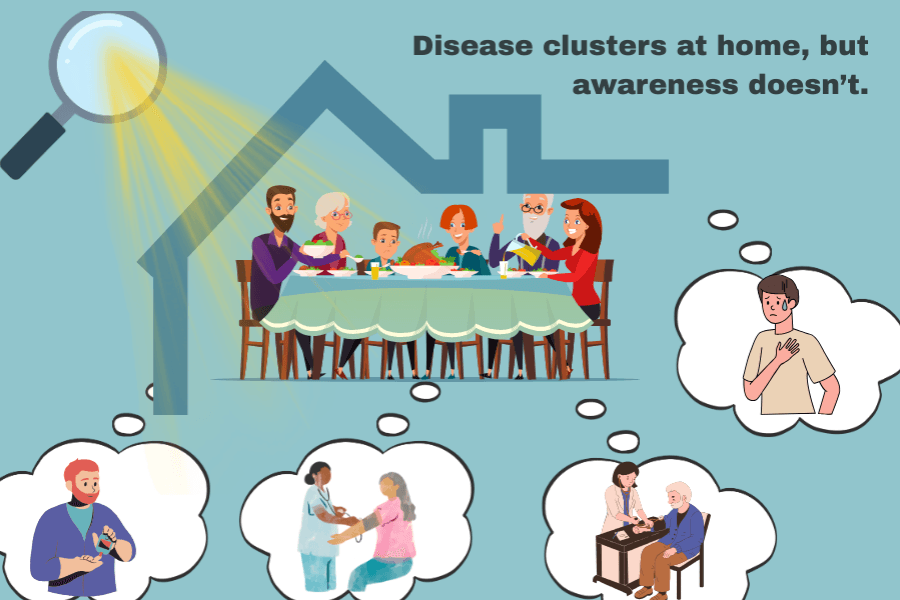
Just 14.9 percent of households account for nearly half of all hypertension cases, while 7.7 percent of households account for 39.3 percent of diabetes cases in India. This concentration reflects how non-communicable diseases (NCDs) are socially and environmentally embedded within families.
However, this concentration does not translate into proportional awareness or treatment. The same households that concentrate disease also concentrate diagnostic gaps.
Even in households with multiple affected members, 42.5 percent (hypertension) and 55.5 percent (diabetes) remain entirely unaware of their condition, showing that detection does not diffuse within households. The household is therefore a site of both risk accumulation and missed opportunity.
Scale Without Diffusion
Roughly half of hypertension cases occur in households where at least one other member is also affected, while the remaining cases are dispersed across single-case households. For diabetes, nearly 40 percent of cases are similarly clustered. This creates a dual structure: a large base of isolated cases alongside a concentrated core of high-burden households.
Within these clustered households, relationships matter. Spouses account for over half of two-member cases, while parent–child links dominate in larger clusters. These patterns reflect shared living environments and behaviours rather than purely genetic transmission. This explains why clustering intensifies in urban and wealthier households, the settings where lifestyle-related risk factors are more prevalent and more consistently shared.
At the same time, awareness remains highly unequal, reflecting underlying disparities in access, education, and location. Rural households, poorer households, and those with lower education levels show significantly higher proportions of undiagnosed disease. In the poorest households, up to 60.3 percent of clustered hypertension cases and 78.5 percent of clustered diabetes cases remain entirely undetected.
The system identifies disease where access and awareness are already higher, while high-risk clusters elsewhere remain underdiagnosed.
Drivers of Household-Level Clustering
The concentration of disease within households is driven by interacting mechanisms. Biological predisposition plays a role, particularly through intergenerational transmission. However, genetic similarity alone cannot explain the dominance of spousal clustering, where no genetic overlap exists. Behavioural alignment within households is more decisive. Diet, physical activity, and substance use are not independent choices; they are shaped by shared routines and social norms within families. When one member adopts a sedentary lifestyle or unhealthy diet, it often becomes a household-level pattern.
Environmental exposure further amplifies this effect. Members of a household experience the same air quality, food environment, and built infrastructure, creating uniform risk conditions.
Socioeconomic factors then modulate both risk and detection. Wealthier households show higher clustering than poorer counterparts partly because lifestyle risks are more prevalent, however, detection is more likely in wealthier households.
Finally, household structure itself shapes transmission. Co-residence enables both the spread of behaviours and the potential for shared care. The same networks that transmit risk could, in principle, support early detection and adherence, but that potential is only partially realised.
Where Progress Breaks
The system achieves initial gains in identifying individual cases but struggles to extend those gains across households. This breakdown occurs at specific transition points.
The first transition is from detection to diffusion. Identifying one case within a household does not systematically trigger screening for others. The expected “snowball effect” remains weak. Mixed-awareness households, where some members are diagnosed and others are not, account for a substantial share of clustered cases. This indicates that information and care do not propagate effectively within families.
The second transition is from access to continuity. Even where awareness exists, it does not consistently translate into sustained management across all affected members. Households with multiple cases face compounded economic and logistical burdens.
The third transition is across socioeconomic gradients. Gains in detection and awareness plateau as they move from urban and wealthier populations to rural and poorer ones. The system’s reach expands, but its effectiveness declines sharply beyond certain thresholds of access and education.
Structural Constraints on NCD Outcomes
These transition failures reflect a layered set of constraints.
Economic pressures are central. Chronic diseases impose recurring costs, and when multiple members are affected, these costs multiply. Households must prioritise treatment, often leading to partial or delayed care.
Structural limitations in the health system reinforce this. Screening programmes are designed around individuals, not family units. There is no systematic mechanism to map or target high-risk households, even when one case is identified.
Social factors also matter. Awareness does not automatically translate into behavioural change, particularly when habits are collectively embedded. Household norms can sustain risk even in the presence of information.
Institutional design further constrains outcomes. Data systems capture individuals but rarely link them within households, limiting the ability to identify clusters and intervene efficiently. The result is a fragmented approach to a fundamentally interconnected problem.
The Plateau Problem in NCD Control
These constraints produce a “diffusion plateau.” Early gains in detection are relatively easy to achieve through broad screening effort, but extending those gains within households and across socioeconomic gradients becomes progressively harder.
The plateau emerges because interventions operate at the level of individuals, while risk and behaviour are organised at the level of networks. As a result, initial improvements in coverage do not translate into comprehensive control.
Reframing the Unit of Intervention
Addressing this plateau requires a shift in how risk is identified and managed. Households need to be treated as epidemiological units where risk is shared and can be addressed collectively.
Integrating household-level screening into existing programmes would allow each identified case to trigger follow-up across the household, redirecting effort towards higher-yield clusters..
Health systems can also leverage intra-household dynamics to improve adherence. Family networks shape care decisions and daily routines, and engaging them can strengthen behaviour change and treatment continuity.
Data systems will need to evolve to support this approach. Linking individuals within households enables the identification of clusters and more targeted interventions.
Finally, addressing socioeconomic disparities remains essential. Household-based strategies must be complemented by targeted outreach in rural and low-income settings, where undiagnosed clusters are most prevalent.
From Entry to Continuity
India’s NCD response has expanded access to screening and diagnosis, but the next phase depends on converting these gains into sustained control. The trajectory ahead will be shaped less by how many individuals are reached and more by how well care is delivered across the networks people are part of.