



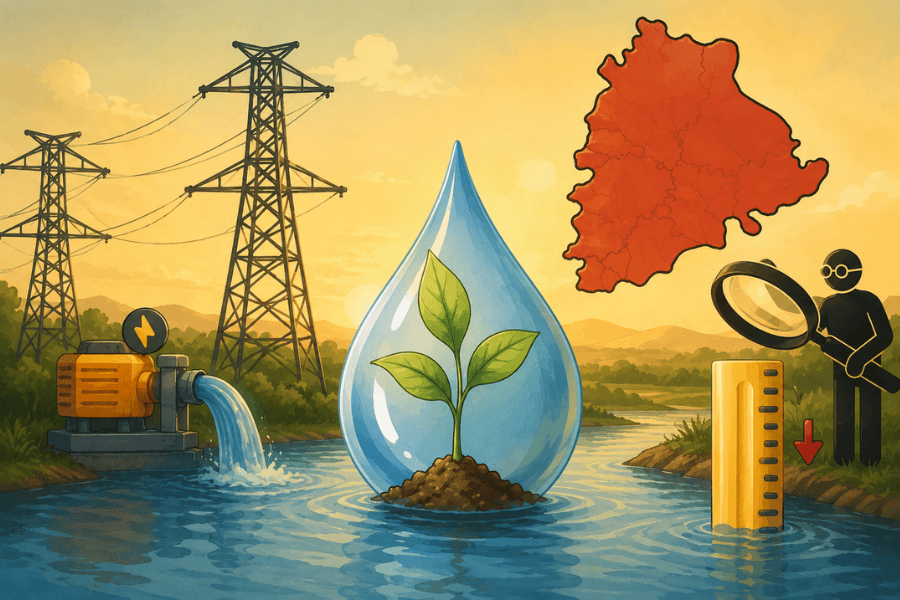
Agricultural electricity is heavily subsidised in many states, leaving farmers with little incentive to economise on power use. Continuous access creates incentives for higher electricity consumption and greater groundwater extraction. Rationing power supply has therefore become a common policy instrument, allowing states to support agriculture while constraining extraction.
In 2018, Telangana introduced 24-hour electricity supply for agriculture. The decision removed limits on when farmers could pump groundwater for irrigation in a state where groundwater plays a central role in farming.
The policy created a natural test of both incentives and measurement. How would farmers respond when electricity constraints were removed, and would existing groundwater monitoring systems be able to capture the resulting effects on water use?
When Incentives Change
The first effects of Telangana’s policy were visible in how electricity was used. Comparing Telangana’s border districts with neighbouring districts in Andhra Pradesh, Karnataka and Maharashtra, agricultural electricity consumption increased by roughly 53 percent in the two years following the introduction of 24-hour supply.
Because groundwater irrigation in Telangana depends overwhelmingly on electric pumps, higher electricity use provides a strong indication of increased groundwater extraction. The scale of the increase also raises questions about how efficiently both energy and water resources are being used.
Changes in cropping patterns point in the same direction. The area under kharif rice increased from 0.9 million hectares to 1.41 million hectares, while rabi rice cultivation expanded from 0.58 million hectares to 0.83 million hectares. Given rice’s heavy irrigation requirements, these shifts point to a substantial increase in groundwater demand following the removal of power rationing.
When Indicators Diverge
Higher extraction would normally be expected to deepen groundwater levels, particularly in regions where irrigation depends heavily on aquifers.
Yet official groundwater indicators showed little corresponding movement. Groundwater levels in Telangana remained broadly unchanged relative to neighbouring states, while monitoring data showed no meaningful increase in the incidence of dry wells.
This divergence matters because policymakers rely on these indicators to assess whether rising extraction is translating into groundwater stress. When measures of resource use and measures of groundwater conditions point in different directions, interpreting the effects of policy becomes considerably more difficult.
What Groundwater Monitoring Misses
The explanation lies in how groundwater conditions are measured. Government observation wells are typically positioned away from actively pumped agricultural wells so that measurements are not distorted by short-term drawdown effects. The objective is to capture broader groundwater conditions rather than the immediate effects of extraction by individual farmers.
That approach becomes more complicated in regions dominated by hard-rock aquifers, which cover much of peninsular India. Unlike large and relatively connected aquifer systems, hard-rock aquifers are fragmented and highly localised. Groundwater availability can vary sharply even across short distances, with neighbouring wells often drawing from different fracture networks underground.
A rise in extraction can therefore affect agricultural water availability without generating a corresponding signal in the observation network. In such settings, measuring groundwater conditions alone may not be sufficient. Understanding agricultural water availability may also require systematically tracking conditions in farmer wells.
Aligning Incentives and Measurement
Telangana’s experience highlights a broader challenge in resource governance. Policymakers often focus on the incentives created by subsidies, pricing policies and access regimes. Yet the effectiveness of those interventions also depends on whether governments can accurately observe their consequences.
In this case, electricity use increased sharply and cultivation shifted towards more groundwater-intensive crops. Yet the indicators used to assess groundwater conditions remained largely unchanged. Distinguishing between genuinely stable groundwater conditions and shortcomings in the measurement framework matters because each diagnosis points to a very different policy response.
The lesson extends beyond Telangana. In regions dominated by hard-rock aquifers, observation wells may need to be complemented by systematic information from agricultural wells. Tracking groundwater levels, well failures and agricultural water availability more consistently could provide a clearer picture of how resource use is evolving on the ground.
As states continue to balance agricultural support with long-term resource sustainability, the quality of monitoring may prove as important as the design of the incentives themselves.