



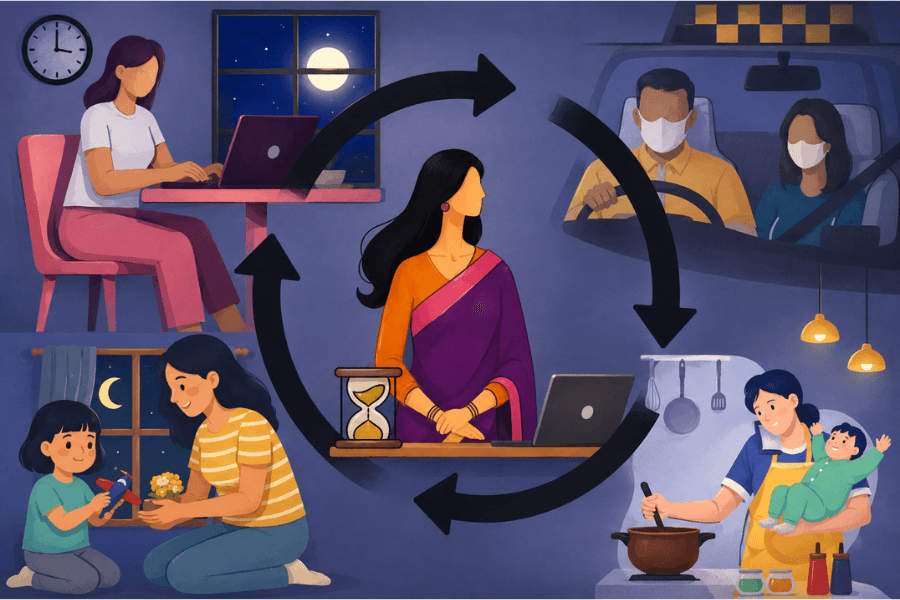
India’s debates about women and work have long centred on a familiar set of questions: Are employers hiring enough women? Are women participating in the labour force at rates comparable to men? If not, what explains the shortfall? Are wage gaps narrowing? These are important questions. But they share a common blind spot. They look outward at employers, markets and labour force participation, while paying far less attention to how households adjust when women’s working hours change.
As of 2024, twenty Indian states have legalised night shift work for women in factories and shops, expanding women’s access to employment while reshaping the household’s daily rhythm. Do households redistribute care, or do women simply absorb the additional burden? That question is largely absent from labour policy, even though it may determine whether labour market reforms lead to durable gains in women’s employment.
When Work Changes, Households Adjust
A woman who leaves for work at ten in the evening and returns at six in the morning is not simply adding income to the household budget. She is absent during the hours when children need care, elderly parents require support, and many other household responsibilities are typically carried out.
Households can respond in different ways. Husbands may assume a greater share of domestic work and caregiving. Older daughters may take on responsibilities for younger siblings and household chores, often at the expense of their own education and leisure. Or women may simply continue carrying both paid work and unpaid responsibilities, sacrificing sleep, health and personal time. These different patterns of adjustment are largely invisible in conventional indicators such as female labour force participation or employer hiring, yet they shape whether employment opportunities are genuinely sustainable.
What Changes Inside the Household
Time-use data from 2024 provide a window into how households differ between states that permit night shift work for women and those that do not.
In states where night shifts are permitted, women spend an average of 93 minutes per day on employment-related activities, nearly double the 49 minutes recorded in states without the policy. This includes both paid work and commuting time. Husbands show no comparable difference, spending almost identical amounts of time in paid employment across both sets of states. The patterns are consistent with night shift work reshaping life inside the home.
The Unequal Distribution of Care
The additional time women spend in paid work is accompanied by surprisingly little redistribution of unpaid work within the household.
Women in states that permit night shifts spend an average of 328 minutes per day on unpaid domestic work, compared to 347 minutes in states without the policy, a reduction of just 19 minutes. Husbands show no comparable increase in domestic work, suggesting that the additional paid work undertaken by women is not matched by a meaningful redistribution of household responsibilities.
The same pattern emerges in caregiving. Women in states permitting night shifts spend an average of 64 minutes per day on unpaid caregiving, compared to 77 minutes elsewhere. The decline is concentrated in activities that typically take place during the evening, including helping children with homework, reading to them and providing physical care. Husbands show no corresponding increase in caregiving time, suggesting that reduced maternal care is not being fully offset within the household.
The effects are also visible among children. School-aged children between 6 and 16 in states permitting night shifts spend an average of 355 minutes per day on learning activities, compared to 413 minutes in other states. The reduction is concentrated in homework and tutoring, consistent with the broader pattern of caregiving responsibilities remaining only partially reallocated within households.
The common thread is clear: labour market reforms can alter women's participation in paid work far more quickly than households adjust to support it.
Beyond Household Responsibilities
The effects extend beyond domestic work and caregiving. Women in states permitting night shifts spend an average of 101 minutes per day on socialising, compared to 125 minutes in other states, suggesting reduced participation in community and social life. They also sleep around 15 minutes less per night.
States that legalised night shifts were not randomly selected and may differ from other states in ways that also influence women's time use. Even so, the consistency of the patterns across employment, unpaid work, caregiving, children's learning, social participation and sleep suggests that the effects of night shift work extend well beyond the workplace, shaping how households allocate time, care and responsibility.
Designing Labour Policy Around Households
State notifications on night shift work focus largely on conditions in and around the workplace, including transportation, lighting, security and harassment prevention. Household conditions that make those opportunities sustainable receive far less attention.
Rather than assuming all households can absorb the demands of night shift work equally, policy should strengthen the support systems that make such work sustainable. Measures such as on-site crèches during night shift hours, extended anganwadi timings to cover evenings, and greater sharing of caregiving responsibilities could help address the care gap.
Building these support systems into policy from the outset is likely to be more effective than retrofitting them after implementation.
Rethinking Labour Policy for Women's Work
Expanding women’s legal right to work at night represents an important step towards greater economic participation. But legal reform alone cannot ensure that these opportunities are equally accessible or sustainable across households.
Labour market reforms do not end at the factory gate. Their success also depends on whether households have the capacity to adapt to changing patterns of work without placing a disproportionate share of unpaid responsibilities on women. Policies that seek to expand women’s economic opportunities must therefore pay as much attention to the conditions that sustain work at home as they do to the conditions that enable work at the workplace.