



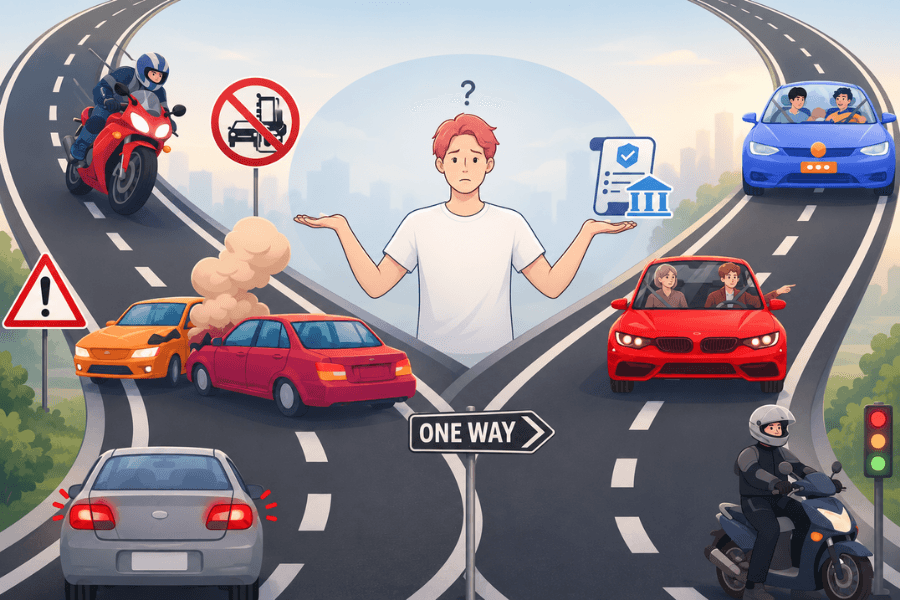
India accounts for only about 1 percent of the world’s vehicles, yet nearly 11 percent of global road deaths. In 2022 alone, the country recorded more than 4.6 lakh road accidents and around 1.5 lakh fatalities. More troublingly, road accidents increased by an estimated 2.7 percent between 2019 and 2022 despite sustained investments in highways, stricter traffic regulations and improvements in vehicle safety, indicating that infrastructure improvements alone have not translated into safer road-user behaviour.
India’s road-safety challenge is therefore no longer simply about expanding infrastructure or tightening regulations. The more important question is why risky driving behaviour persists even as the conditions for safer mobility improve. State-level evidence suggests that the answer lies not only in the rules themselves, but in how driving behaviour varies across states and how slowly those behaviours change over time.
The Geography of Risky Driving
State-level records on the causes of road accidents reveal considerable variation in risky driving behaviour across India. Overspeeding, mobile-phone use while driving, red-light jumping, wrong-side driving and drunk driving recur across states, but their prevalence differs markedly.
Wrong-side driving illustrates this variation. Goa and Puducherry, which ranked among the poorer performers in 2019, moved towards lower-risk categories by 2022. Overspeeding followed a different trajectory. Karnataka and Tamil Nadu continued to report high levels of speeding-related violations despite broader road-safety efforts, while Punjab and Gujarat showed signs of improvement. Sikkim, Mizoram and Himachal Pradesh displayed relatively stable patterns throughout the period.
The differences extend beyond individual violations. Risky driving behaviours often occur together. States with higher levels of overspeeding also tended to report greater mobile-phone use while driving, with a correlation of 0.71. Overspeeding was similarly associated with red-light jumping, with a correlation of 0.65. Rather than occurring independently, unsafe driving practices appear to cluster, pointing to broader patterns of non-compliance.
These differences are striking because the underlying legal framework is broadly similar across India. The more important question, therefore, is not simply why states differ, but whether improvements in driving behaviour endure once they begin.
The Persistence of Driving Behaviour
Between 2019 and 2022, eight states improved their performance on key driving violations, five deteriorated, and sixteen remained broadly unchanged. More importantly, states rarely moved directly from high-risk to low-risk categories. Only one state made that transition during the period. Most improvements occurred incrementally, with states progressing through intermediate stages before reaching lower-risk categories. Deterioration followed a similarly gradual pattern.
This suggests that safer driving practices develop through accumulation rather than sudden transformation. Patterns of compliance and non-compliance, once established, tend to persist and evolve slowly over time. Road safety therefore reflects not only infrastructure and regulation, but also the durability of everyday behavioural norms.
From Uniform Rules to Behavioural Policy
The state-level patterns suggest that India’s road-safety challenge has entered a different phase. The country has spent the past decade expanding highways, strengthening vehicle standards and introducing stricter penalties for traffic violations. Those investments remain essential, but they are no longer sufficient to explain why road deaths remain so high.
The evidence points instead to a problem of behavioural persistence. States where overspeeding is entrenched face a different challenge from those where wrong-side driving or signal violations dominate. Applying identical enforcement strategies across all states may produce uneven outcomes because the dominant behavioural risks differ considerably across regions.
Nor is this a problem that can be solved through periodic enforcement drives. Between 2019 and 2022, improvements occurred gradually, while deterioration was equally gradual. That pattern suggests that driving behaviour changes through repeated reinforcement rather than short bursts of enforcement. Technologies such as speed cameras, e-challan systems and automated monitoring matter not because they are more punitive, but because they make compliance predictable and continuous.
Road safety policy should therefore focus less on reducing violations in a particular year and more on changing the behavioural norms that generate them. The objective is not simply fewer traffic offences, but a gradual shift in what drivers come to regard as normal behaviour on the road.
Beyond Enforcement
For decades, India’s road-safety debate has understandably focused on engineering, infrastructure and legislation. Those remain indispensable. But as road networks improve and regulations become more comprehensive, the limiting factor increasingly shifts from the quality of roads to the behaviour of those who use them.
That changes the policy question. The challenge is no longer simply how to build safer roads, but how to make safer driving the default rather than the exception. Habits develop slowly, differ across states and, once established, tend to persist. Policies that acknowledge those realities are more likely to deliver lasting reductions in road deaths than those that rely solely on tougher penalties or periodic campaigns.
The gains extend beyond fewer fatalities. Safer driving can reduce healthcare costs, productivity losses and the long-term burden of disability, making it an economic imperative as much as a public-safety one. The success of India’s road-safety strategy will therefore depend not only on the roads it builds, but on the driving culture it succeeds in creating.