



India's rapidly expanding industrial economy generates approximately 7.46 million metric tonnes of hazardous waste annually from more than 44,000 companies. Yet only 103 contaminated sites are officially identified nationwide. This disparity raises an important policy question: does India's current inventory reflect the true extent of contamination, or does it reveal limitations in how contamination are identified, assessed and recorded?
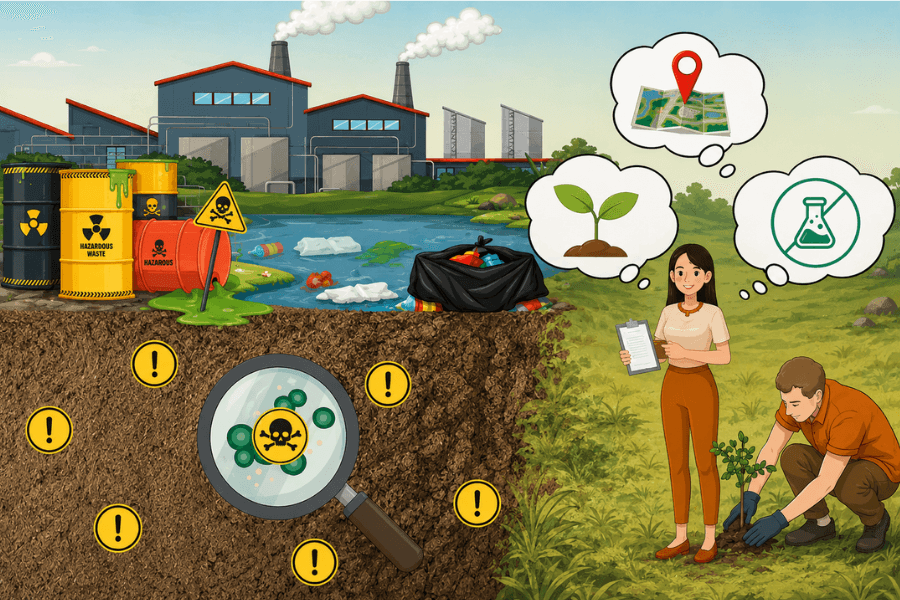
Contaminated sites are locations where hazardous substances have accumulated in soil, groundwater, sediments, or surrounding ecosystems at levels that pose risks to human health and the environment. Delhi's Ghazipur landfill illustrates these risks. Leachate from the site has been linked to heavy-metal contamination, while methane emissions and recurring fires have generated broader environmental concerns. Ghazipur is unlikely to be an isolated case. Across India, decades of industrialisation, mining, waste disposal, informal recycling activities and urban expansion may have left a legacy of contamination that remains poorly characterised. Without systematic identification and assessment, the scale of these risks remains uncertain.
Identifying contaminated sites is only part of the challenge. Determining which sites pose the greatest risks and warrant intervention is equally important. This is where contaminated-site management moves beyond environmental regulation and becomes a question of institutional design.
Fragmented Rules, Fragmented Accountability
Contaminated-site management begins from a different starting point than environmental regulation.
Environmental regulation is typically organised around pollution sources such as factories, waste facilities, or industrial processes. Contaminated-site governance, by contrast, focuses on places where hazardous substances have already accumulated, sometimes years after the original source of pollution has changed ownership, ceased operations, or disappeared altogether.
India already possesses a substantial body of environmental legislation, including the Environment (Protection) Act, hazardous-waste regulations, solid-waste management rules, pollution-control standards, and the National Green Tribunal. These laws and institutions play an important role in controlling pollution and enforcing compliance. Contaminated sites, however, present a different governance challenge.
Unlike pollution control, contaminated-site governance requires long-term monitoring, site investigation, risk assessment, remediation and post-remediation stewardship across multiple environmental media. The challenge extends beyond regulating current emissions to understanding and managing the environmental legacy of past activities.. Information relevant to a single site may therefore be scattered across multiple agencies, while a unified national contamination inventory remains absent.
Without a common evidence base, identifying high-risk sites, understanding contamination pathways, and prioritising remediation efforts becomes considerably more difficult. The absence of a national contaminated-site inventory also limits the ability to evaluate cumulative human-health risks, particularly for vulnerable communities located near industrial zones, landfills, mining areas and informal waste-processing facilities.
What Global Experience Reveals
Countries that have made progress in managing contaminated sites have generally treated them as a distinct policy domain rather than as an extension of pollution control.
Switzerland has identified around 4,000 contaminated sites despite being far smaller than India. The United States manages approximately 1,345 high-priority locations through its Superfund programme, while the United Kingdom has identified more than 11,000 contaminated land sites under dedicated regulatory provisions. Australia similarly operates structured frameworks for site assessment and remediation.
Although these systems differ in design, they share several common features. Contaminated sites are tracked through dedicated inventories, assessed using risk-based methodologies, and managed through clearly defined institutional responsibilities. Remediation is not treated as an isolated environmental intervention but as part of an ongoing governance process that links scientific assessment, regulatory decision-making, and implementation.
The broader lesson is that contamination management becomes significantly more effective when governments establish dedicated institutions, transparent inventories and risk based decision frameworks that identify risks, prioritise interventions, and coordinate responses across agencies and environmental media.
Building A CS-MAR Architecture
The challenge for India is creating a governance system capable of translating information into action. This is where a Contaminated Site Monitoring, Assessment and Remediation (CS-MAR) Architecture becomes relevant. Its value lies in linking site identification, risk assessment, remediation planning, financing, and regulatory oversight into a coherent decision-making framework.
Monitoring provides the foundation. A national contamination inventory that integrates information on industrial activity, waste generation, contaminants of concern, groundwater quality, and site status would help reveal where risks are concentrated and how they evolve over time. However, India is now strongly pursuing digital governance and AI-enabled decision-making. Advances in geospatial technologies, remote sensing, AI and environmental data analytics provide new opportunities to develop dynamic contamination inventories that can support evidence-based decision making at national and state levels.
Assessment converts environmental information into policy priorities. A risk-based approach allows governments to distinguish between sites requiring immediate intervention and those suitable for long-term monitoring, improving both efficiency and transparency in decision-making.
Remediation translates assessment into action. Because contaminated sites differ significantly in their environmental and public-health consequences, remediation ultimately becomes a question of prioritisation. Governments can then target interventions where risks are greatest, whether through containment, cleanup, ecosystem restoration, or long-term risk management. Such prioritisation is particularly important in resource-constrained settings where environmental, social and economic benefits must be balanced against available remediation funding.
Viewed together, monitoring, assessment, and remediation form an integrated governance cycle through which contamination can be systematically identified, prioritised, and managed over time.
Contaminated-site management is not solely an environmental issue; it is also an economic-development issue. Unmanaged contamination can constrain urban redevelopment, reduce land values, affect groundwater resources, increase public-health costs and undermine investor confidence. Conversely, effective site assessment and remediation can unlock land for productive use, support sustainable infrastructure development and contribute to long-term economic resilience.
Building Environmental Infrastructure for the Future
The effectiveness of a CS-MAR Architecture ultimately depends on supporting institutions. Shared data platforms, public participation, technical capacity, and sustainable financing determine whether a contaminated-site framework remains a policy aspiration or becomes an operational reality. Integrating these elements into a common architecture allows information to guide action and environmental risks to be addressed through clear policy priorities.
As India pursues cleaner growth, groundwater security, and climate resilience, contaminated sites are likely to become a more visible environmental policy concern. The question is no longer whether contamination exists, but whether environmental policy evolves rapidly enough to identify, prioritise and manage the contamination that has already accumulated. As India advances towards its environmental, public-health and sustainable-development goals, establishing a national contaminated-site management framework may prove as important as controlling future pollution itself.